

BLDC motor ceiling fans are no longer a niche upgrade in Indian homes. Ceiling fans run for hours every day, often longer than lights, TVs, or refrigerators. So when a fan claims to use 65 percent less power, it is worth paying attention.
BLDC motor ceiling fans are slowly replacing regular fans, and not because of hype. The math makes sense. The technology is better. And over time, they cost less to run.
Here’s the thing. Most people hear the term BLDC and assume it is complicated or meant only for premium homes. It is not. It is simply a more efficient way to run a fan.
Let’s break it down clearly.
What a BLDC Motor Ceiling Fan Really Is
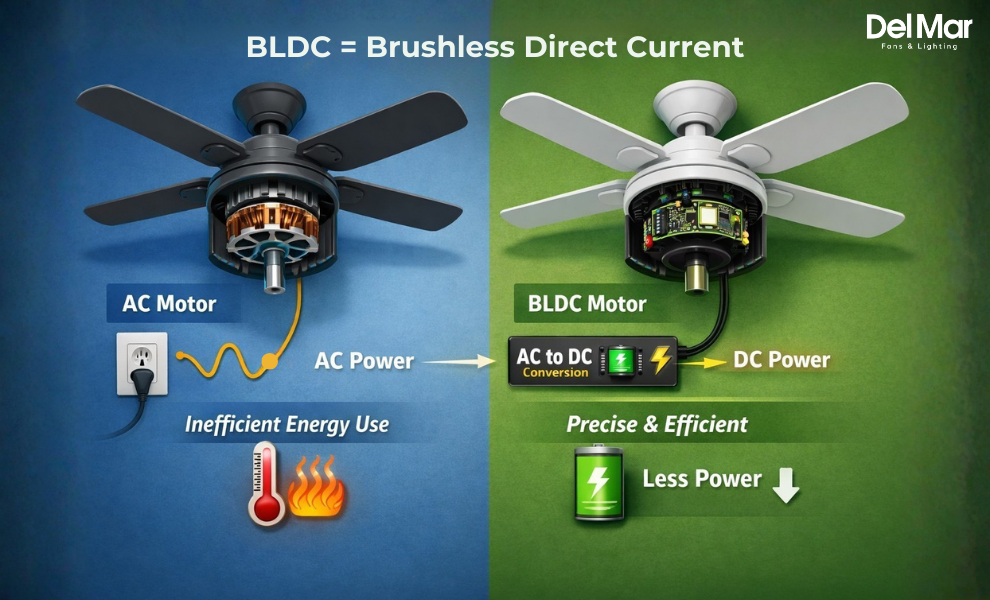
BLDC stands for Brushless Direct Current. It sounds technical, but the concept is straightforward.
Traditional ceiling fans use an AC motor. A BLDC ceiling fan uses a DC motor controlled by an electronic circuit. Even though your home supplies AC power, the fan converts it internally to DC and manages it with precision electronics.
What this delivers is control.
Instead of pulling a fixed amount of electricity and wasting the excess, a BLDC fan draws only the power needed to maintain the selected speed.
Less wasted energy.
Less heat.
Lower electricity use.
How Traditional Ceiling Fans Use Power

Most standard ceiling fans in the U.S. use single-phase induction motors. They’re inexpensive and reliable, but not very efficient.
At high speed, a conventional ceiling fan typically uses 70 to 90 watts. Speed is controlled by a wall regulator or dimmer that reduces voltage by burning off excess electricity as heat.
That heat is pure energy loss.
You can feel it sometimes; older fan controls get warm. That warmth is literally your electric bill turning into heat instead of airflow.
Another downside is voltage sensitivity. When the voltage drops, the fan slows down. When it rises, the motor experiences more stress. Over time, that wear can lead to noise, wobbling, or premature failure.
How BLDC Motor Fans Work Differently
BLDC fans take a completely different approach.
Power from your wall outlet is first converted into DC. A built-in controller then delivers exactly the amount of power needed to maintain the selected speed—no more, no less.
There are no brushes creating friction.
There is no resistive speed control wasting electricity.
Speed is adjusted electronically, not mechanically.
The result is simple. BLDC fans run smoother, consume far less power, and maintain steady speed even when the voltage fluctuates.
Understanding the ~65% Energy Savings
The energy savings aren’t a marketing gimmick. They come from a direct watt-for-watt comparison.
- Typical traditional fan: ~75 watts
- Typical BLDC fan: ~25–30 watts
That difference adds up quickly.
Let’s use realistic numbers:
If a fan runs 10 hours a day:
- A regular fan uses about 275 kWh per year
- A BLDC fan uses about 100–110 kWh per year
That’s a savings of roughly 170 kWh per fan, every year, based on real-world ceiling-fan-power-consumption differences between traditional AC fans and BLDC models.
At an average U.S. electricity rate of $0.15 per kWh, that works out to about $25 in savings per fan annually.
In a home with four ceiling fans, lower ceiling fan power consumption can translate to around $100 per year in savings, without any loss of comfort.
Why BLDC Fans Use So Much Less Power
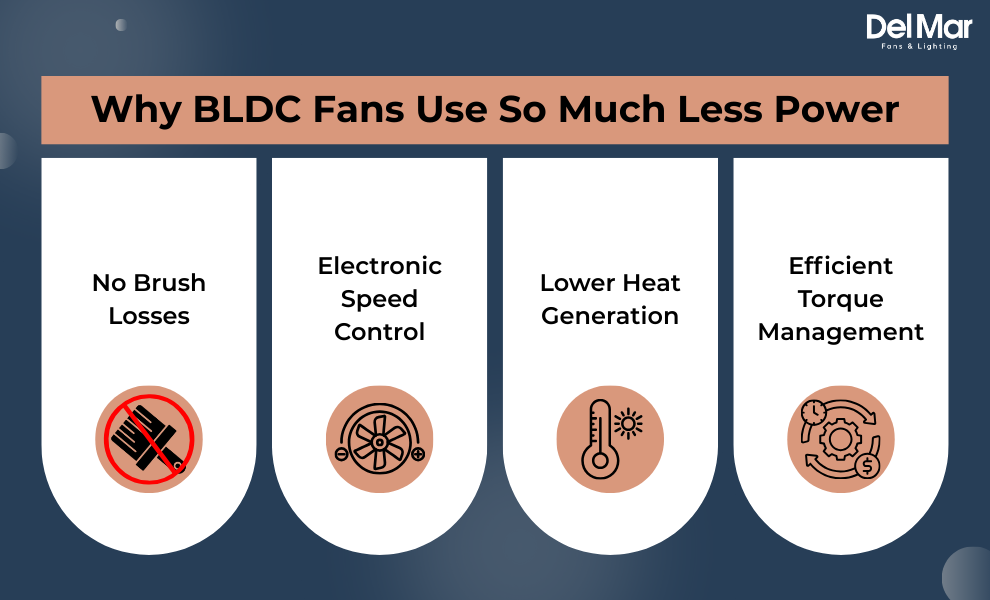
- No Brush Losses
BLDC motors don’t use brushes, eliminating friction and energy loss common in traditional motors. - Electronic Speed Control
Instead of wasting energy through a resistor or dimmer, BLDC fans adjust speed digitally. Lower speed means lower power draw. - Lower Heat Generation
Less wasted energy means cooler operation. More electricity goes into moving air, not heating components. - Efficient Torque Management
BLDC motors maintain torque efficiently, even at low power, which keeps airflow consistent without pulling extra watts.
Airflow and Performance
A common concern is airflow; lower wattage must mean weaker air, right?
That used to be true. It isn’t anymore.
Modern BLDC ceiling fans use improved blade designs and stable RPM control. Most deliver airflow comparable to traditional fans, typically on par or better than standard models.
What stands out is consistency.
The fan doesn’t slow down late at night or during minor voltage dips. It keeps pushing air steadily, hour after hour.
Voltage Stability in Real-World Use
While voltage fluctuation is less dramatic in the U.S. than in some regions, it still happens, especially in older homes or during peak demand.
Traditional fans react poorly. BLDC fans are designed to handle a wide voltage range, with the controller automatically compensating.
That means steadier airflow, fewer issues, and longer motor life.
Remote Control and Everyday Convenience
Most BLDC ceiling fans come with a remote control as standard.
This typically includes speed control, timers, sleep mode, and memory that restores the last setting after a power outage.
Some models also offer app or voice assistant compatibility. That’s optional. The real benefit is smooth control without noisy wall regulators.
Noise Levels
BLDC fans are noticeably quieter.
They are not silent, but they produce less vibration, less electrical hum, and smoother overall operation. This makes a real difference in bedrooms, offices, and quiet spaces.
Cost and Payback Period
Yes, BLDC ceiling fans cost more upfront.
- Traditional fan: roughly $75–$150
- BLDC fan: roughly $150–$300
But the payback is reasonable.
With savings of about $25 per year per fan, most BLDC fans recover their added cost in 2–4 years. After that, the savings continue.
Considering a lifespan of 10–15 years, the long-term value is clear.
Environmental Impact
Lower energy use reduces strain on the power grid and lowers emissions from electricity generation.
Switching to BLDC fans isn’t a lifestyle change. It’s a practical efficiency upgrade. Small improvements, multiplied across millions of homes, make a meaningful impact.
Maintenance and Longevity
BLDC fans have fewer wear-and-tear components.
- No brushes to degrade.
- Less heat stress.
- Stable electronic control.
That usually translates into fewer service issues and more consistent performance over time.
When BLDC Fans Make the Most Sense

BLDC ceiling fans are ideal if you:
- Run fans for long hours
- Want lower monthly energy bills
- Prefer quieter operation
- Are you building or renovating and thinking long-term
What to Look for Before Buying
Check airflow ratings, wattage at top speed, warranty coverage, and service support. Brand quality matters more than extra features.
Final Take
BLDC motor ceiling fans aren’t a luxury upgrade; they’re a practical one.
They use far less electricity, run quieter, maintain steady airflow, and pay for themselves over time. If you’re replacing older fans or setting up a new home, choosing BLDC is a smart, future-proof decision.
Lower bills. Same comfort. Less waste.
More Helpful Resources:
