


When you’re shopping for a fan, all the specs can blur together. Blade size, wattage, motor type, it’s a lot. But one number matters more than anything if you care about actual comfort: CFM. If you’ve ever wondered what CFM in fans is, this guide will make it simple.
What Does CFM Mean for Fans?
CFM stands for cubic feet per minute. It’s the measurement of how much air a fan moves in one minute. Think of it as the fan’s strength rating.
A fan with 5,000 CFM moves 5,000 cubic feet of air every minute. A fan with 2,000 CFM only moves 2,000. That’s the difference between a breeze that cools the whole room and a weak stir that barely reaches your chair.
So when you ask, what does CFM mean for fans? It’s really just the measure of how powerful the airflow is.

Why CFM Actually Matters
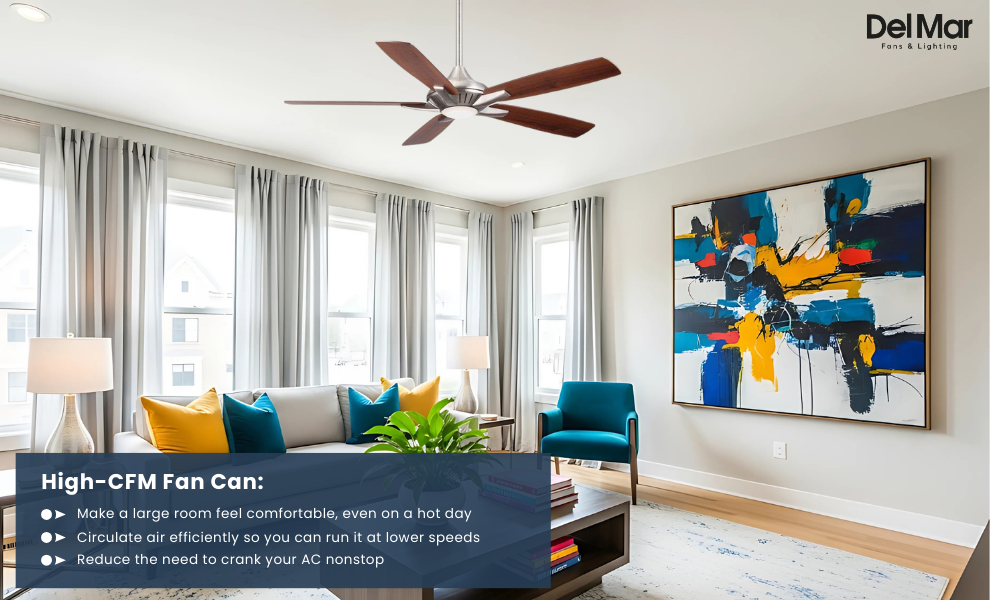
Here’s the thing: fans don’t cool the air. They move it. The airflow is what makes you feel cooler. That means CFM is the single number that tells you whether your fan is just for looks or if it will actually do its job.
A high-CFM fan can:
- Make a large room feel comfortable, even on a hot day
- Circulate air efficiently so you can run it at lower speeds
- Reduce the need to crank your AC nonstop
A low-CFM fan? You’ll probably regret it. It might look good, but you’ll still be sweating.
How is CFM Measured?

You don’t need to memorize formulas, but it helps to know what goes into them. Manufacturers test fans in controlled conditions to figure out their CFM. The main factors are:
- Motor strength
- Blade size and angle
- Speed settings
- Room resistance (things like ceiling height and obstacles)
Basically, stronger motors and angled blades mean higher CFM. Flat blades and weak motors? Not so much.
Ceiling Fan CFM Chart
Here’s a quick ceiling fan CFM chart for you:
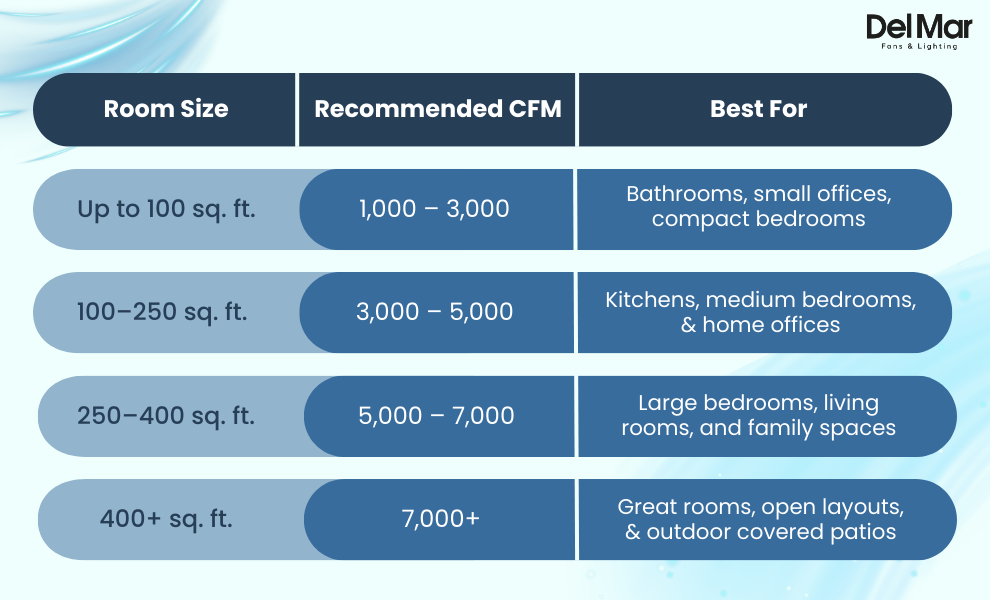
Follow it as a rule of thumb.
What is a Good CFM for a Ceiling Fan?
This is where people usually get stuck. What is a good CFM for a ceiling fan? The answer depends on your space.

The short version: under 3,000 feels weak, over 4,000 is solid, and the higher you go, the more powerful the airflow.
CFM of Ceiling Fan vs. Size
A common mistake is assuming a bigger fan always has more airflow. Not true. A 60-inch fan with flat blades can have lower CFM than a 52-inch fan with a strong motor and angled blades.
That’s why checking the actual CFM of ceiling fans matters more than just looking at size. Style and span don’t guarantee power.
Efficiency and CFM
Another thing most people don’t realize: a high-CFM fan can actually save you energy. Why? Because if your fan moves a ton of air, you don’t need to run it at top speed all the time. Lower speed, same comfort.
Look at the efficiency rating called CFM per watt. Anything above 75 CFM/W is considered good. That means the fan is moving a lot of air without wasting electricity.
How to Use CFM When Buying a Fan
So, you’re comparing two fans. Both look nice. Which one do you pick?

If you remember those three steps, you won’t go wrong.
Myths About CFM
A few things people often get wrong:
- Myth: The biggest fan always has the best airflow.
Nope. Blade design and motor quality matter just as much.
- Myth: CFM only matters in summer.
Wrong again. Reverse your fan in winter, and good CFM helps push warm air down.
- Myth: More CFM is always better.
Not if it’s blasting you in bed while you’re trying to sleep. Match CFM to the room.
Fans vs. Air Conditioners
A fan with a strong CFM won’t cool the air as AC does. But it can feel like the room is 4–6 degrees cooler, just from the airflow. That means you can nudge the thermostat higher and let the fan do the comfort work. Over time, that saves you money.
Outdoor Spaces Need Higher CFM
Outdoors are different. Since air isn’t contained, you need more CFM to actually feel it. For porches and patios, start at 5,000 CFM. For really large or open spaces, aim for 8,000 or higher. Anything less will disappear into the open air.
Quick Tips to Maximize CFM
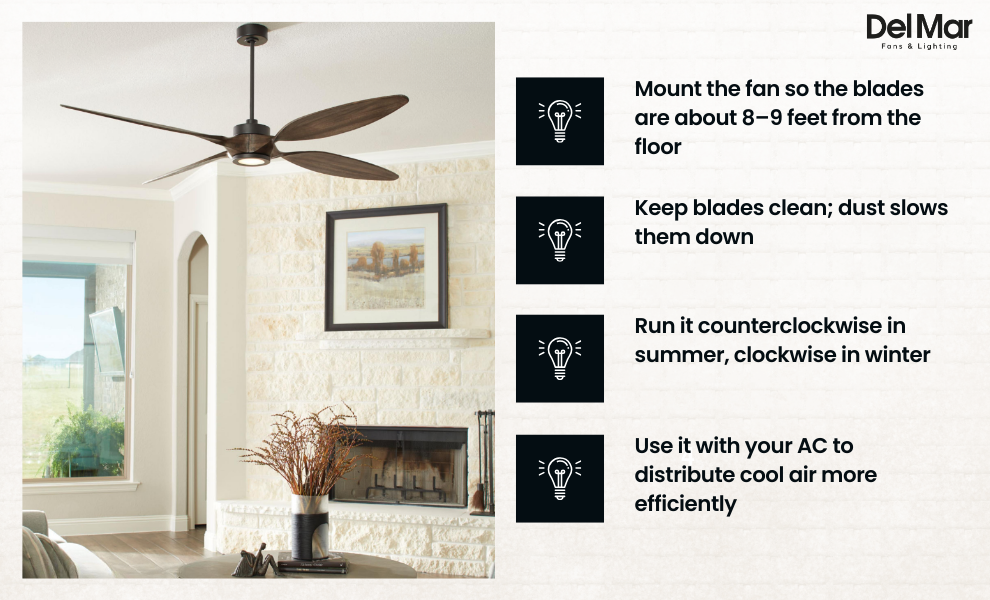
These tips will ensure that your ceiling fan serves its purpose, efficiently.
Beyond CFM: What Really Impacts Fan Performance
Here’s the thing: CFM tells part of the story, but it’s not the whole picture. How a fan actually performs depends on more than just that number. Static pressure, total pressure, and even air density all change the way air moves. In HVAC systems, ductwork and dampers can eat into airflow before it even reaches the room.
Now, let’s talk about the fan itself. RPM, blade pitch, and size all matter. They control how fast air moves, how much of it gets pushed, and how efficiently the fan does its job. That’s why different fans behave so differently. A blower doesn’t move air the same way an exhaust fan does. A high-speed ceiling fan feels nothing like either of them.
If you want a true CFM reading, you also have to look at the size of the space and how many times the air needs to cycle each hour. That’s especially important in ventilation and AC systems. This is where fan laws come in: when pressure shifts, airflow changes, and so does energy use.
What this really means is that design matters. A fan with well-built blades and efficient engineering won’t just sound good on paper. It will actually move air better, feel stronger, and use less energy where it counts, in your space.
Bottom Line
So, what is CFM in fans? It’s the measurement that tells you how much air a fan can move, and it’s the most important factor in whether the fan actually works for your space.
Here’s what to remember:
- Use a ceiling fan CFM chart to match airflow to room size.
- A good CFM for ceiling fan use is 4,000 or higher in most rooms.
- Don’t trust blade size alone; always check the CFM rating.
When you buy with CFM in mind, you get more than a good-looking fixture. You get airflow that makes the whole room feel comfortable, without wasting energy.
Frequently Asked Questions
1. Is there a simple ceiling fan CFM chart I can use?
A. Yes. Here’s the quick breakdown:
- Small rooms: 1,000–3,000 CFM
- Medium rooms: 3,000–5,000 CFM
- Large rooms: 5,000–7,000 CFM
- Big open spaces or patios: 7,000+ CFM
2. Can a fan’s CFM actually save me money on energy?
A. Yes. A fan with strong airflow lets you run it on lower speeds and even turn up your AC a notch. That combo uses less energy and saves you money.
3. Is more CFM always better?
A. Not really. Too much airflow in a small space feels like sitting in a wind tunnel. The key is matching the CFM to your room size.
4. How can I check the CFM before buying a fan?
A. Look at the product details or spec sheet. If the CFM isn’t listed, skip that fan. The number tells you way more than blade size or style ever will.
5. What’s the difference between fan speed and CFM?
A. Fan speed is how fast the blades spin. CFM is how much air they actually push. A fan can spin like crazy and still move very little air if the design is weak.
6. How much CFM should an outdoor ceiling fan have?
A. Outdoors, you need more power since the air isn’t trapped. Start at 5,000 CFM for a porch, and go 8,000 or more for wide-open patios or decks.
