


Did you know that nearly 60% of homeowners choose the wrong chandelier size for their space, creating rooms that feel either cramped or awkwardly empty? Selecting the perfect chandelier isn't just about style—it's a precise balance of mathematics, room proportions, and functional lighting design.
Whether you're illuminating a cozy dining nook or a grand foyer, understanding chandelier sizing fundamentals will transform your space from ordinary to extraordinary. This comprehensive chandelier size guide walks you through every calculation, rule, and consideration you need to confidently choose a chandelier that fits your room perfectly.
You'll learn the essential formulas for determining chandelier diameter and height, room-specific sizing recommendations, common mistakes to avoid, and expert tips that interior designers use daily. By the end, you'll know exactly how to size a chandelier for any space in your home.
What Is a Chandelier Size Guide?
A chandelier size guide is a set of proven formulas and recommendations that help you determine the appropriate dimensions for a chandelier based on your room's measurements. These guidelines ensure your lighting fixture is proportionate to the space, provides adequate illumination, and creates visual harmony.
The guide addresses two critical measurements: chandelier diameter (width) and chandelier height (or drop length). Both dimensions must work together to create a balanced look that doesn't overpower or underwhelm your room.
Who Needs a Chandelier Size Guide?
This guide is essential for:
- Homeowners renovating or redecorating any room
- Renters selecting lighting for apartments or rental homes
- Interior design enthusiasts learning proper proportions
- Anyone replacing an outdated or incorrectly sized chandelier
- New homeowners furnishing spaces for the first time
Why Chandelier Size Matters for Home Comfort

Choosing the correct chandelier size directly impacts both the functionality and aesthetics of your living space. A properly sized chandelier creates balanced illumination, enhances room proportions, and serves as an elegant focal point.
Visual Balance and Proportion
An oversized chandelier dominates a room and makes the space feel smaller and cluttered. Conversely, an undersized fixture looks awkward and fails to provide adequate light. The right size creates visual harmony that makes your room feel complete.
Functional Lighting Coverage
Chandelier size determines light distribution throughout your space. Too small means dark corners and insufficient illumination. The proper diameter ensures even light coverage across your room's square footage.
Safety and Clearance
Correct chandelier height prevents head bumps, maintains proper clearance over furniture, and ensures safe passage through hallways and entryways. These practical considerations are just as important as aesthetics.
Property Value Impact
Well-proportioned lighting fixtures enhance perceived home value. Real estate professionals note that proper chandelier sizing contributes to a polished, professionally designed appearance that appeals to potential buyers.
How Chandelier Sizing Works
Chandelier sizing follows simple mathematical formulas based on room dimensions and ceiling height. These industry-standard calculations ensure professional results every time.
Step 1: Calculate Chandelier Diameter
The basic formula for chandelier diameter uses your room's dimensions:
Room Length (feet) + Room Width (feet) = Chandelier Diameter (inches)
For example, a 12-foot by 14-foot dining room would need a chandelier approximately 26 inches in diameter (12 + 14 = 26).
This formula provides a starting point that ensures your chandelier is proportionate to the overall space.
Step 2: Determine Chandelier Height
Chandelier height depends on ceiling height and the fixture's location. For rooms with standard 8-foot ceilings, your chandelier should hang so the bottom sits 7 to 7.5 feet above the floor.
For higher ceilings, add 3 inches of chandelier height for every additional foot of ceiling height above 8 feet. A 10-foot ceiling would support a chandelier that's 6 inches taller than one designed for an 8-foot ceiling.
Step 3: Consider Table and Furniture Clearance
When hanging a chandelier over a dining table, maintain 30 to 36 inches between the table surface and the bottom of the fixture. This clearance ensures diners can see each other comfortably while preventing head bumps when standing.
For entryways and foyers, ensure at least 7 feet of clearance from the floor to the chandelier's lowest point.
Step 4: Adjust for Room Purpose
Different rooms may require adjustments to the standard formula. Rooms with high traffic, multiple furniture groupings, or unique architectural features may need slight modifications to the basic calculations.
Types of Chandeliers and Size Considerations
Different chandelier styles have unique size characteristics that affect how they fit in your space. Understanding these variations helps you apply the sizing formula more effectively.
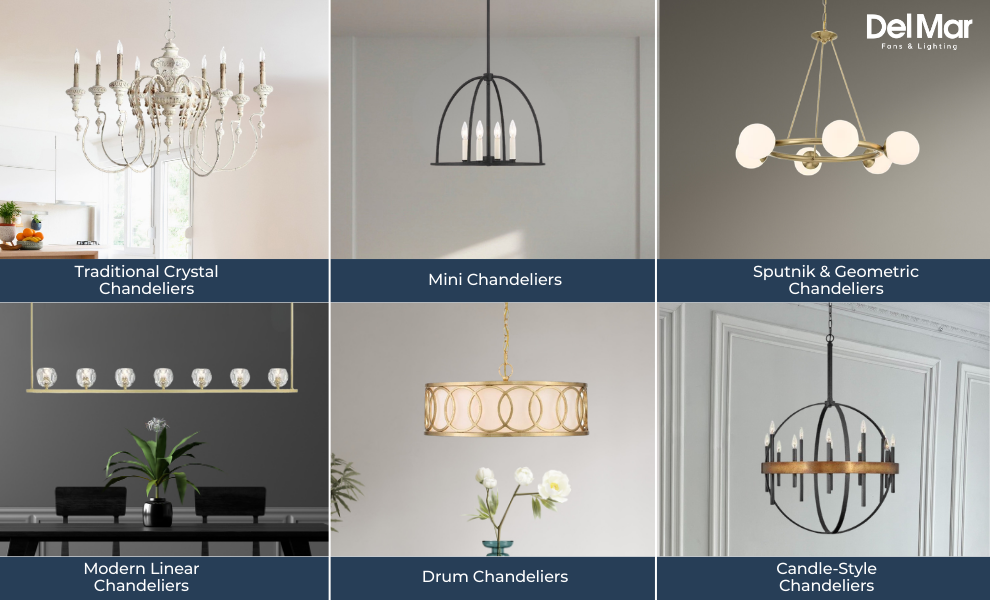
Traditional Crystal Chandeliers
- Multi-tiered designs with ornate details
- Generally measure larger due to decorative elements
- Best suited for formal dining rooms and grand entryways
- Require higher ceilings (9 feet or more) for proper visual impact
Modern Linear Chandeliers
- Rectangular or elongated shapes
- Ideal for rectangular dining tables and kitchen islands
- Measured by length rather than diameter
- Should be one-half to two-thirds the length of the table below
Mini Chandeliers
- Compact fixtures typically under 20 inches in diameter
- Perfect for small dining nooks, bedrooms, and bathrooms
- Follow the same diameter formula but work well in spaces under 100 square feet
Drum Chandeliers
- Enclosed shades create a cleaner, contemporary look
- Appear visually heavier than open designs
- May look best sized slightly smaller than the formula suggests
Sputnik and Geometric Chandeliers
- Angular arms extend outward creating wider visual span
- Actual diameter includes arm extension
- Work well in rooms with modern or mid-century design
Candle-Style Chandeliers
- Open, airy design creates less visual weight
- Can sometimes accommodate slightly larger sizing
- Transitional style works in various room types
Key Features to Look For When Sizing Chandeliers
Beyond basic measurements, several features influence how a chandelier fits and functions in your space. Consider these elements during your selection process.
- Adjustable chain or rod length: Allows customization for your specific ceiling height
- Scale of decorative elements: Intricate details add visual weight even if actual diameter is appropriate
- Number of light bulbs: More bulbs typically mean larger fixture dimensions
- Shade or crystal coverage: Enclosed designs appear larger than open frameworks
- Finish color: Dark finishes make fixtures appear heavier; light finishes seem more delicate
- Mounting hardware: Flush-mount versus hanging styles affect total drop length
- Canopy size: Larger ceiling plates require proportional room size
- Tiered versus single-level: Multi-tier designs need taller ceiling clearance
Benefits of Properly Sized Chandeliers
Selecting the right chandelier size delivers multiple advantages that enhance both room functionality and design appeal.
- Improved room proportions: Creates visual balance that makes spaces feel intentionally designed
- Better light distribution: Adequate diameter ensures even illumination without dark spots
- Enhanced ceiling height perception: Properly hung chandeliers can make ceilings appear higher
- Increased home value: Professional-looking lighting elevates overall interior design
- Safer navigation: Correct clearance prevents accidents and injuries
- Comfortable dining experience: Proper height over tables allows easy conversation
- Focal point creation: Right-sized fixtures draw the eye without overwhelming
- Flexibility in decor changes: Correct proportions accommodate future furniture rearrangements
- Energy efficiency: Appropriately sized fixtures use the right number of bulbs for the space
Common Room Types and Chandelier Sizing Examples
Different rooms have specific requirements that modify the basic sizing formula. Use these guidelines for the most common chandelier locations.
Dining Room Chandelier Size
Dining rooms are the most popular chandelier location. Calculate the diameter using the room dimension formula, then ensure the chandelier is two-thirds to three-quarters the width of your dining table.
For a 4-foot by 6-foot table, your chandelier should be 24 to 32 inches wide. Hang it 30 to 36 inches above the table surface for 8-foot ceilings.
Living Room Chandelier Size
Living rooms often have larger square footage and higher ceilings. Apply the standard room dimension formula, but consider the primary seating area rather than total room size if it's a very large space.
Position the chandelier over the main conversation area, ensuring it doesn't hang too low over furniture. The bottom should clear any furniture by at least 7 feet.
Foyer and Entryway Chandelier Size
Foyers create first impressions and can accommodate dramatic chandeliers. For two-story entryways, calculate chandelier height as one-quarter to one-third of the total ceiling height.
A 20-foot tall foyer could support a 5 to 7-foot tall chandelier. Maintain at least 7 feet clearance from the floor for safe passage.
Bedroom Chandelier Size
Bedrooms typically use smaller chandeliers or flush-mount styles. For standard bedrooms (10 by 12 feet), a 22-inch diameter chandelier works well.
Center the fixture over the bed or in the middle of the room. Ensure adequate clearance if you have a ceiling fan nearby.
Kitchen and Breakfast Nook Chandelier Size
Kitchen islands often use linear chandeliers that follow table-length guidelines. Breakfast nooks can use smaller round chandeliers sized to the table using the two-thirds rule.
For a 3-foot round breakfast table, an 18 to 24-inch chandelier provides proper proportion.
Bathroom Chandelier Size
Small bathrooms (5 by 8 feet) can accommodate mini chandeliers around 13 inches in diameter. Ensure moisture-rated fixtures in bathrooms with showers or tubs.
Center over the tub or vanity area, maintaining standard 7-foot floor clearance.
Chandelier Size Chart by Room Dimensions
| Room Size (L × W) | Room Square Footage | Recommended Chandelier Diameter | Chandelier Height (8 ft Ceiling) |
|---|---|---|---|
| 10' × 10' | 100 sq ft | 20 inches | 20–24 inches |
| 12' × 12' | 144 sq ft | 24 inches | 24–28 inches |
| 12' × 14' | 168 sq ft | 26 inches | 26–30 inches |
| 14' × 16' | 224 sq ft | 30 inches | 28–32 inches |
| 16' × 18' | 288 sq ft | 34 inches | 30–34 inches |
| 18' × 20' | 360 sq ft | 38 inches | 32–36 inches |
| 20' × 22' | 440 sq ft | 42 inches | 34–38 inches |
Ceiling Height Adjustments for Chandelier Sizing
Ceiling height significantly impacts both chandelier size selection and hanging length. Follow these guidelines for non-standard ceiling heights.
Standard 8-Foot Ceilings
For typical 8-foot ceilings, chandeliers should hang with their bottom 7 to 7.5 feet above the floor. Total fixture height typically ranges from 20 to 28 inches depending on room size.
Choose fixtures on the smaller end of your calculated diameter to avoid overwhelming the space.
9 to 10-Foot Ceilings
Add 3 inches of chandelier height for each additional foot of ceiling. A 10-foot ceiling supports a chandelier 6 inches taller than an 8-foot ceiling equivalent.
You can also increase diameter slightly (2 to 4 inches) to fill the vertical space better.
11 to 12-Foot Ceilings
These higher ceilings offer significant flexibility for larger, more dramatic fixtures. Consider chandeliers with multiple tiers or elongated designs.
Maintain proportional clearance—the bottom should sit approximately 7 to 8 feet from the floor in living spaces.
Two-Story Entryways and Vaulted Ceilings
Extremely high ceilings (15 feet or more) allow for statement chandeliers. Calculate height as one-quarter to one-third of the total ceiling height.
These spaces can accommodate chandeliers 4 to 7 feet tall. Ensure professional installation with adequate support.
Chandelier Sizing for Different Table Shapes
When hanging chandeliers over tables, the table shape influences your size selection beyond the standard formulas.
Round Tables
Match chandelier shape to table shape when possible. For round tables, choose round chandeliers that are half to two-thirds the table diameter.
A 5-foot round table pairs well with a 30 to 40-inch diameter chandelier.
Rectangular Tables
Linear chandeliers work exceptionally well over rectangular tables. The chandelier should be one-half to two-thirds the table length and one-quarter to one-third the table width.
For a 4-foot by 8-foot table, select a chandelier 48 to 64 inches long and 12 to 16 inches wide.
Square Tables
Square tables accommodate round or square chandeliers. Apply the two-thirds rule to table dimensions for appropriate chandelier size.
A 4-foot square table needs a 24 to 32-inch chandelier.
Oval Tables
Oval tables have similar requirements to rectangular tables. Linear chandeliers work well, or choose round fixtures sized to two-thirds of the table's width.
Pros and Cons of Different Chandelier Sizes
| Size Category | Pros | Cons |
|---|---|---|
| Small Chandeliers (under 20") | Fit tight spaces; affordable; easy installation; suitable for low ceilings | Limited light output; may look insignificant in large rooms; fewer style options |
| Medium Chandeliers (20–30") | Versatile for most rooms; balanced proportions; good light coverage; wide style variety | May not make a strong statement in very large spaces; requires standard ceiling height |
| Large Chandeliers (30–40") | Dramatic focal point; excellent illumination; ideal for spacious rooms; strong visual impact | Require high ceilings; more expensive; complex installation; can overwhelm smaller spaces |
| Extra-Large Chandeliers (40"+) | Grand statement pieces; ideal for entryways; commercial-grade illumination; unique designs | Very expensive; professional installation required; limited room compatibility; heavy weight |
Common Chandelier Sizing Mistakes to Avoid
Even with formulas and guidelines, certain errors occur frequently during chandelier selection. Avoid these common pitfalls for best results.
- Ignoring room dimensions: Choosing based solely on appearance without measuring leads to proportion problems
- Forgetting ceiling height adjustments: Standard formulas assume 8-foot ceilings; higher ceilings need modifications
- Overlooking furniture scale: Your chandelier must relate to table size, not just room size
- Selecting before measuring: Always measure before shopping to narrow appropriate options
- Assuming bigger is better: Oversized fixtures overwhelm spaces and create uncomfortable glare
- Neglecting clearance requirements: Insufficient height causes safety hazards and traffic flow issues
- Matching chandelier to only one element: Consider room size, ceiling height, and furniture simultaneously
- Choosing style before size: Style preferences are secondary to proper proportions
- Installing at wrong height: Even correctly sized fixtures fail when hung improperly
- Forgetting about visual weight: Heavy, ornate designs appear larger than their actual measurements
- Ignoring other light sources: Chandelier size should complement, not compete with, other fixtures
Chandelier Size vs. Light Bulb Requirements
Understanding the relationship between chandelier size and illumination helps you select fixtures that meet both aesthetic and functional needs.
Lumens per Square Foot
Dining rooms typically need 30 to 40 lumens per square foot. A 200-square-foot dining room requires 6,000 to 8,000 total lumens from all light sources.
Your chandelier should provide a significant portion of this light while allowing for supplemental sources.
Bulb Count by Chandelier Size
Small chandeliers (under 20 inches) typically hold 3 to 5 bulbs. Medium chandeliers (20 to 30 inches) accommodate 5 to 8 bulbs. Large chandeliers (30+ inches) feature 8 to 12 or more bulbs.
More bulbs generally mean larger fixture dimensions and greater light output.
Adjustable Lighting Considerations
Chandeliers with dimmer switches offer flexibility for different occasions. Ensure your chandelier size supports enough bulbs to provide adequate light at lower dimmer settings.
LED bulbs in properly sized chandeliers offer energy efficiency without sacrificing illumination.
How to Measure Your Space for a Chandelier
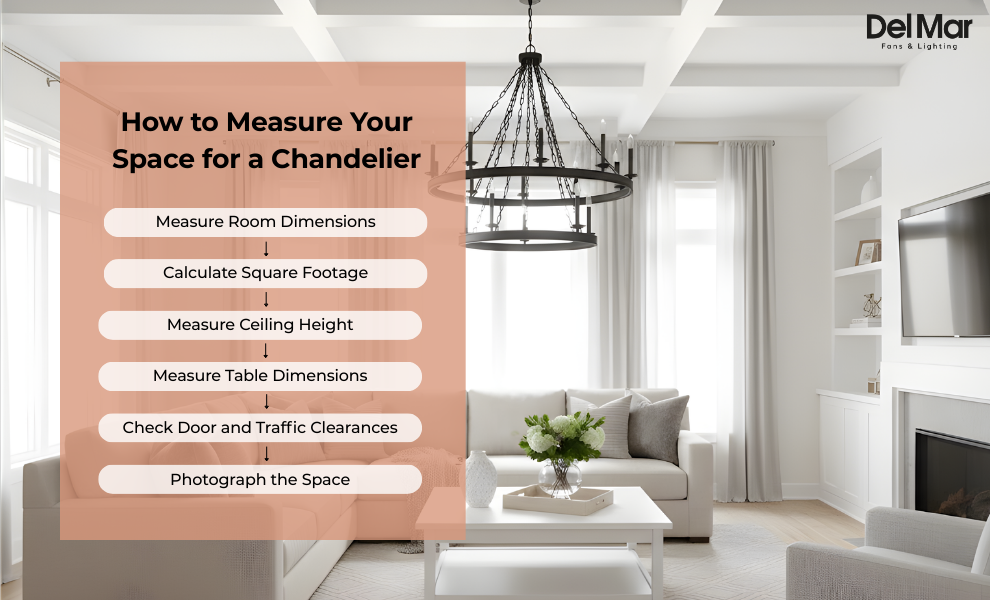
Accurate measurements are the foundation of proper chandelier sizing. Follow this step-by-step process for precise calculations.
Step 1: Measure Room Dimensions
Use a tape measure to determine room length and width in feet. Measure from wall to wall at the room's widest points. Write these numbers down.
Step 2: Calculate Square Footage
Multiply length by width to determine square footage. This helps you understand the total area requiring illumination.
Step 3: Measure Ceiling Height
Measure from floor to ceiling at several points, as older homes may have uneven ceilings. Use the lowest measurement for safety.
Step 4: Measure Table Dimensions
If installing over a table, measure the table's length and width. Note whether it's round, rectangular, square, or oval.
Step 5: Check Door and Traffic Clearances
Measure the height of doorways and traffic paths near the proposed chandelier location. Ensure adequate clearance for safe passage.
Step 6: Photograph the Space
Take photos from multiple angles to reference while shopping. Photos help you visualize how different styles will look in your space.
Maintenance and Care Tips for All Chandelier Sizes
Proper maintenance keeps your chandelier looking beautiful and functioning safely regardless of size. Follow these practical care guidelines.
- Dust weekly with microfiber cloths: Prevent buildup that dulls crystal and metal finishes
- Clean crystals quarterly: Remove and wash crystals in warm soapy water, dry thoroughly
- Check for loose parts monthly: Tighten any loose screws, chains, or decorative elements
- Replace bulbs promptly: Mismatched wattages and dead bulbs affect appearance and function
- Inspect wiring annually: Look for frayed cords or loose connections requiring professional repair
- Use appropriate cleaners: Avoid harsh chemicals that damage finishes; use manufacturer-recommended products
- Turn off power before cleaning: Safety first—always switch off electricity at the breaker
- Consider professional cleaning: Very large or complex chandeliers benefit from annual professional service
- Document chandelier specifications: Keep model numbers, bulb types, and installation details accessible
- Maintain proper bulb wattage: Exceeding recommended wattage creates heat damage and fire hazards
Key Takeaways
- Calculate chandelier diameter by adding room length and width in feet, converting to inches
- Maintain 30 to 36 inches between dining table surface and chandelier bottom
- Add 3 inches of chandelier height for every foot of ceiling above 8 feet
- Size chandeliers to two-thirds of your table width for proper proportion
- Ensure minimum 7-foot clearance from floor to chandelier bottom in traffic areas
- Consider visual weight—ornate designs may need slightly smaller dimensions
- Measure room dimensions, ceiling height, and furniture before shopping
- Different room types require adjustments to the standard sizing formula
- Chandelier shape should complement table shape when installed over furniture
- Professional installation ensures safety for large or heavy chandeliers
Conclusion
Selecting the perfect chandelier size transforms your space from ordinary to elegantly proportioned. By applying the simple room dimension formula, adjusting for ceiling height, and considering furniture scale, you'll confidently choose a chandelier that enhances both the beauty and functionality of any room.
Remember that chandelier sizing is both science and art. The mathematical formulas provide your foundation, while thoughtful consideration of visual weight, room purpose, and design style helps you make final adjustments. Take time to measure carefully, calculate properly, and visualize how your chosen fixture will look in the space.
Whether you're illuminating a cozy breakfast nook or a grand two-story entryway, these guidelines ensure your chandelier becomes a stunning focal point that's perfectly proportioned for years of enjoyment. Your well-chosen chandelier will provide beautiful illumination while showcasing your attention to design detail.
Frequently Asked Questions
How do you calculate the right chandelier size for a room?
Add your room's length and width in feet, then convert that sum to inches for your chandelier diameter. For example, a 12-foot by 14-foot room needs a 26-inch diameter chandelier. Adjust slightly based on ceiling height and furniture scale.
How high should a chandelier hang above a dining table?
Hang your chandelier 30 to 36 inches above the dining table surface for standard 8-foot ceilings. This height allows comfortable sight lines across the table while preventing head bumps. For higher ceilings, add 3 inches for every foot above 8 feet.
Can a chandelier be too big for a room?
Yes, oversized chandeliers overwhelm spaces and make rooms feel cramped. They can also create excessive glare and obstruct sight lines. Always use the room dimension formula as your starting point, adjusting down if your chandelier has heavy visual weight or ornate details.
What size chandelier do I need for a 10-foot ceiling?
For 10-foot ceilings, add 6 inches to the chandelier height you'd use for an 8-foot ceiling. The fixture's bottom should sit approximately 7.5 feet from the floor. You can also increase diameter by 2 to 4 inches to better fill the vertical space.
Should a chandelier be wider than the table?
No, your chandelier should be one-half to two-thirds the width of your table, never wider. A chandelier wider than the table creates unbalanced proportions and may interfere with seating. For rectangular tables, match chandelier length to one-half to two-thirds of table length.
How do I size a chandelier for a two-story foyer?
For two-story foyers, select a chandelier that's one-quarter to one-third the total ceiling height. A foyer with 20-foot ceilings can accommodate a 5 to 7-foot tall chandelier. Always maintain minimum 7-foot clearance from the floor for safety.
What's the difference between chandelier diameter and height?
Diameter measures the chandelier's width from side to side, determining if it fits proportionally in your room. Height measures the chandelier from top to bottom, determining how far it hangs from the ceiling. Both measurements are essential for proper fit.
Can I use the same chandelier size formula for all rooms?
The basic room dimension formula works for most spaces, but requires adjustments for specific rooms. Dining rooms need table proportion considerations. Entryways can accommodate larger fixtures. Bedrooms often work better with slightly smaller chandeliers than the formula suggests.
