

Coastal regions are some of the most beautiful locations in the world, but they are also some of the harshest environments for lighting fixtures. Whether you are illuminating seaside homes, boardwalks, docks, marinas, resorts, or waterfront pathways, coastal lighting engineering requires materials that can withstand the effects of salt, moisture, wind, and constant exposure to the elements.
Salt may look harmless floating on the ocean breeze, but in reality, it is one of the most aggressive corrosive agents found in nature. When salt combines with humidity, UV rays, and temperature fluctuations, it becomes a relentless enemy to metals, finishes, wiring, and even internal components. Without the right material science behind the design, lighting systems can degrade rapidly, leading to discoloration, rust, structural weakness, safety risks, and costly replacements.
This is where coastal-grade lighting engineering comes in. By taking a scientific approach to materials, coatings, and construction methods, manufacturers can produce fixtures that not only perform reliably but also maintain their appearance year after year.
Let’s explore how it works.
Why Salt Environments Are So Challenging
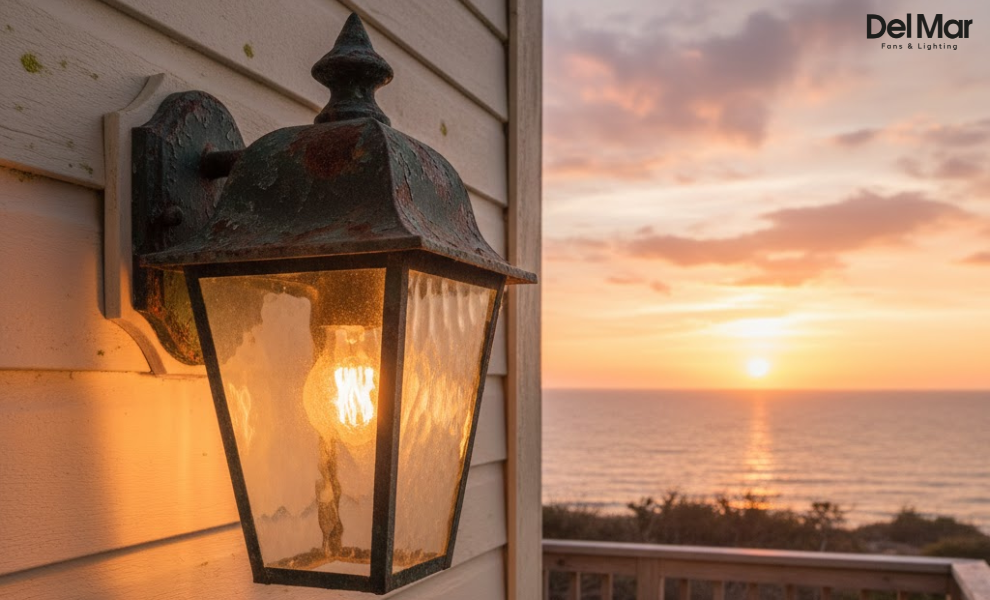
Lighting installed near coastlines faces far more than “normal weathering.” Here are the main stressors at play:
Salt Spray and Airborne Chlorides
Salt from seawater becomes airborne, forming microscopic chloride particles. These land on metal surfaces, where they:
- Break down protective oxide layers
- Accelerate oxidation
- Trap moisture
- Trigger electrochemical corrosion
Unlike freshwater, saltwater actively accelerates rust formation.
Persistent Moisture and Humidity
Coastal zones experience high humidity levels nearly year-round. Moisture becomes trapped inside fixtures and tiny crevices, attacking both interior and exterior materials.
UV Exposure
Sunlight degrades plastics, paints, seals, and coatings, fading color and weakening structural integrity.
Wind and Abrasion
Wind carries sand and debris, which can scratch surfaces. These scratches expose raw material beneath coatings, accelerating corrosion.
Temperature Changes
Thermal expansion and contraction can gradually weaken welds, seals, and fasteners. Put simply, everything rusts faster near the ocean, unless it’s engineered not to.
The Science of Corrosion Resistance

To survive coastal environments, lighting manufacturers have to think like material scientists. Two primary corrosion mechanisms affect lighting:
Oxidation
Metals like steel react with oxygen and water to form rust. This weakens the structure and flakes away protective layers.
Galvanic Corrosion
Occurs when dissimilar metals come into contact with moisture contaminated by salt. One metal sacrifices electrons to the other, corroding rapidly. This is why you’ll often see rust clustered around screws, joints, or hardware, even when the main body looks fine.
Good coastal lighting design works to:
- Prevent moisture penetration
- Isolate metals
- Use inherently corrosion-resistant materials
- Seal vulnerable electrical components
Best Materials for Coastal Lighting
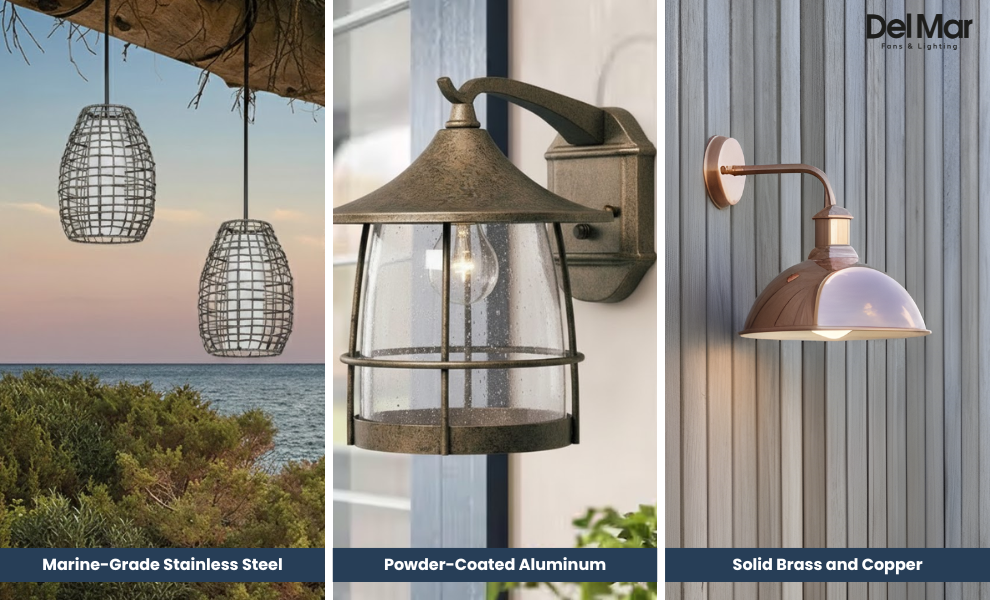
Not all “outdoor lighting” materials perform the same at the coast. Here’s how the most commonly used materials compare.
Marine-Grade Stainless Steel (316)
Type 316 stainless steel contains molybdenum, giving it exceptional resistance to salt corrosion compared to standard 304 stainless steel.
Benefits:
- Extremely durable
- Resists pitting corrosion
- Maintains strength and finish
- Ideal for structural parts & fasteners
Used in:
- Luxury coastal homes
- Marine hardware
- High-end architectural lighting
Downside:
Higher cost, but unmatched longevity.
Powder-Coated Aluminum
Aluminum naturally forms an oxide layer that protects it from corrosion. When combined with marine-grade powder coating, it becomes highly resistant to coastal wear.
Advantages:
- Lightweight
- Won’t rust
- Resistant to UV and salt air
- Cost-effective
What matters most:
- high-quality pre-treatment
- multilayer coating process
- sealed edges
Inferior coatings will blister or peel.
Solid Brass & Copper
Brass and copper do not rust. Instead, they patina, forming a natural protective layer.
Pros:
- Ideal for coastal climates
- Long-lasting
- Beautiful weathered finish over time
- Resistant to corrosion
They are especially popular for:
- Pathway lights
- Lanterns
- Marine-inspired fixtures
Marine-Grade & Coastal-Rated Lighting Products: What to Look For in Real-World Applications
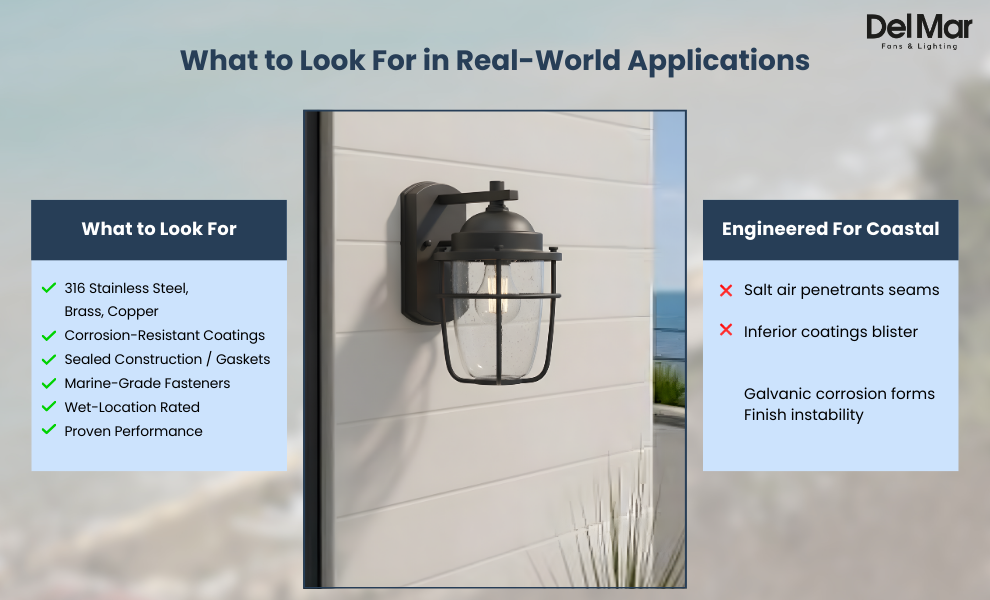
Choosing the right material is only part of coastal lighting success. Equally important is selecting manufacturers that engineer complete coastal-rated systems, not just “outdoor” fixtures relabeled for marine environments.
True coastal-grade products are designed holistically, considering material selection, coatings, fasteners, sealing methods, and long-term exposure to salt-laden air.
What Defines a Marine-Grade or Coastal-Rated Lighting Product?
A fixture suitable for high-salt environments should meet most (if not all) of the following criteria:
- Marine-grade metals such as 316 stainless steel, solid brass, copper, or high-quality aluminum
- Advanced corrosion-resistant coatings (powder coating, e-coating, anodizing)
- Sealed construction with high-performance gaskets
- Marine-grade stainless steel fasteners and hardware
- Wet-location safety ratings
- Proven performance in coastal or salt-spray environments
Fixtures lacking these characteristics often fail prematurely, even if labeled “outdoor.”
For homeowners and professionals new to coastal installations, understanding the difference between standard outdoor fixtures and true marine-grade products is critical. Our Guide To Marine Grade Fans and Lights breaks down materials, ratings, finishes, and design considerations that help ensure long-term performance in salt-heavy environments.
Coastal-Engineered Brands Matter More Than You Think
Not all lighting brands design specifically for coastal environments. Many standard outdoor fixtures are optimized for inland weather, not continuous salt exposure.
Manufacturers that specialize in coastal and marine-grade lighting understand:
- How salt air penetrates seams and fasteners
- Why do inferior coatings blister and peel
- How galvanic corrosion forms at connection points
- The importance of long-term finish stability near the ocean
This is where selecting a coastal-focused brand becomes critical.
Suggested Coastal-Grade Brand: Del Mar Fans & Lighting
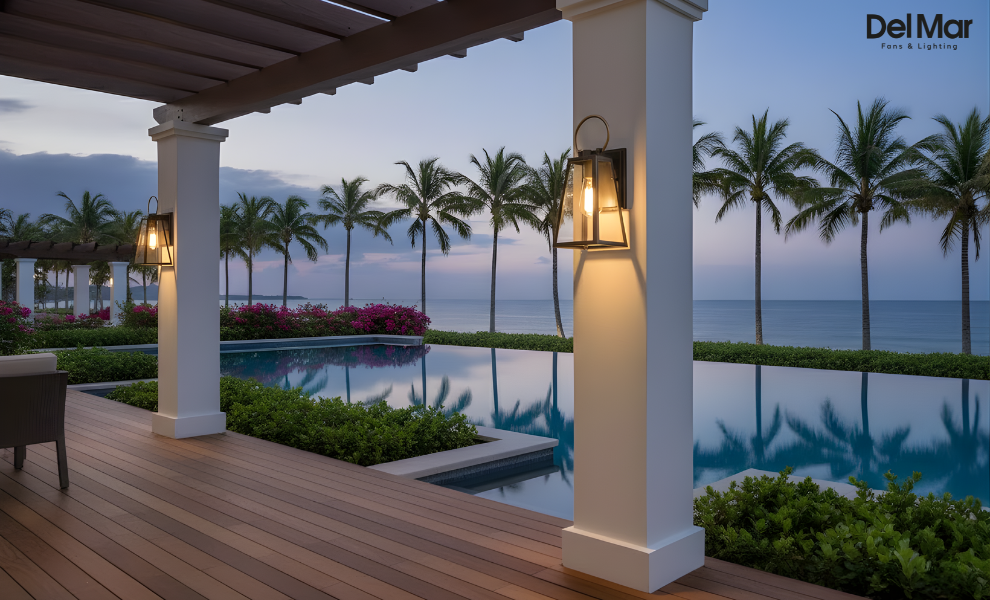
For projects in beachfront and high-humidity regions, Del Mar Fans & Lighting is often considered a reliable source for coastal-appropriate lighting and fans. Their product offerings are well-suited for environments where salt air, moisture, and UV exposure are constant challenges.
Why brands like Del Mar Fans & Lighting are commonly specified for coastal projects:
- Strong emphasis on outdoor and wet-location-rated products
- Use of corrosion-resistant materials and finishes
- Designs that balance durability with architectural aesthetics
- Options suitable for residential beachfront homes, resorts, patios, and waterfront properties
For contractors and homeowners working in coastal zones, choosing manufacturers with a proven coastal focus reduces callbacks, maintenance costs, and premature replacements.
Materials to Avoid Near the Coast
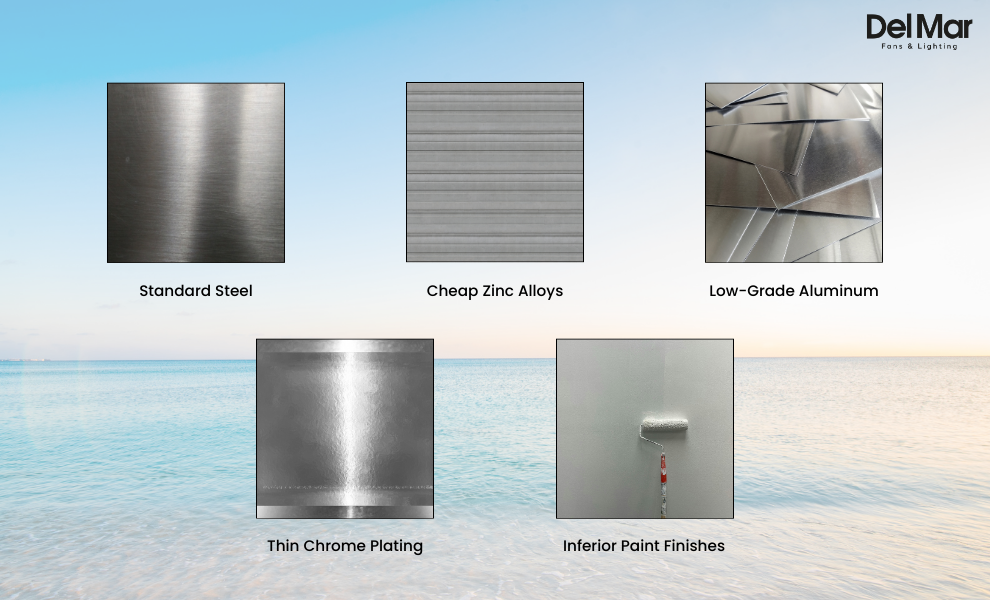
Some materials simply don’t hold up well:
- Standard steel
- Cheap zinc alloys
- Low-grade aluminum
- Thin chrome plating
- Inferior paint finishes
These will corrode quickly, even within months.
The Role of Protective Coatings
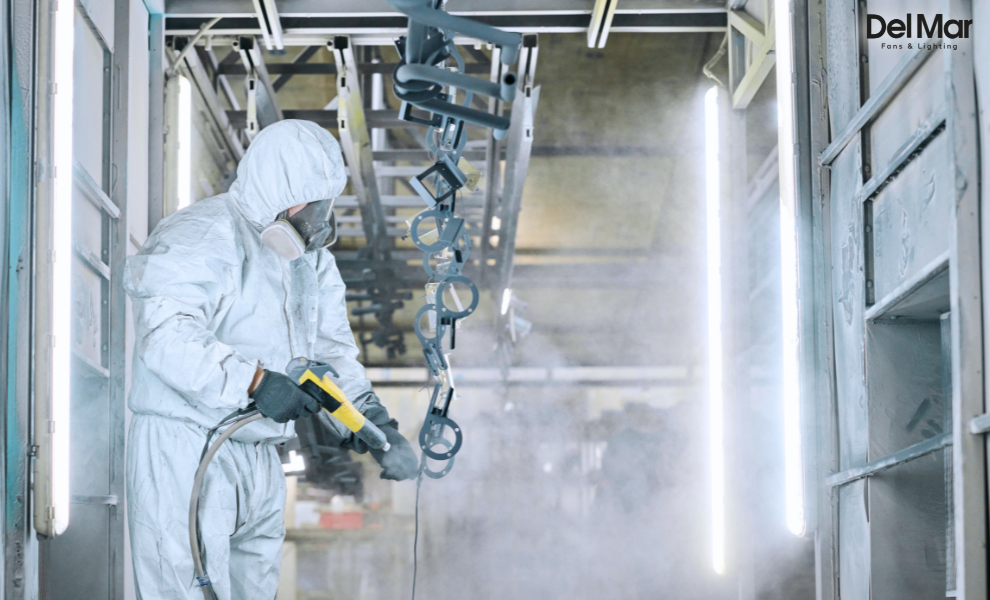
Material selection is only half the battle. Surface engineering makes a massive difference in durability.
Powder Coating
High-quality powder coating bonds to the surface during curing, creating:
- UV stability
- Impact resistance
- Salt resistance
Marine-grade processes may include:
- chemical pre-treatment
- double-coating
- sealing edges and seams
E-Coating
Used in the automotive and marine industries, e-coating electrically bonds coating to metal. This ensures deep, uniform coverage, even inside seams.Anodizing
Aluminum fixtures may be anodized to harden the protective oxide layer.
Benefits:
- Scratch-resistant
- Fade-resistant
- Environmentally friendly
Internal Protection Matters Too
It’s not just the outside that counts.
Waterproof Seals and Gaskets
High-quality silicone or rubber seals:
- prevent water ingress
- protect wiring
- stop internal corrosion
Even coastal-engineered fixtures benefit from proper care and preventive measures. Routine maintenance, smart installation practices, and protective treatments can significantly extend lifespan. Learn practical tips in our detailed guide on How to Protect Outdoor Fans in the Coastal Region, especially for high-wind and high-salt locations.
Marine-Grade Fasteners
Even the best fixture will fail if the screws corrode.
316 stainless hardware is the gold standard.
Encapsulated Electronics
Drivers and connections may be:
- sealed
- resin-encapsulated
- isolated from exposure
This reduces failure risk dramatically.
Standards for Coastal Lighting
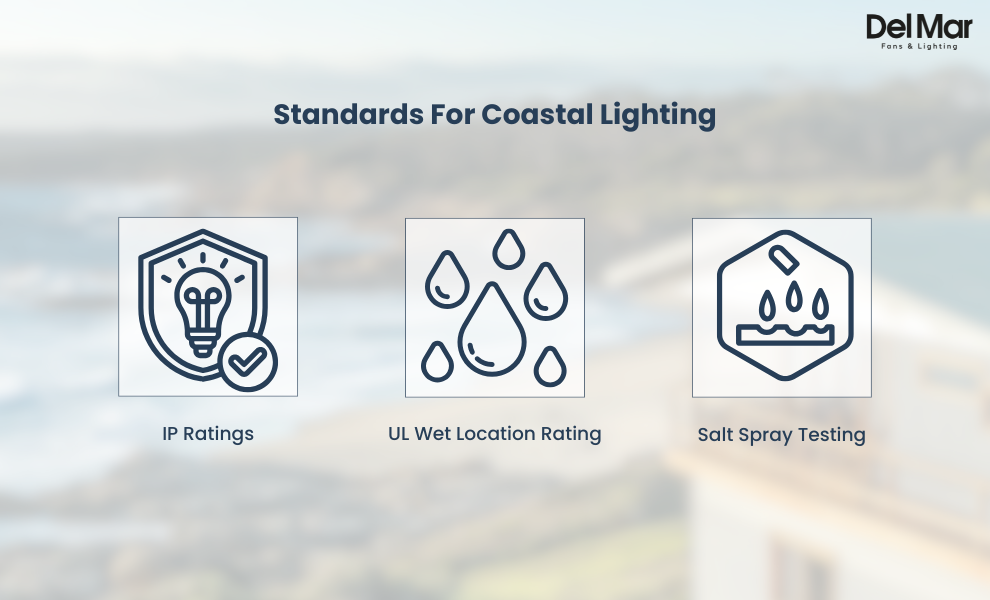
When shopping for coastal-grade lighting, look for performance ratings.
IP Ratings (Ingress Protection)
Measures dust and water resistance.
For coastal outdoor lighting, IP65 or higher is recommended.
UL Wet Location Rating
Indicates suitability for direct weather exposure.
Prefer wet location over damp-rated
Salt Spray Testing
Some manufacturers test fixtures in accelerated corrosive chambers to simulate real-world exposure.
This replicates years of salt contact in days or weeks.
Design Considerations for Coastal Lighting Installation

Even the best materials can fail if installed poorly.
Smart Coastal Installation Tips:
- Avoid dissimilar metal contact
- Use dielectric barriers
- Seal junction boxes
- Allow airflow to minimize condensation
- Rinse fixtures periodically
- Avoid abrasive cleaning
Routine fresh-water rinsing can significantly extend lifespan.
Sustainability in Coastal Lighting Engineering
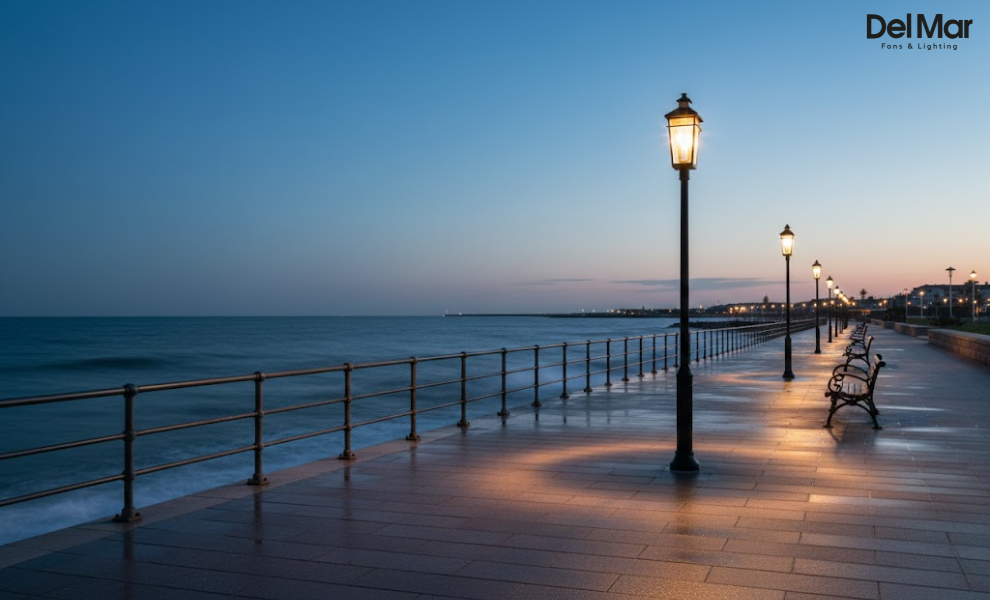
Durability is more than convenience; it’s eco-responsible.
Long-lasting lighting systems:
- reduce landfill waste
- minimize replacement manufacturing impact
- use fewer resources over time
Many coastal-grade fixtures now also incorporate:
- energy-efficient LEDs
- recyclable metals
- low-VOC coatings
This creates lighting that’s kinder to both the environment and the shoreline ecosystem.
Where Coastal-Grade Lighting is Essential

Coastal-engineered lighting is highly recommended for:
- Beachfront homes
- Marinas and ports
- Piers and boardwalks
- Seaside hotels and resorts
- Coastal resorts
- Boat docks
- Waterfront landscaping
And even inland locations are exposed to salty wind drift.
Final Thoughts
Coastal lighting engineering is where material science meets design performance. From marine-grade metals to advanced coatings and corrosion-resistant hardware, every detail plays a role in durability. Salt-rich environments are unforgiving, but with the right technology and engineering, lighting systems can thrive rather than deteriorate.
Whether you're designing for a luxury beachfront property or a public waterfront walkway, choosing coastal-grade materials ensures:
- longevity
- safety
- aesthetics
- value
And most importantly, a lighting system that shines beautifully against the ocean backdrop for years to come.
