


You might have invested heavily in creating your dream bathroom, but even the most beautiful design can fall short if the space is not properly lit.
It might have a stylish ceiling fixture, a well-designed vanity, and plenty of square footage, yet if you still deal with shadows while getting ready, dim corners near the shower, or lighting that feels too bright late at night, the problem is often not the fixture itself but the lack of a complete lighting plan.
A well-lit bathroom usually combines different types of lighting to support different activities and moments throughout the day. The goal is not to fill the room with as many fixtures as possible. It is to give each area the type of light it actually needs.
Before choosing fixtures, start by understanding how the room will be used, identify the areas that need light, and then build your lighting plan around those needs.
How Should You Layer Bathroom Lighting?
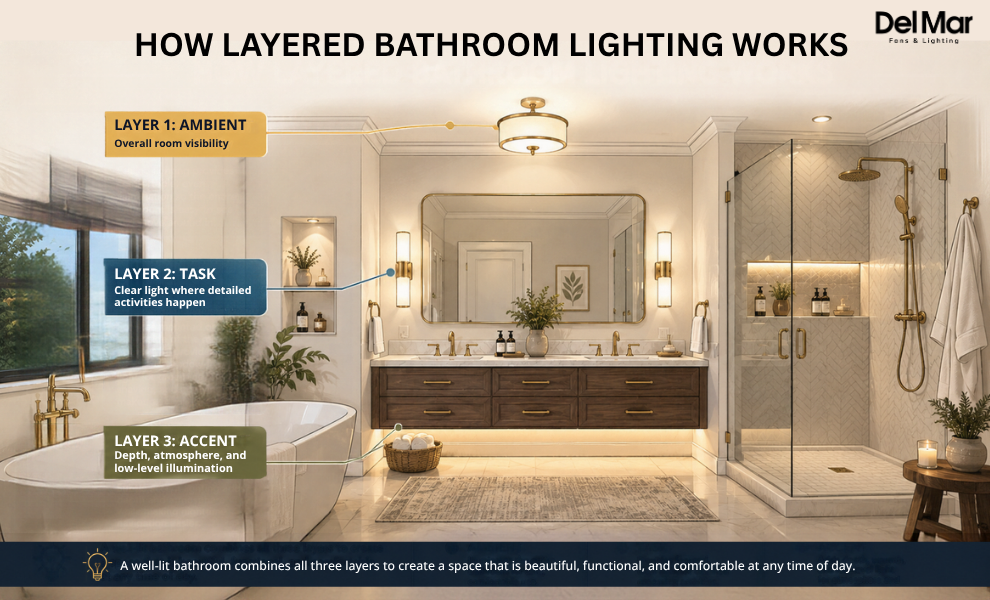
A bathroom lighting plan should generally begin with ambient lighting for overall room visibility, followed by task lighting where detailed activities require clearer illumination, and accent lighting where additional depth, atmosphere, or low-level illumination would improve the space.
The three layers do not have to carry equal weight. A compact bathroom may need a simple ambient source and effective task lighting at the vanity, while a larger primary bathroom may benefit from a more developed combination.
The rest of your lighting decisions from fixture selection and light output to color quality, installation ratings, and controls should support these needs.
What Is Layered Bathroom Lighting, and Why Does It Matter?
A bathroom serves several purposes throughout the day. It may be where you get ready in the morning, apply makeup, shave, style your hair, shower, relax in the tub, or simply make a quick nighttime visit.
Those activities do not all require the same lighting conditions.
That is why planning the bathroom as a combination of lighting layers is more effective than expecting a single fixture to do everything. A ceiling light that makes it easy to move around the room, for example, may not provide the same quality of illumination needed for grooming at the mirror. Likewise, the bright lighting useful during a morning routine may not create the most comfortable setting for a relaxing bath or a nighttime visit.
Layered lighting allows different parts of the bathroom to support different needs without requiring every fixture to perform the same function.
Ambient Lighting Creates the Foundation
Ambient lighting provides the general illumination that allows you to comfortably move around and use the bathroom. It establishes the overall brightness of the room and helps prevent the space from feeling dark or uneven. This is where the overall lighting plan begins, but the right approach depends on the size, ceiling height, layout, and design of the bathroom.
Flush mounts and semi-flush mounts are practical choices for many bathrooms because they provide general illumination without taking up significant visual or physical space. A flush mount can work particularly well in a bathroom with a lower ceiling or limited overhead clearance, while a semi-flush fixture can add more decorative presence without hanging too far into the room.
In larger bathrooms, however, relying on one central fixture may not distribute light effectively throughout the entire space. Separate ceiling fixtures or recessed lighting can help spread general illumination more evenly, especially when the room includes distinct areas such as a vanity, shower, or freestanding tub.
Bathrooms with generous ceiling height and more open space also offer opportunities to make decorative lighting part of the ambient layer. A chandelier can create a dramatic focal point in a spacious primary bathroom, while a pendant can add vertical interest and a sculptural element to the room.
These statement fixtures should not automatically be expected to perform every lighting function on their own. A chandelier or pendant may contribute to the room's ambient illumination while dedicated vanity lighting handles grooming and other light sources support areas beyond the decorative focal point.
That combination is what makes the lighting plan feel intentional. A decorative fixture becomes part of the overall composition rather than being asked to do the work of the entire bathroom.
The important point is that ambient lighting provides the foundation, not necessarily every type of illumination the bathroom needs.
Task Lighting Helps You See Clearly
The next question is simple: Where do you need to see details clearly?
For most bathrooms, the answer begins at the vanity.
This is where you groom for the day ahead, apply makeup, shave, style your hair, or perform other activities that require clear, useful illumination. A bathroom can have plenty of general light and still provide poor lighting at the mirror because overall brightness and useful illumination at the face are not the same thing.
That is where dedicated task lighting becomes important.
General ceiling lighting can contribute to the overall brightness of the room, but light that comes primarily from above may not illuminate the face in the same way as properly planned vanity lighting. The direction, placement, size, and distribution of the light all influence how useful the mirror area feels during everyday routines.
This is why the vanity should be treated as its own lighting zone rather than simply assuming that the room's ambient lighting will handle every task.
Once you have established that the vanity needs dedicated task lighting, the next decisions involve the size of the mirror and vanity, the fixture configuration, placement, installation height, and the overall style of the space.
For detailed guidance on choosing the right vanity fixture, including sizing, placement, style, and configuration, read our How to Pick the Perfect Vanity Light: A Comprehensive Guide.
Accent Lighting Adds Depth and Flexibility
Accent lighting is the most flexible layer and is not necessary in every bathroom. Its role is different from the other two layers. Rather than establishing the room's general visibility or supporting a detailed activity, accent lighting can add visual depth, emphasize an architectural feature, create a more relaxing atmosphere, or provide low-level illumination when full room lighting is unnecessary.
A backlit mirror, illuminated niche, or subtle lighting beneath a floating vanity can all contribute to this layer. In each case, the light does something more specific than simply making the room brighter. For example, low-level lighting beneath a vanity can create a soft glow that makes nighttime movement more comfortable without requiring the entire bathroom to be brightly illuminated. Lighting inside a recessed niche can draw attention to an architectural feature, while a backlit mirror can add depth and visual interest around the vanity. In a larger or more luxurious bathroom, accent lighting can also help prevent the space from feeling visually flat. The lighting can create a sense of depth by drawing attention to different areas of the room and allowing the bathroom to take on a softer atmosphere when the full ambient and task layers are not needed.
The key is restraint.
Accent lighting works best when it has a clear purpose. Adding multiple decorative sources without considering how they relate to the rest of the lighting plan can make the bathroom feel busy rather than sophisticated. When the layers are planned together, the bathroom becomes easier to adapt throughout the day. The ambient layer establishes the foundation, task lighting supports activities that require clear visibility, and accent lighting adds flexibility where it genuinely improves the experience.
That is the advantage of planning bathroom lighting in layers: you can give the room what it needs without adding fixtures simply for the sake of adding fixtures.
Choose the Right Amount and Quality of Light
Once you have planned the different lighting layers in your bathroom, the next step is to consider how those lights will actually perform.
A fixture can be beautiful and appropriately placed but still fail to provide enough useful light. On the other hand, a bathroom can be extremely bright without making it easier to see your face clearly in the mirror or accurately judge colors.
That is why bathroom lighting decisions should go beyond simply asking whether a fixture is bright enough. Lumens help you understand light output, Kelvin affects the appearance of the light, and CRI influences how accurately you see colors.
Each specification answers a different question, and understanding the difference can help you choose lighting that works better for the way you use your bathroom.
How Much Light Does a Bathroom Need?
There is no single lumen total that works for every bathroom.
A large primary bathroom generally needs a different lighting plan from a compact powder room, but room size is only one part of the decision. Ceiling height, natural light, dark or reflective finishes, fixture placement, and the layout of the room can all influence how much illumination is needed and how bright the bathroom actually feels.
The lighting plan itself also matters. A bathroom with well-distributed ceiling lighting and dedicated vanity lighting may function better than one with a single, extremely bright fixture in the center of the room.
That is why the goal should not be to reach an arbitrary total number of lumens. Instead, consider whether the light is providing useful illumination where you need it.
Why Lumens Matter More Than Watts
Watts and lumens measure two different things.
Watts measure energy consumption, while lumens measure the amount of visible light a source produces.
This distinction has become particularly important with LED lighting. Modern LEDs can produce substantial amounts of light while using much less energy than traditional incandescent bulbs. As a result, wattage alone is no longer a reliable way to compare how much light different fixtures or bulbs can provide.
Lumens give you a more useful starting point when comparing light output.
However, higher lumen output does not automatically mean better bathroom lighting.
A brighter ceiling fixture cannot necessarily replace properly positioned lighting at the vanity, and adding more light to one area may not solve a problem caused by poor distribution elsewhere in the room. The location and direction of the light matter just as much as the amount being produced.
When evaluating lumen output, think about the bathroom as a complete lighting plan rather than treating every fixture as though it has the same job.
Lumens tell you how much light is produced. They do not tell you whether that light is reaching the right place.
For a more detailed explanation of lumens and their relationship to watts, Kelvin, and CRI, read our guide to Understanding LED Lights: Kelvin, Lumens and CRI.
Choose Light That Looks Right and Helps You See Clearly
Brightness is only one part of how lighting performs.
Two fixtures can produce similar amounts of light while creating very different experiences in a bathroom. One may make the room feel warm and relaxed, while another appears crisp and cool. The same light source can also differ in how accurately it reveals colors.
This is where color temperature and CRI become important.
Color Temperature: Choosing How the Light Feels
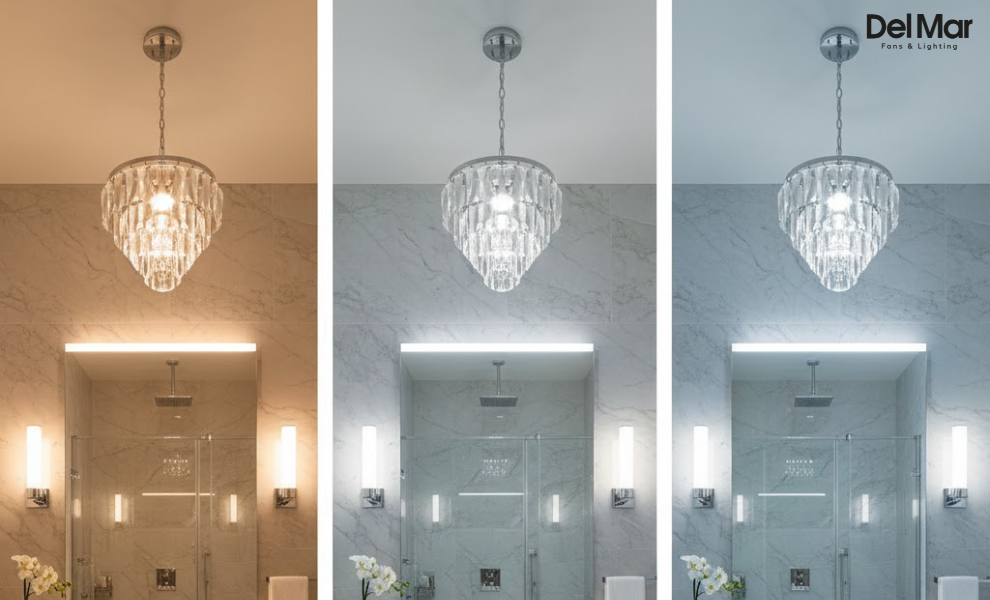
Color temperature describes the visual appearance of light and is measured in Kelvin.
Lower Kelvin values generally produce a warmer, softer appearance, while higher values produce a cooler, whiter appearance. This affects the atmosphere of the bathroom and the way the room's finishes appear under the lighting.
The right choice depends on how you use the space.
A bathroom designed primarily around grooming and getting ready may call for a different visual effect than a spa-like primary bathroom where relaxation is an important part of the experience. The finishes in the room can also influence your decision, as different color temperatures can change how tile, paint, wood, and other materials appear.
Consistency is another important consideration. When several fixtures in the same bathroom produce noticeably different color temperatures, the room can feel visually disconnected unless that contrast is intentional.
Why CRI Is Especially Important for Bathroom Lighting
Color rendering is particularly important in a bathroom because many of the activities performed there depend on seeing colors accurately.
Imagine applying makeup in front of the mirror, selecting cosmetics based on how they appear on your skin, or grooming under lighting that makes skin tones and colors look dull or distorted. You may think something looks right in the bathroom and then notice a significant difference when you step outside or view yourself under another light source.
This is where CRI can make a meaningful difference.
CRI, or color rendering index, indicates how faithfully a light source renders colors compared with a reference source. In practical terms, it helps you understand how naturally and accurately colors are likely to appear under that light.
For bathroom lighting, this is especially relevant at the vanity.
The vanity is where you may apply makeup, shave, style your hair, assess your complexion, or perform other detailed grooming tasks. In these situations, brightness alone is not enough. You need sufficient light to see clearly, but you also want that light to reveal colors and skin tones as accurately as possible.
A light can be bright but still provide poor color rendering.
That distinction is important because lumens and CRI solve completely different problems. Increasing the amount of light does not automatically improve the accuracy of the colors you see under it.
For that reason, CRI deserves more attention when selecting lighting for task-oriented areas of the bathroom than it might in areas where accurate color perception is less critical.
Where Should You Prioritize High-CRI Lighting?
If you are making lighting decisions based on where color accuracy matters most, start with the vanity.
High-quality color rendering can be particularly valuable for:
- Applying makeup
- Shaving and detailed grooming
- Evaluating skin tone and complexion
- Matching cosmetic colors
- Performing other close-up tasks where visual accuracy matters
This does not mean every light in the bathroom must serve exactly the same purpose or carry the same color-rendering requirements.
Instead, evaluate the lighting based on how each area is used. The vanity is typically the place where color rendering deserves the greatest attention because it combines detailed tasks with close visual observation.
Lumens, Kelvin, and CRI: Three Different Lighting Decisions
These three specifications are often grouped together, but they answer different questions.
Lumens: How much light is being produced?
Kelvin: How warm or cool does the light appear?
CRI: How accurately are colors rendered under the light?
Thinking about them separately makes fixture selection easier.
If a bathroom feels too dim, lumen output and light distribution may need attention. If the room feels too warm or too cool visually, color temperature may be the issue. If skin tones, makeup, or other colors do not appear natural, CRI becomes a more important consideration.
The strongest bathroom lighting plans consider all three rather than relying on brightness alone.

Match Each Fixture to Its Installation Location
A beautiful fixture is not automatically the right fixture for every part of the bathroom.
This becomes especially important because different areas of the same bathroom can experience very different levels of moisture exposure. A ceiling fixture above the main floor, a wall sconce beside the vanity mirror, and a light installed in the shower may all be located in the same room, but they are not necessarily exposed to the same conditions. That is why you should not choose a fixture based simply on whether it is described as suitable for a bathroom.
The more useful question is:
- Is this fixture rated appropriately for the exact location where it will be installed?
In general, bathroom fixtures may need to be evaluated based on whether the installation location is exposed primarily to humidity and moisture or may experience direct exposure to water.
Damp-Rated Lighting for General Bathroom Areas
Damp-rated fixtures are designed for environments where moisture and humidity may be present. This makes damp ratings particularly relevant throughout many parts of a bathroom, including areas that experience steam and humidity without being directly exposed to water.
Depending on the specific installation and applicable requirements, damp-rated fixtures may be appropriate for locations such as:
- The main ceiling area of the bathroom
- Ceiling locations away from direct water exposure
- Above a vanity or mirror
- Wall sconces installed beside the mirror
- Decorative lighting installed elsewhere in the bathroom, such as an appropriately located pendant or chandelier
For example, the vanity lights and wall sconces beside a vanity mirror may be exposed to the humidity created by showers and baths, but they are not necessarily exposed to direct water in the same way as a fixture installed inside a shower enclosure.
The same principle can apply to a fixture mounted above the mirror. Its location within the bathroom does not automatically mean it needs the same rating as a fixture exposed directly to shower water.
However, the fixture's exact placement still matters.
A vanity located very close to a shower or another water source may require additional consideration based on the layout of the bathroom, the fixture's exposure, the manufacturer's specifications, and applicable electrical requirements.
The important distinction is that humidity and direct water exposure are not the same thing.
Wet-Rated Lighting for Shower and Direct-Water Locations
Wet-rated fixtures are designed for locations where they may be directly exposed to water.
In a bathroom, this is particularly important when selecting lighting for areas such as the shower or other locations where the fixture may be exposed to water spray.
A recessed light installed in a shower, for example, should be evaluated very differently from a recessed light installed in the center of the main bathroom ceiling.
The same is true when considering decorative or specialty lighting near areas with significant water exposure. A fixture being marketed as suitable for bathrooms does not automatically mean it is appropriate for every bathroom location.
Before installing lighting in or near a shower or another area exposed to water, confirm that the specific fixture is approved for the intended location.
A Simple Way to Evaluate Bathroom Lighting Locations
When choosing a fixture, start by considering where it will actually be installed.
Main Bathroom Ceiling
A fixture installed in the general ceiling area of the bathroom may primarily need to withstand humidity and moisture rather than direct water exposure. Flush mounts, semi-flush mounts, recessed fixtures, and decorative ceiling lighting should always be evaluated based on their individual manufacturer specifications and the exact installation location.
Above the Vanity Mirror
Lighting installed above the mirror is generally performing a task-lighting function while also existing in a humid bathroom environment. Check the fixture's location rating rather than assuming that every vanity light is appropriate simply because it is designed for use near a mirror.
The exact location of the vanity within the bathroom can also affect the decision.
Beside the Vanity Mirror
Wall sconces placed beside the mirror are often an effective way to provide balanced task lighting at the face. Because these fixtures are installed within the bathroom, their suitability for moisture exposure should be verified. However, a sconce beside the mirror in a general vanity area does not necessarily experience the same conditions as a fixture directly exposed to shower water.
- Always consider the fixture's exact location and proximity to water.
- Inside the Shower or Other Direct-Water Areas
- Lighting installed where it may experience direct water exposure requires particular attention.
- Wet-rated fixtures are designed for locations with direct exposure to water, making the product's specific location rating especially important for shower installations and other wet locations.
Do not assume that a standard damp-rated fixture is automatically appropriate for a shower simply because it is designed for bathroom use.
Decorative Pendants and Chandeliers
Pendants and chandeliers can add dramatic visual interest to a spacious bathroom, but their decorative appearance does not determine where they can safely be installed. Before placing a pendant above a bathtub, near a shower, or elsewhere in the bathroom, review the manufacturer's specifications for the exact fixture and evaluate the installation location carefully.
This is particularly important because bathroom layouts vary widely. A decorative fixture positioned in an open, dry portion of a large primary bathroom may face very different conditions from one installed close to a shower or tub.
A fixture may be appropriate for the general bathroom or vanity area without being appropriate for direct-water locations such as a shower.
Always Verify the Exact Fixture and Installation Location
Location ratings are not a detail to check after choosing a fixture. They should be part of the selection process.
Before purchasing or installing bathroom lighting:
- Identify exactly where the fixture will be installed.
- Consider whether the location is exposed primarily to humidity or may experience direct water exposure.
- Review the manufacturer's rating for that specific product.
- Check applicable electrical and building requirements for the installation.
- Consult a qualified electrician or other qualified professional if you are unsure about the appropriate fixture or installation location.
A vanity fixture with clearly documented damp-location suitability, such as the Austin Allen Shelton Vanity Light, can demonstrate why checking the product's technical specifications matters when selecting lighting for a moisture-prone bathroom environment. A wet-location-rated fixture, such as the Bulbrite 10-Inch round disc light, illustrates that fixtures intended for locations with potential direct water exposure may require a different level of location suitability.
These examples are not meant to suggest that every damp-rated fixture can be installed anywhere in a bathroom or that every wet-rated fixture is automatically appropriate for a particular shower or tub installation. The exact product specifications, installation location, and applicable requirements should always be reviewed before making a final selection.
The goal is not simply to find a light that works in a bathroom. It is to choose a fixture that is appropriate for its specific place within the bathroom.
Make Your Lighting Layers Work Together Throughout the Day
One of the greatest advantages of layered lighting is flexibility. Your bathroom does not serve the same purpose every hour.
In the morning, you may want the ambient and task layers working together so the room feels bright and functional. During a relaxing bath, you may prefer softer ambient light with a subtle accent layer. Late at night, low-level illumination may be enough.
Independent controls can make those transitions easier.
Why Dimmers Can Improve a Bathroom Lighting Plan
A dimmer allows compatible lighting to operate at different levels rather than always delivering the same amount of light. This can be particularly useful for ambient lighting because the amount of general illumination that feels comfortable during a busy morning routine may feel excessive in the evening. Dimming can also help accent lighting serve different purposes, from subtle decorative emphasis to low-level nighttime illumination.
Always verify compatibility between the fixture, light source, and dimming control before installation.
Why Separate Controls Matter
When possible, controlling different layers independently gives you more flexibility. For example, the ability to use vanity task lighting without relying entirely on the general ceiling light or to turn on low-level accent lighting without flooding the entire bathroom with light allows the room to adapt to the situation.
This is where layered lighting becomes more than a design principle.
It becomes a practical system for using the bathroom more comfortably throughout the day.

Bathroom Lighting Plans by Room Type
The three layers do not need to look identical in every bathroom.
The size and layout of the room should determine how much complexity the lighting plan actually needs.
Small Bathroom: Keep the Layers Efficient
A compact bathroom does not necessarily need a large number of fixtures. In fact, adding too many lighting sources can make a smaller space feel visually busy without meaningfully improving how the room functions. The goal is to make each lighting decision work efficiently.
A compact flush mount can be a practical choice for providing general illumination without taking up unnecessary visual or physical space. For example, the damp rated low profile and compact Capital Lighting Perkins flush mount ceiling light is an appropriate fixture to consider in a bathroom's general moisture-prone environment.
Since this fixture uses replaceable bulbs, the amount and appearance of light can also be influenced by the bulbs you choose. That allows homeowners to consider light output, color temperature, and color rendering as part of the overall lighting plan rather than treating the fixture alone as the complete lighting decision.
The vanity should then receive the lighting it needs for grooming and other detailed activities. Depending on the layout, a simple combination of effective ambient lighting and dedicated vanity task lighting may provide everything the room needs.
Accent lighting is optional. In a compact bathroom, it can be useful when it serves a specific purpose, such as providing low-level illumination for nighttime use or adding subtle depth beneath a floating vanity. The goal should not be to force all three lighting layers into the room in equal measure, but rather to make sure the essential functions are covered without overcrowding the space with unnecessary fixtures.
Standard Bathroom: Balance General and Task Lighting
A standard bathroom often benefits most clearly from the combination of ambient and task lighting. The ceiling or general lighting provides the foundation for the room, while the vanity receives dedicated attention for grooming and other detailed activities.
Accent lighting can be added when it improves the design or provides a practical benefit, but it should not be considered mandatory.
This approach creates a clear hierarchy:
First, make the room comfortable to use.
Then, make the task area effective.
Finally, decide whether an additional layer would improve the experience.
Spacious Primary Bathroom: Create Multiple Lighting Zones
A large primary bathroom may contain several areas that function almost like separate zones. There may be a double vanity, an enclosed shower, a freestanding tub, and significant open floor space. In this type of layout, one central fixture is unlikely to create equally useful illumination everywhere.
Ambient lighting may need to be distributed across the room. The vanity or vanities need dedicated task lighting. Accent lighting can help define the bathing area, add visual depth, or create a more relaxed setting. The larger the room becomes, the more useful it is to think about lighting as a coordinated composition rather than a collection of individual fixtures.
A substantial decorative pendant can also become part of the ambient lighting plan when the bathroom has sufficient ceiling height and an appropriately rated installation location. For example, the Crystorama Palla 6-Light Pendant can create a strong visual focal point in a spacious primary bathroom while contributing to the room's overall lighting composition. Its damp-location rating makes it suitable for consideration in humid interior environments, although the fixture should still be selected and installed according to the manufacturer's specifications and the requirements of its exact installation location.
A decorative fixture like this should not be expected to illuminate every part of the bathroom or replace dedicated task lighting at the vanity. Instead, it can serve as one element within a larger lighting plan that includes general illumination, effective vanity lighting, and additional location-appropriate lighting where needed.
Luxury Bathroom: Use Decorative Lighting as Part of the Composition
A luxurious bathroom can offer more architectural space for decorative lighting to become part of the design. A chandelier above an appropriate open area can create a dramatic focal point. A pendant may add sculptural interest in a space with generous ceiling height, while decorative wall fixtures can introduce additional layers of visual character.
For example, a substantial chandelier such as the Hudson Valley Beaumont chandelier can become a defining visual element in a spacious luxury bathroom when the ceiling height, scale of the room, and installation location are appropriate. Rather than functioning as the bathroom's only source of light, a statement fixture like this can contribute to the ambient layer while giving the room a stronger sense of visual hierarchy.
But the most successful luxurious bathrooms use the available space to create a more sophisticated hierarchy of light. A statement fixture may draw the eye and contribute to ambient illumination. Vanity lighting handles detailed grooming. Recessed or other general sources support areas beyond the decorative focal point. Accent lighting adds depth around a tub, vanity, niche, or architectural feature.
That is what makes the lighting feel layered rather than crowded.
Common Layered Bathroom Lighting Mistakes
- Expecting One Fixture to Do Everything
One ceiling fixture may make the room generally visible without providing the best light for grooming or creating a comfortable nighttime environment. Each lighting layer exists because the bathroom may have more than one need.
- Adding More Brightness Instead of Improving Light Distribution
If one part of the room feels dark, installing a brighter fixture may not always solve the problem. Consider whether the existing light is reaching the right place. Sometimes another light source in a better location is more effective than increasing the output of a single fixture.
- Treating Decorative Lighting as the Entire Lighting Plan
A beautiful pendant or chandelier can transform a spacious bathroom, but it should not automatically be expected to illuminate every task area. Let decorative fixtures contribute to the overall composition while other layers handle the practical needs they are not designed to solve.
- Ignoring the Vanity as a Separate Task Zone
A bright bathroom is not necessarily a well-lit vanity. Evaluate the mirror area according to the tasks you perform there rather than assuming general ceiling lighting will handle everything.
- Using Accent Lighting Without a Purpose
Accent lighting should add something. If it does not improve visibility, create a useful nighttime option, emphasize a feature, or enhance the atmosphere, another fixture may not be necessary.
- Choosing Fixtures Before Checking Their Installation Location
Never assume that a fixture suitable for one part of the bathroom can be installed anywhere in the room.
Check the manufacturer's specifications for the exact product and installation location before making your final decision.
- Forgetting That Your Lighting Needs Change Throughout the Day
The lighting you want while getting ready in the morning may be very different from what you want before bed.
Independent controls and dimming can help the different layers adapt to those changing needs.
Bathroom Lighting Checklist
Before choosing your fixtures, work through the following questions.
Start With the Room
- How large is the bathroom?
- How high is the ceiling?
- How much natural light does the room receive?
- Are there separate zones, such as a vanity, shower, or tub area?
Build the Ambient Layer
- Where will the general illumination come from?
- Will one ceiling fixture provide useful coverage, or does the room need multiple sources?
- Would a pendant or chandelier suit the scale and ceiling height of the room?
Add the Task Layer
- Where do detailed activities take place?
- Does the vanity have lighting designed specifically for grooming?
- Is the light useful where you actually need to see?
Consider the Accent Layer
- Would accent lighting add depth or atmosphere?
- Would low-level lighting make nighttime use more comfortable?
- Does each accent source have a clear purpose?
Evaluate Light Performance
- Do the fixtures provide enough light for their intended tasks?
- Are you comparing light output in lumens rather than relying on wattage alone?
- Do you want warmer or cooler-looking light?
- Does accurate color rendering matter at the vanity?
Verify the Installation
- Where will each fixture be installed?
- Is it appropriate for the conditions in that exact location?
- Have you checked the manufacturer's specifications?
Think About Daily Use
- Would dimming make the bathroom more comfortable at different times?
- Would independent controls help you use the lighting layers more effectively?
Frequently Asked Questions About Bathroom Lighting
Q. How should you layer bathroom lighting?
A. A well-layered bathroom typically starts with ambient lighting for overall visibility, adds task lighting where detailed activities take place, and uses accent or low-level lighting where it improves the atmosphere or functionality of the room. The three layers do not need to be equally prominent. A small bathroom may rely primarily on ambient and task lighting, while a large primary bathroom may use all three layers more extensively.
Q. Do I need all three layers of lighting in every bathroom?
A. Not necessarily. Ambient lighting and effective task lighting are often the most important priorities. Accent lighting is optional and should be added when it provides a practical or visual benefit. A compact bathroom may function perfectly without extensive accent lighting, while a large primary bathroom may benefit from the added depth and flexibility that another layer provides.
Q. How many lumens does a bathroom need?
A. There is no single lumen total that works for every bathroom. Lumens are useful for comparing the light output of fixtures and bulbs, but the right amount of light depends on the size and layout of the bathroom, natural light, ceiling height, fixture placement, and the activities taking place in different areas.
It is generally more useful to consider how ambient, task, and accent lighting work together than to rely on one universal total.
Q. Why are lumens more useful than watts when choosing LED lighting?
A. Watts measure energy use, while lumens measure visible light output. Because LEDs can produce substantial light while using relatively little energy, two products with similar wattages may not provide the same amount of visible illumination. Lumens are therefore a more useful starting point when comparing brightness.
Q. What color temperature is best for bathroom lighting?
A.The best color temperature depends on how you use the bathroom and the atmosphere you want to create. Warmer light creates a softer appearance, while cooler light creates a crisper, brighter visual impression. Consider how the light will work with the room's finishes and make sure multiple fixtures in the same space create a visually cohesive result.
Q. Why is CRI important for bathroom lighting?
A. CRI is particularly important when you need to see colors accurately. At the vanity, this can matter when applying makeup, grooming, or evaluating skin tones. For general ambient lighting, CRI may not be the deciding specification in every purchase. The importance of CRI depends on what you need to see under that particular light.
Q. Can I use a chandelier in a bathroom?
A. A chandelier can be part of a bathroom lighting plan, particularly in a spacious bathroom with appropriate ceiling height and an open area that benefits from a decorative focal point.
However, the fixture must be appropriate for its intended installation location. A chandelier should also be considered as one part of the lighting plan rather than automatically being expected to provide every type of illumination the bathroom needs.
Q. Are pendant lights suitable for bathrooms?
A. Pendants can add decorative illumination and visual interest to a bathroom, especially in larger spaces with generous ceiling height. Before installation, verify that the exact fixture is suitable for the conditions of its intended location and consider how it will work with the other layers of bathroom lighting.
Q. Do all bathroom lights need to be damp-rated?
A.The appropriate location rating depends on where the fixture will be installed and the conditions of that specific location.
Do not assume that a fixture suitable for one area of a bathroom is appropriate for every area. Always review the manufacturer's specifications and follow applicable installation requirements.
Q. Do shower lights need to be wet-rated?
A. The appropriate rating depends on the exact installation location and its potential exposure to water. Check the manufacturer's specifications and applicable requirements rather than assuming that a general bathroom fixture is suitable for a shower area.
Q. Can one ceiling light be enough for a bathroom?
A. One ceiling fixture may provide sufficient general illumination in a small or simple bathroom. However, it may not provide the most useful lighting for detailed tasks at the vanity or adequately illuminate every area of a large or divided bathroom. The best approach depends on the layout and how the room is used.
Plan the Lighting Before You Choose the Fixtures
The most effective bathroom lighting plans do not begin with a fixture.
They begin with the room.
Start by identifying where you need general visibility, where you perform detailed tasks, and whether another layer of lighting would improve the way the bathroom looks or functions. Then evaluate the light output, color quality, and installation requirements for each part of the plan.
Once those decisions are clear, choosing the fixtures becomes much easier.
The result is not simply a brighter bathroom. It is a bathroom where every layer of light has a purpose and the entire space works together, from the first morning routine to the last nighttime visit.
Bathroom lighting is one of those things people underestimate until they get it wrong. Too dim, and shaving or makeup turns into guesswork. Too harsh, and the room feels like a hospital. Poor placement creates shadows where you least want them. The right lighting, on the other hand, makes your bathroom feel comfortable, functional, and well thought out.
Here’s the thing. Bathroom lighting is not just about picking a pretty fixture. It is about understanding how light behaves in a small, reflective space and using it intentionally. This guide breaks down what actually matters so you can make smart decisions that hold up long after the renovation dust settles.
Let’s break it down step by step.
Understanding the Purpose of Bathroom Lighting
Before getting into fixtures or styles, it’s important to understand what bathroom lighting is meant to do. Thoughtful lighting plays a key role in both function and comfort, and when done right, it can align with broader cozy lighting ideas for home while still meeting practical needs.
Why bathroom lighting is different from other rooms
Bathrooms are task-heavy spaces. You are not just walking through or sitting down. You are grooming, cleaning, inspecting, and sometimes relaxing. That means the lighting has to be accurate, balanced, and forgiving at the same time.
Unlike living rooms or bedrooms, bathrooms have more hard surfaces. Tiles, mirrors, glass, and metal all bounce light around. This can be helpful or problematic depending on how the lighting is placed.
The three layers of bathroom lighting
Good bathroom lighting always uses layers. Relying on a single ceiling light is the most common mistake homeowners make.
Ambient lighting
This is the base light that fills the room. Ceiling-mounted fixtures, recessed lights, or flush mounts usually handle this role.
Task lighting
This is where bathroom vanity lighting comes in. It provides focused light for activities like shaving, skincare, and makeup.
Accent lighting
Accent lighting adds depth and visual interest. Think toe-kick lights, niche lighting in showers, or subtle wall washers.
What this really means is that no single light does everything well. You need a combination.
Types of Bathroom Lighting Fixtures Explained

With the purpose clear, let’s look at the main fixture types and when to use each one.
Ceiling lights and recessed lighting
Ceiling lights provide ambient illumination. Recessed lights are popular because they keep the ceiling clean and uncluttered.
When they work well
- Small to medium bathrooms
- Rooms with lower ceilings
- Minimal or modern designs
Common mistake
Placing recessed lights directly above the mirror. This casts shadows on the face and defeats the purpose of task lighting.
Bathroom vanity lighting
Bathroom vanity lighting deserves special attention because it directly affects how you see yourself.
Best options
- Vertical sconces on both sides of the mirror
- A wide horizontal fixture above the mirror, used carefully
- Side lighting is usually better because it illuminates the face evenly and reduces shadows under the eyes and chin.
Wall sconces
Wall sconces are both functional and decorative. When placed correctly, they elevate the entire bathroom.
Ideal placement
- Mounted at eye level
- Positioned symmetrically on either side of the mirror
Shower and tub lighting
Yes, your shower needs light too.
Good choices
- Recessed wet-rated fixtures
- Directional lights angled toward the shower wall
- Avoid placing a single light directly overhead unless it is diffused.
Accent and decorative lighting
Accent lighting is optional, but it makes a big difference.
Examples include:
- LED strips under floating vanities
- Lighting inside shower niches
- Backlit mirrors
These add dimension without overwhelming the space.
Bathroom Lighting Placement: What Actually Works
Bathroom lighting placement is where most designs succeed or fail.
How to light the vanity properly
This is the most important lighting zone in the bathroom.
Best practice
- Two vertical fixtures placed 36 to 40 inches apart
- Mounted around 60 to 66 inches from the floor, depending on ceiling height and user height
- If side lighting is not possible, a wide fixture above the mirror can work, but it should be placed high enough to avoid casting harsh shadows.
Where ceiling lights should go
Ceiling lights should fill the room evenly.
Tips
- Space recessed lights evenly, not just around the edges
- Keep them a safe distance from walls to avoid spotlighting
- In larger bathrooms, use multiple ceiling lights instead of one powerful fixture.
Shower and wet zone placement
- Use fixtures rated for damp locations.
Placement tips
- Position lights toward the shower walls, not directly above your head
- Use diffused lenses to soften the light
Avoiding shadows and glare
Shadows usually come from lighting that is too directional or poorly placed. Glare comes from exposed bulbs or overly bright fixtures.
The fix is simple. Use diffused light sources and place them where light hits faces and surfaces evenly.
Choosing the Right Light Temperature and Brightness
Brightness and color temperature matter more than most people realize.
Warm vs cool light in bathrooms
Color temperature is measured in Kelvin.
2700K to 3000K: Warm, soft, relaxing
3500K to 4000K: Neutral, clean, accurate
For most bathrooms, neutral light works best. It shows skin tones accurately without feeling harsh.
How bright should bathroom lighting be?
Brightness is measured in lumens.
General guidelines:
Small bathroom: 4000 to 6000 lumens total
Medium bathroom: 6000 to 8000 lumens
Large bathroom: 8000 lumens or more, layered properly
Vanity lighting should be bright enough for tasks but not blinding. Dimmers help fine-tune this.
The importance of dimmers
Dimmers are not a luxury. They are essential.
They let you:
- Brighten the room for grooming
- Soften the light for nighttime use
- Reduce eye strain
Install dimmers on ambient and vanity lights whenever possible.
Bathroom Lighting Ideas for Different Styles
Bathroom lighting ideas should support the overall design, not fight it.
Modern bathrooms
Modern spaces favor clean lines and minimal fixtures.
Lighting ideas
- Recessed ceiling lights
- Linear vanity lights
- Backlit mirrors
Keep finishes simple and consistent.
Traditional bathrooms
Traditional bathrooms benefit from decorative fixtures.
Lighting ideas
- Classic sconces with fabric or frosted shades
- Warm color temperatures
- Symmetrical layouts
Small bathroom lighting ideas
Small bathrooms need smart lighting to feel larger.
Tips
- Use mirrors to reflect light
- Choose bright but diffused fixtures
- Avoid bulky chandeliers or oversized pendants
Luxury and spa-inspired bathrooms
For a spa feel, lighting should be layered and subtle.
Ideas
- Soft accent lighting
- Hidden LED strips
- Dimmable warm light for evening use
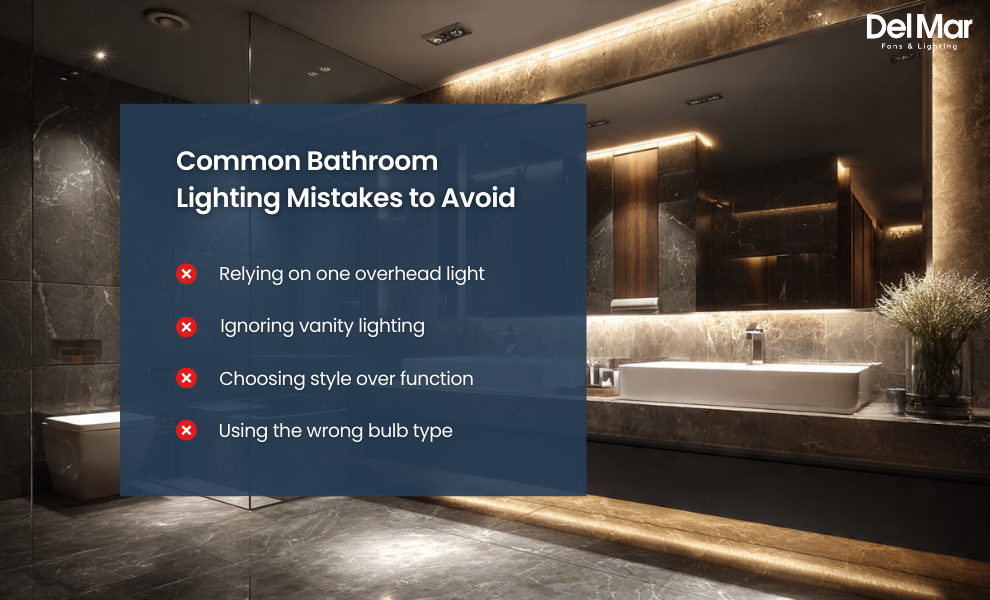
Common Bathroom Lighting Mistakes to Avoid
Let’s talk about what not to do.
- Relying on one overhead light
This creates shadows, glare, and a flat look. Always layer your lighting.
- Ignoring vanity lighting
Bathroom Vanity Lighting is not optional. Poor vanity lighting makes daily tasks harder than they need to be.
- Choosing style over function
A beautiful fixture that produces bad light is still bad lighting. Always test brightness, spread, and glare.
- Using the wrong bulb type
Mixing color temperatures in the same bathroom looks messy. Stick to one range throughout the space.
Great bathroom design isn’t just about the fixtures you choose; it’s about how they work together. When you avoid common mistakes and focus on understanding ambient, accent, and task lighting, your space instantly feels balanced, functional, and intentional. Layered lighting eliminates harsh shadows, supports daily routines, and enhances the overall mood of the room. The right brightness, consistent color temperature, and properly placed vanity lighting transform your bathroom from basic to beautifully practical. Thoughtful lighting isn’t an extra detail; it’s the foundation of a well-designed space.
Energy Efficiency and Safety Considerations
Lighting should be safe and efficient.
LED lighting for bathrooms
LEDs are the best choice for most bathrooms.
Benefits:
- Long lifespan
- Low energy use
- Available in many color temperatures
IP ratings and safety zones
- Bathrooms are divided into zones based on the level of moisture exposure.
- Zone near showers and tubs requires wet-rated fixtures
- Ceiling fixtures should be rated for damp locations at a minimum
- Always check local electrical codes.
Smart lighting options
Smart switches and bulbs allow:
- Scheduling
- Scene setting
- Voice control
These are useful, but not necessary. Start with a good placement first.
Bathroom Lighting Guide: Planning Before You Buy
This bathroom lighting guide would not be complete without planning advice.
Questions to ask before choosing fixtures
- Who uses this bathroom daily?
- What tasks happen here?
- How much natural light is available?
- Is the ceiling height standard or tall?
The answers guide every lighting decision.
Coordinating lighting with mirrors and finishes
Mirrors amplify light. Glossy tiles reflect it. Dark finishes absorb it.
Balance these elements so the room feels comfortable, not glaring or gloomy.
When to consult a lighting professional
If your bathroom is large, oddly shaped, or part of a major renovation, a lighting designer can save you money and frustration.
Final Thoughts: Getting Bathroom Lighting Right
Bathroom lighting is not about trends or fancy fixtures. It is about clarity, comfort, and usability. When lighting is planned properly, everything else in the bathroom looks better. The tile feels richer. The mirror feels kinder. The space feels finished.
Start with the function. Layer your lights. Pay attention to placement. Choose bulbs with intention. Do that, and your bathroom lighting will work for you every single day, not just on reveal photos.
Frequently Asked Questions About Bathroom Lighting
1. What is the most practical bathroom lighting setup for everyday use?
Here’s the thing. One light will never do the job. Good bathroom lighting combines ambient lighting for overall brightness, task lighting where work happens, and proper vanity mirror lighting so you can see your face clearly. When these layers work together, the bathroom feels easy to use, not frustrating.
2. How many lumens for bathroom lighting do I actually need?
The right lumens for bathroom lighting depend on size and layout. Smaller bathrooms usually need around 4000 to 6000 lumens. Medium and large bathrooms often need more. What matters most is that the vanity has strong task lighting, so you are not relying on ceiling light alone.
3. What color temperature (Kelvin) is best for bathroom lighting?
Most bathrooms work best with a color temperature (Kelvin) between 3000K and 4000K. This range gives clean, natural light without feeling harsh. Warmer light feels relaxed. Cooler light feels sharper. Pick what matches how the bathroom is used, not just how it looks.
4. Why is vanity mirror lighting more important than ceiling lights?
Ceiling lights help you see the room. Vanity mirror lighting helps you see yourself. Side lighting or evenly diffused mirror lighting creates shadow-free lighting, which makes shaving, makeup, and skincare easier. Overhead lighting alone almost always creates shadows.
5. How do I reduce glare in bathroom lighting?
Glare reduction starts with fixture choice and placement. Avoid exposed bulbs at eye level. Use frosted glass or diffused LEDs. Dimmers also help control brightness so the light works for both daytime and night use without feeling harsh.
6. What causes shadows in bathroom lighting, and how do I fix them?
Shadows happen when light comes from the wrong angle. One overhead light creates deep shadows on the face. The fix is simple. Use task lighting at the vanity and place lights on both sides of the mirror. That is how you get true shadow-free lighting.
7. What is the difference between ambient lighting and task lighting in bathrooms?
Ambient lighting fills the room so you can move around safely. Task lighting is focused light for specific activities like grooming. You need both. Ambient lighting sets the base. Task lighting handles precision. Skipping either one leads to poor results.
8. Do bathrooms really need damp-rated lighting fixtures?
Yes. Most bathroom spaces deal with steam and humidity. Damp-rated lighting is designed for these conditions and should be used on ceilings and walls outside the shower. It is about safety, durability, and avoiding problems later.
9. When should I use wet-rated lighting in a bathroom?
Use wet-rated lighting anywhere water can splash directly onto the fixture. That includes inside showers and directly over bathtubs. Wet-rated fixtures are sealed to handle direct moisture and are essential for those zones.
10. Are LED lights good for bathroom lighting?
LEDs are a strong choice for lighting in bathrooms. They work well for ambient lighting, task lighting, and vanity mirror lighting. They last longer, use less energy, and come in a wide range of color temperatures that suit different bathroom styles.
11. Can the right bathroom lighting ideas make a small bathroom feel bigger?
Yes, and it happens more often than you think. Smart bathroom lighting ideas like layered lighting, bright vanity lighting, and reflective surfaces reduce shadows and make small bathrooms feel more open and comfortable.
12. Why does bathroom lighting placement matter so much?
Bathroom lighting placement affects how light falls on your face, walls, and floor. Poor placement creates glare and dark spots. Thoughtful placement improves visibility, comfort, and safety. Good lighting is not accidental. It is planned.
