


Close to ceiling lights are a good choice for general purpose lighting in a hallway, closet, or smaller room.
Close to Ceiling Lights come in many finishes and designs, from basic (and copied) designs to close mount crystal lights. We have hundreds of different models to choose from, so follow our guide to help narrow your choices down to a more manageable selection.
When To Use Flush Mount Ceiling Lighting
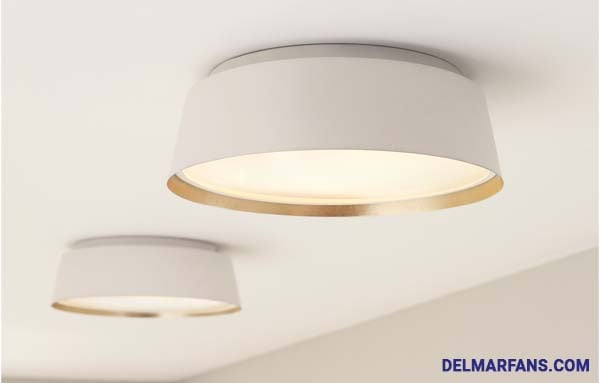
Close to the Ceiling Light Fixtures may not be the best solution, depending on your needs:
- If the location on the ceiling isn't wired for a lighting fixture and you are unwilling to hire an electrician, you might want to consider a floor lamp.
- If you have a low ceiling and want to light a room and move air at the same time, go with hugger ceiling fans with lights.
- For the most visually artistic and complex lighting setups, use track lighting.
- For focused light instead of general purpose lighting, try recessed lighting fixtures.
- For a large room with higher ceilings, a chandelier light may be a better choice.
When To Use Sem-Flush Mount Ceiling Lighting

Now that you have decided to go with close to the ceiling lighting, you have to figure out if you need flush or semi flush mounted fixtures.
Based on the room size, you may be limited in what fixture you can install:
- For low ceilings (below 8'), stick to flush mount lighting. They are installed flush, right up against the ceiling, so taller people won't walk into the fixture. Kids rooms are a great place for flush mount lighting because when kids jump up and down, they will not hit the flush light fixture.
- For slightly higher ceilings (between 8' and 10'), semi flush lighting is an option. These semi flush ceiling lights generally hang less than a foot away from the ceiling. The semi flush mount light will still give good enough clearance for taller people.
- For over 10' ceilings, you might want to graduate to chandeliers or pendants. Their hanging height can vary wildly.
Flush Vs Semi-Flush Mount
You might still be intimidated at the number to fixtures you can go through. Close to ceiling lighting fixtures are available in many styles and shapes. Here is some advice on choosing a fixture:
- A flush light fixture is a good idea for a hallway, closet, or a bathroom.
- A semi-flush light fixture is a good idea for a kitchen or a smaller low-ceiling dining room.
- If you are looking to buy other fixtures for the room (such as vanities), try to purchase all the fixtures from one collection for a unified look.
- Flush Mount Crystal lights are usually for more formal themed rooms. Many classic styled homes use flush mount crystal lights to dress an elegant dining room.
- Some styled fixtures (like floral, nautical, or rustic) may not be for everyone, they have a specific target audience and intended room type.
- Energy Star close mount lights can help lower your utility bill.
Flush mount and semi-flush mount ceiling lights are two of the most practical choices for rooms where you want overhead illumination without the drop of a pendant or chandelier. The main difference is simple: flush mount lights sit directly against the ceiling, while semi-flush fixtures extend slightly below it. That difference affects both clearance and how the fixture distributes light within a room.
Ceiling height is an important starting point, but it is not the only factor that determines which fixture will work best. Fixture height and diameter, room size, lighting needs, viewing angles, and the position of existing lights can all influence the right choice.
A low ceiling or narrow hallway may call for the minimal projection of a flush mount. A bedroom or living room with more ceiling height may have room for a semi-flush fixture with greater visual presence. In a kitchen, bathroom, or laundry room, the choice also needs to work with task or accent lighting rather than leave areas underlit or create unwanted shadows.
The best ceiling light is therefore not determined by ceiling height alone. It should provide the right amount and distribution of light, maintain comfortable clearance, suit the scale of the room, and work with the rest of the lighting plan.
This guide explains the differences between flush mount and semi-flush ceiling lights, how to choose between them based on ceiling height and room conditions, and what to consider when planning ceiling lighting for bedrooms, hallways, living rooms, kitchens, bathrooms, laundry rooms, entryways, closets, and covered porches.
What is a Flush-Mount Ceiling Light?
A flush mount ceiling light attaches directly to the ceiling with little or no visible gap between the fixture and the mounting surface. Its low profile makes it useful wherever vertical clearance is limited or where a homeowner wants the ceiling fixture to remain visually unobtrusive.
Flush mount lights are commonly used in hallways, bedrooms, closets, laundry rooms, bathrooms, and other areas where people move directly beneath the fixture. They are available in simple utility-oriented designs as well as decorative glass, metal, crystal, and integrated LED fixtures.
One important point is that not every flush mount has the same height. A low-profile LED fixture may project only a few inches from the ceiling, while a more decorative flush mount can have a deeper profile. Always check the manufacturer's actual fixture dimensions rather than assuming that “flush mount” means one standard height.
What is a Semi-Flush Ceiling Light?
A semi-flush ceiling light hangs slightly below the ceiling, creating a small gap between the mounting surface and the fixture. That additional space can give the fixture more visual dimension and, depending on its construction, allow light to travel upward as well as downward.
Semi-flush fixtures are useful when you want more decorative presence than a typical flush mount but do not have—or do not want—the vertical drop of a pendant or chandelier.
The important distinction is that semi-flush is a fixture category, not a standard fixture height. One semi-flush light may project only a few inches from the ceiling while another may extend much farther. The actual fixture height should therefore be considered alongside the ceiling height.

Flush Mount vs. Semi-Flush: Which One Should You Choose?
There is no single ceiling-height rule that determines the right fixture for every room.
As a practical starting point:
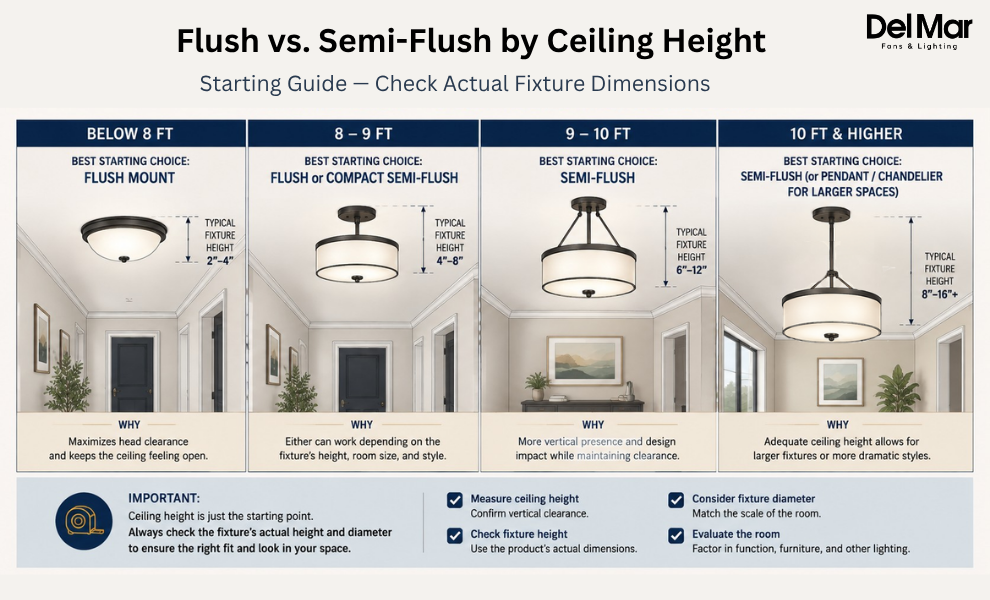
- Below 8 feet: Flush mount is generally the safest choice when head clearance is a concern.
- Around 8 to 9 feet: Flush and compact semi-flush fixtures can both work, depending on the fixture's actual height, room size, and desired visual presence.
- Around 9 to 10 feet: Semi-flush fixtures become more versatile, particularly when you want greater decorative dimension without using a pendant.
- Above 10 feet: Semi-flush can still work, but larger rooms may benefit from a pendant or chandelier with greater vertical scale.
These are starting points, not absolute rules.
A 4-inch semi-flush and a 10-inch semi-flush do not have the same clearance requirements. Likewise, a small flush mount may physically fit a large living room while still looking visually undersized.
Expert Tip
Before choosing a fixture, check these four things together:
CEILING HEIGHT + FIXTURE HEIGHT + FIXTURE DIAMETER + ROOM FUNCTION
That gives you a much more useful starting point than ceiling height alone.
How Ceiling Height Changes Your Choice
Ceiling height determines how much vertical space is available, but it should not be treated as an automatic fixture selector.
- Ceilings Below 8 Feet
Flush mount lighting is generally the most practical starting point. Its low profile preserves head clearance and can help a room with a low ceiling feel less visually crowded.
This is particularly useful in hallways, bedrooms, closets, laundry rooms, and other spaces where people regularly move directly beneath the fixture.
- Ceilings Around 8 to 9 Feet
This is where the choice becomes more flexible. A compact semi-flush can work when its actual height leaves comfortable clearance, while a flush mount may be preferable when the room is small or the design calls for a quieter ceiling.
Look at the fixture's actual height rather than choosing based only on the words “flush” or “semi-flush.”
- Ceilings Around 9 to 10 Feet
Semi-flush fixtures become increasingly useful because there is more room for visual and physical projection. The additional space can also make decorative glass, metalwork, or upward light distribution more noticeable.
- Ceilings Above 10 Feet
Higher ceilings provide more options, but a semi-flush fixture is not automatically too small. A large, well-scaled semi-flush can work particularly well when you want a substantial ceiling fixture without the drop of a pendant.
In very tall or double-height spaces, however, consider whether a chandelier or pendant would create a stronger visual connection between the ceiling and the room below.
Flush Mount vs. Semi-Flush Ceiling Lights by Room
The same ceiling height can require different lighting decisions in different rooms. A hallway is experienced while walking, a bedroom while reclining, and a kitchen while standing at a work surface.
That means the right fixture is determined by more than clearance. How the room is used should influence the fixture's size, height, light distribution, and placement.
Hallway Ceiling Lighting: Flush Mount or Semi-Flush?
Hallways generally benefit from fixtures that provide consistent illumination without projecting too far below the ceiling. Because people experience hallways while standing and walking, clearance and light distribution are particularly important.
Hallway Ceiling Light Placement Guidelines
1. Start with the fixture-to-hallway proportion.
A useful starting point for a ceiling fixture is approximately one-third of the hallway width. For example, a 36-inch hallway will need approximately 12-inch fixture.
This is a visual starting point rather than a fixed sizing formula. Larger or more decorative fixtures may require adjustment based on their actual visual weight and light output.
2. Check the actual fixture height.
Do not assume that every flush mount has the same profile. Measure the fixture's actual height from the ceiling and consider the available head clearance, particularly in hallways with ceilings below 8 feet.
3. For long hallways, start with approximately 6–8 feet between fixtures.
Measure center to center when multiple ceiling lights are used.
This is a starting range rather than a universal spacing requirement. Fixture lumen output, beam spread, ceiling height, and light distribution may require the fixtures to be closer together or farther apart.
4. Aim for overlapping light coverage.
The goal is not simply to place fixtures at equal intervals. Their illumination should overlap enough to minimize dark sections between fixtures. A narrow-beam fixture may require closer spacing than a broadly diffused fixture.
For a 36-inch-wide, 20-foot hallway with an 8-foot ceiling, a low-profile flush mount around 12 inches in diameter could be a reasonable starting proportion. If multiple fixtures are required, begin with approximately 6–8 feet between fixture centers, then evaluate how the actual light spreads across the floor and walls.
Hallway Planning Check
- ⅓ — starting fixture-to-hallway proportion
- ACTUAL FIXTURE HEIGHT — check clearance
- 6–8 FT — starting fixture spacing
- LIGHT SPREAD — aim for overlapping coverage
If you are comparing fixture sizes and profiles for a hallway, browse our Ceiling Lights collection to compare flush mount and semi-flush options by diameter, height, and design.

Bedroom Ceiling Lighting: Flush Mount or Semi-Flush?
Bedrooms need to be evaluated from a different perspective because the ceiling fixture may be viewed while lying in bed. A fixture can have adequate clearance and still create uncomfortable glare if its light source is exposed or concentrated.
Bedroom Ceiling Light Placement Guidelines
1. Use flush mounts when ceiling height is limited or the fixture is directly above the bed.
The low profile keeps the fixture visually and physically close to the ceiling.
2. Consider a semi-flush on taller ceilings when greater decorative presence is desired.
A semi-flush can add dimension without requiring the vertical drop of a pendant.
3. Check the fixture from the bed.
Lie down and look toward the fixture from the normal sleeping position. If an exposed bulb or bright LED is directly in your field of view, consider a diffuser, shade, different fixture height, or alternative placement.
4. Consider diffused light for general bedroom illumination.
Frosted glass and integrated diffusers can distribute light more comfortably than a concentrated exposed source.
5. Use dimming when possible.
A bedroom ceiling light may need to provide useful illumination in the morning but softer light at night.
For bedrooms with limited ceiling height, flush mount ceiling lights offer a low-profile option that keeps the fixture close to the ceiling while providing general illumination.
Bedroom Planning Check
- CEILING HEIGHT — determine available clearance
- FIXTURE HEIGHT — check the actual profile
- BED POSITION — evaluate glare from the mattress
- LIGHT DISTRIBUTION — avoid a concentrated source directly in the sightline

Living Room Ceiling Lighting: Flush Mount or Semi-Flush?
Living rooms generally provide more flexibility because ceiling height, room size, furniture, and other lighting layers all influence the fixture choice.
A semi-flush can provide more decorative presence than a typical flush mount, while a flush mount may be preferable in a lower-ceiling room or when the ceiling fixture needs to remain visually quiet.
Living Room Ceiling Light Placement Guidelines
1. Match the fixture diameter to the room's visual scale.
A fixture can provide sufficient light while still looking too small for a large living room. Consider the room dimensions and the scale of major furniture before choosing the diameter.
2. Use ceiling height to determine how much vertical projection is practical.
Lower ceilings generally favor flush or shallow semi-flush fixtures. Taller ceilings allow more room for larger semi-flush designs.
3. Consider the fixture's relationship to the furniture below.
The ceiling light should feel connected to the room's major elements rather than floating independently above the furniture.
4. Check the fixture from the main seating positions.
A bright LED or exposed bulb that looks comfortable while standing may create glare from a sofa or lounge chair.
5. Use the ceiling fixture as one layer of the lighting plan.
Floor lamps, table lamps, wall sconces, and accent lighting can illuminate the perimeter of the room where a central ceiling fixture may not reach effectively.
An 8-foot living room ceiling may favor a decorative flush mount combined with lamps and wall lighting. For rooms with more ceiling height, semi-flush ceiling lights can provide additional decorative presence without the vertical drop of a pendant or chandelier.
Living Room Planning Check
- ROOM SCALE — size the fixture to the space
- CEILING HEIGHT — determine vertical projection
- SEATED SIGHTLINE — check glare
- LAYERED LIGHTING — don't expect one fixture to do everything
Kitchen Ceiling Lighting: Flush Mount or Semi-Flush?
A kitchen ceiling light generally provides ambient or general illumination, not complete task lighting. Cabinets, shelves, appliances, and the position of the person working at the counter can all create shadows.
Kitchen Ceiling Light Placement Guidelines
1. Establish what the ceiling fixture needs to illuminate.
Use it for general room illumination rather than assuming it will adequately light every countertop.
2. Check fixture height around cabinetry.
A deeper semi-flush fixture should be evaluated in relation to cabinet heights and the visual scale of the kitchen.
3. Plan for task lighting separately.
Under-cabinet lighting, pendants, or other task fixtures may be necessary over countertops and islands.
4. Look for broad, useful light distribution.
A concentrated beam can create a bright area directly beneath the fixture while leaving other work areas darker.
5. Consider CRI.
Good color rendering can be particularly useful in kitchens where homeowners prepare food and evaluate finishes and colors.
An 8-foot kitchen ceiling may work well with a flush mount supplemented by under-cabinet lighting. A larger kitchen with a 9- or 10-foot ceiling can accommodate a semi-flush fixture for general illumination, while pendants provide focused light over the island. For a layered kitchen lighting plan, see our guide to under-cabinet lighting installation for more on adding task lighting beneath cabinets and other work surfaces.
Kitchen Planning Check
- CEILING HEIGHT — determine fixture type
- FIXTURE PROJECTION — check cabinet clearance
- WORK SURFACE — prevent shadows
- LIGHT DISTRIBUTION — provide broad general illumination

Laundry Room Ceiling Lighting: Flush Mount or Semi-Flush?
Laundry rooms are often overlooked during lighting planning, but they benefit from bright, even illumination. Cabinets, shelves, appliances, and hanging areas can create shadows, making light distribution more important than decorative fixture depth.
Laundry Room Ceiling Light Placement Guidelines
1. Prioritize even illumination.
A broad, diffused fixture is often more useful than a concentrated decorative beam.
2. Use a flush mount where ceiling height is limited.
Its low profile keeps the fixture out of the way of shelves and cabinets.
3. Consider a compact semi-flush when ceiling height allows.
A semi-flush can add visual interest without requiring a pendant.
4. Check color rendering.
Higher-CRI lighting can make it easier to distinguish clothing colors and inspect stains.
5. Consider multiple fixtures in larger laundry rooms.
One central fixture may not adequately illuminate deep counters, cabinets, or separate folding areas.
Laundry Room Planning Check
- LOW PROFILE — preserve clearance
- EVEN LIGHT — minimize shadowed areas
- CRI — support accurate color visibility
- SHELVING — check for blocked illumination
Bathroom Ceiling Lighting: Flush Mount or Semi-Flush?
Bathrooms often favor low-profile ceiling fixtures because of limited ceiling height and the need to maintain comfortable clearance. However, ceiling lighting should not be treated as a replacement for properly positioned vanity lighting.
Bathroom Ceiling Light Placement Guidelines
1. Check the fixture's location rating.
Choose a fixture appropriate for the installation environment and follow applicable electrical requirements.
2. Use flush mounts where ceiling height is limited.
Their low profile works particularly well in compact bathrooms.
3. Consider semi-flush fixtures when height and location rating allow.
A decorative semi-flush can provide more visual presence in a larger bathroom with sufficient ceiling height.
4. Use diffused light where possible.
A diffuser can help reduce uncomfortable glare from bright overhead sources.
5. Coordinate the ceiling fixture with vanity lighting.
The ceiling light provides general illumination; properly positioned vanity lights provide the facial illumination needed for grooming.
The ceiling light provides general illumination; properly positioned vanity lights provide the facial illumination needed for grooming. For more guidance on the second layer of bathroom lighting, see our bathroom vanity lighting guide for recommendations on positioning light around the mirror and vanity.
Bathroom Planning Check
- LOCATION RATING — verify suitability
- CEILING HEIGHT — check clearance
- DIFFUSION — control glare
- VANITY LIGHTING — illuminate the face separately
Entryway and Foyer Ceiling Lighting: Flush Mount or Semi-Flush?
Entryways are where ceiling height begins to have a stronger effect on visual scale. A low-ceiling foyer may require a flush mount, while a taller entryway can accommodate a semi-flush fixture with more decorative presence.
For a double-height foyer, however, do not assume a close-to-ceiling fixture is automatically the best option. A chandelier or pendant may provide a stronger visual connection between the upper ceiling and the entry below.
Entryway Ceiling Light Placement Guidelines
1. Measure ceiling height before choosing the fixture.
2. Consider the fixture from the main approach into the home.
The entry light is often one of the first fixtures people see.
3. Match fixture diameter to the scale of the entryway.
A tiny fixture can disappear in a large foyer.
4. Maintain comfortable head clearance.
5. Consider a pendant or chandelier for tall or double-height spaces.
Entryway Planning Check
- CEILING HEIGHT — determine fixture category
- FIXTURE SCALE — match the entryway
- SIGHTLINE — consider the approach
- CLEARANCE — maintain comfortable circulation

Walk-In Closet Ceiling Lighting: Flush Mount or Semi-Flush?
Closets are particularly well suited to flush mount lighting because shelves, clothing, and storage already occupy much of the available space. A low-profile ceiling fixture keeps the ceiling visually open while providing general illumination.
The bigger challenge is shadowing. A single fixture in the center of a deep closet can leave shelving and clothing along the perimeter darker.
Walk-In Closet Ceiling Light Placement Guidelines
1. Use flush mounts when clearance is limited.
2. Choose broad, diffused illumination.
3. Consider multiple fixtures in larger or irregularly shaped closets.
4. Supplement ceiling lighting where deep shelving creates shadows.
5. Consider higher-CRI lighting where accurate clothing colors matter.
Closet Planning Check
- LOW PROFILE — preserve clearance
- BROAD DISTRIBUTION — illuminate storage
- MULTIPLE FIXTURES — for larger layouts
- CRI — improve color recognition
Covered Porch Ceiling Lighting: Flush Mount or Semi-Flush?
Covered porches introduce another consideration that does not apply to indoor rooms: location rating.
A covered porch may be protected from direct rain but still experience humidity, wind-driven moisture, and changing outdoor conditions. The fixture must be rated for the environment in which it is installed.
Covered Porch Ceiling Light Placement Guidelines
1. Verify the fixture's damp or wet location rating.
Do not assume an indoor fixture is suitable simply because the porch has a roof.
2. Consider the degree of weather exposure.
A deeply covered porch and a porch exposed to wind-driven rain may require different fixture ratings.
3. Use flush mounts where ceiling height or a ceiling fan limits vertical clearance.
4. Consider semi-flush fixtures when the porch has enough height for additional projection.
5. Consider corrosion exposure in coastal locations.
Homes near salt air may require additional attention to fixture construction and finish.
For a broader overview of choosing fixtures for outdoor environments, see our outdoor lighting guide, including considerations for placement, weather exposure, and location ratings.
Porch Planning Check
- LOCATION RATING — verify environmental suitability
- CEILING HEIGHT — check fixture clearance
- WEATHER EXPOSURE — consider wind-driven moisture
- CORROSION — consider coastal conditions

Don't Choose a Flush or Semi-Flush Fixture by Ceiling Height Alone
Ceiling height is important, but it is only one part of the decision.
1. Check the Fixture's Actual Height
Two semi-flush fixtures can have completely different vertical dimensions. Always use the manufacturer's listed fixture height when determining clearance.
2. Consider Fixture Diameter
A fixture can have adequate vertical clearance and still look wrong for the room because it is too small or too large.
3. Look at Where the Light Source Sits
The center of the fixture is not necessarily where the bulb or integrated LED sits. This matters when evaluating glare, especially in bedrooms and living rooms.
4. Consider Surface Colors
Dark walls, ceilings, floors, and cabinetry absorb more light than lighter surfaces. The same fixture can therefore produce very different perceived brightness in two rooms.
5. Consider Existing Lighting
A ceiling fixture does not always need to provide all the room's illumination. In a living room, lamps and wall sconces may provide perimeter lighting while the ceiling fixture supplies general overhead light.
6. Think About How the Room Is Used
A fixture that works well in a hallway may not be the best choice above a bed or in a kitchen where shadows and glare matter more.

How Light Distribution Changes the Choice
The shape and mounting style of a ceiling fixture do not tell you everything about how its light will behave.
Two fixtures with similar dimensions can produce very different results depending on their shade, diffuser, LED position, and direction of light.
Downward Light
Fixtures that direct most of their light downward can provide useful illumination beneath the fixture but leave walls and room edges darker.
Diffused Light
Frosted glass and integrated diffusers spread light more broadly and can reduce harsh points of brightness. This can be particularly useful in bedrooms, hallways, and bathrooms.
Uplight and Indirect Light
Some semi-flush fixtures allow light to escape above the fixture and reflect from the ceiling. This can create a softer effect than a fixture that directs nearly all of its output downward.
Exposed Bulbs
Exposed bulbs can create a strong decorative statement but may also produce glare when viewed from below. Consider the fixture's position and the room's primary sightlines before choosing an open design.
Expert Note
Fixture height determines clearance. Light distribution determines how the room experiences the fixture.
Both need to be evaluated before installation.
Common Flush Mount and Semi-Flush Ceiling Light Mistakes
- Choosing Only by Ceiling Height
A ceiling-height rule is useful as a starting point, but it does not account for fixture height, room scale, or how the light will be used.
- Choosing a Fixture That Is Too Small
A flush mount may fit perfectly on a high ceiling but disappear visually in a large room. Fixture diameter should relate to the room rather than simply the available ceiling space.
- Ignoring Glare
A bright integrated LED or exposed bulb can be uncomfortable from beds, sofas, and other seated positions even when the fixture is technically appropriate for the ceiling height.
- Expecting One Fixture to Do Everything
A central ceiling fixture provides general illumination, but kitchens, bathrooms, living rooms, and other active spaces often need additional task or accent lighting.
- Forgetting Location Ratings
Bathrooms, porches, and other moisture-prone locations require fixtures rated for their environment. Never assume an indoor ceiling fixture is appropriate simply because it physically fits.
- Ignoring Light Distribution
A fixture that produces a narrow pool of light may leave dark areas around the room. Look at the actual distribution pattern when deciding how many fixtures you need.
A Quick Ceiling Light Planning Guide
Use these as starting checkpoints, then adjust according to the actual fixture and room.
| Planning Check | Starting Guidance |
|---|---|
| Fixture-to-Hallway Proportion | About ⅓ of the hallway width as a visual starting point |
| Ceilings Below 8 ft | Flush mount is generally the safest starting choice |
| Ceilings 8–9 ft | Flush or compact semi-flush |
| Ceilings 9–10 ft | Semi-flush becomes more versatile |
| Hallway Fixture Spacing | Start around 6–8 ft center to center |
| Light Distribution | Aim for overlapping illumination |
| Bedroom | Check the fixture from the bed |
| Kitchen | Pair general ceiling lighting with task lighting |
| Bathroom | Check location rating and coordinate with vanity lighting |
| Covered Porch | Check damp/wet rating and environmental exposure |
Don't install from the measurement alone.
Before electrical rough-in, mark the fixture's actual width and height on the ceiling or use the manufacturer's dimensions to visualize its scale. Then evaluate it from the positions where the room will actually be used.
Choose the Ceiling Light for the Room, Not Just the Ceiling
Flush mount and semi-flush ceiling lights are both practical, versatile choices, but the best fixture cannot be determined by ceiling height alone.
A low ceiling may point you toward a flush mount, but the fixture's diameter, light distribution, and position still determine whether it works. A taller ceiling may give you room for a semi-flush fixture, but the room's scale and function determine whether that additional visual and vertical presence is actually useful.
The most reliable approach is to start with the ceiling height, then check the actual fixture height, fixture diameter, room function, light distribution, and existing layers of lighting.
In other words, don't ask only:
“Will this fixture fit?”
Ask:
“Will this fixture fit the room—and provide the kind of light the room actually needs?”
That is the difference between simply filling a ceiling junction box and creating a lighting plan that works.
Frequently Asked Questions regarding ceiling lights:
Q. What is the difference between a flush mount and a semi-flush ceiling light?
A. A flush mount attaches directly to the ceiling, while a semi-flush fixture hangs slightly below it, creating a small gap between the fixture and ceiling. Flush mounts generally provide the most vertical clearance, making them useful for lower ceilings and circulation areas. Semi-flush fixtures can provide more decorative presence when the ceiling has enough height for additional projection. Always check the fixture's actual height rather than choosing based on the fixture category alone.
Q. What ceiling height is best for a flush mount light?
A. Flush mount lights are generally the safest starting point for ceilings below 8 feet because their low profile preserves head clearance. On 8- to 9-foot ceilings, both flush and compact semi-flush fixtures may work depending on the fixture's actual height and the room. Ceiling height should be treated as a starting measurement, not an automatic fixture-selection rule.
Q. Can you use a semi-flush light on an 8-foot ceiling?
A. Yes, but the fixture's actual height matters. A compact semi-flush fixture may work on an 8-foot ceiling when it provides adequate clearance, while a deeper fixture may be better suited to a taller ceiling. Check the manufacturer's overall fixture height and consider how the light will be viewed from the room's primary seating or standing positions before installation.
Q. How big should a ceiling light be for a hallway?
A. A useful starting point is to choose a ceiling fixture with a diameter of approximately one-third of the hallway's width. For example, a 36-inch-wide hallway could start with a fixture around 12 inches in diameter. This is a proportion guideline rather than a fixed formula. Fixture height, visual weight, light output, and the hallway's length should also influence the final selection.
Q. How far apart should hallway ceiling lights be?
A. For a long residential hallway, start with approximately 6 to 8 feet between fixture centers when using multiple ceiling lights. The final spacing should be adjusted according to lumen output, beam spread, ceiling height, and fixture distribution. The goal is overlapping illumination rather than simply maintaining an exact distance, since narrow-beam fixtures may require closer spacing to prevent dark sections.
Q. Should a bedroom ceiling light be flush mount or semi-flush?
A. Either can work, depending on ceiling height, fixture dimensions, and how the light is experienced from the bed. Flush mounts are useful where clearance is limited, while a shallow semi-flush can add more decorative presence on taller ceilings. Before installation, check the fixture from the bed. Exposed bulbs or concentrated LEDs can create glare when viewed from a reclining position.
Q. Does a ceiling light provide enough lighting for a kitchen?
A. A ceiling light can provide general or ambient illumination, but it should not automatically be expected to provide all the light a kitchen needs. Cabinets, appliances, and the person working at the counter can create shadows. Under-cabinet lighting and pendants over an island may be needed for task lighting. Choose the ceiling fixture for broad room illumination, then add task lighting where the work actually happens.
Q. Can a flush mount ceiling light work on a high ceiling?
A. Yes. A flush mount can work on a high ceiling when its low-profile appearance suits the room and the fixture is appropriately scaled. However, a small flush mount may look visually undersized in a large or tall space. Consider the fixture's diameter, room dimensions, and overall visual scale rather than assuming that a higher ceiling requires a semi-flush, pendant, or chandelier.
Q. Do I need a damp-rated ceiling light for a covered porch?
A. A covered porch may require a fixture rated for damp or wet locations depending on how much moisture and weather exposure it receives. A roof does not automatically make an outdoor area equivalent to an indoor space. Consider humidity, wind-driven rain, and the degree of enclosure, then select a fixture with a location rating appropriate for the installation and follow the manufacturer's instructions.
Q. Does a semi-flush ceiling light provide more light than a flush mount?
A. Not necessarily. Light output depends on the fixture's lumens, bulbs or integrated LED system, diffuser, beam spread, and light direction—not simply whether the fixture is flush or semi-flush. A flush mount with broad diffusion can illuminate a room more evenly than a semi-flush fixture with a concentrated downward beam. Evaluate the fixture's actual light distribution as well as its appearance and dimensions.
Q. What should I consider besides ceiling height when choosing a ceiling light?
A. Consider at least five factors: actual fixture height, fixture diameter, room function, light distribution, and existing lighting. Ceiling height determines the available vertical space, but the fixture's dimensions determine clearance and scale, while its light distribution affects how the room is illuminated. Existing sconces, lamps, pendants, or task lighting also determine how much work the ceiling fixture needs to perform.
