


Choosing the right ceiling fans for small rooms is not about picking the cutest design or the lowest price. It is about blade span, airflow efficiency, and proper proportions. The best ceiling fans for home strike the perfect balance between performance and scale. Get the size wrong, and the room either feels stuffy or looks awkward.
Here’s the thing. Small rooms are unforgiving. Every inch matters. The fan has to move enough air without overpowering the space visually or physically.
What Size Ceiling Fan Do You Actually Need for a Small Room?
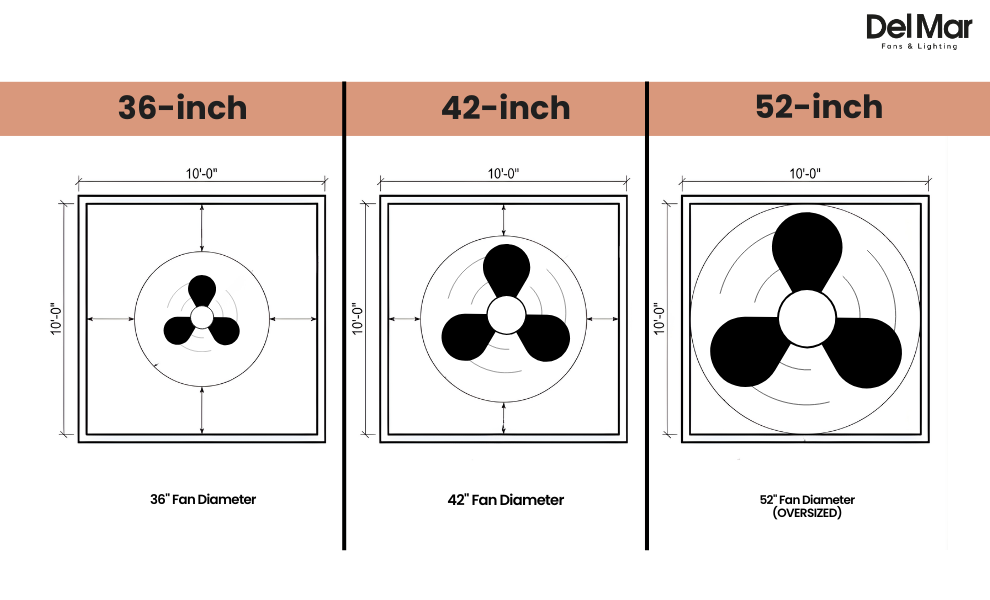
Small room ceiling fan size refers to the blade span diameter appropriate for rooms under 144 square feet.
Most small bedrooms, offices, nurseries, and guest rooms fall into this category.
If you’re wondering about fan size for a 10x10 room, that space equals 100 square feet. The ideal blade span is 36 to 42 inches, producing around 2,000 to 3,000 CFM.
What this really means is simple:
Too small, and the airflow suffers. Too large, and the room feels cramped.
Small vs Medium Ceiling Fans: Where 42” and 48” Fit
Small ceiling fans: Under 42 inches
Best for rooms under 120–144 sq ft. Ideal for 8x10, 9x10, and compact 10x10 bedrooms.
Recommended Pick:
The Hunter Newsome Flush 42" ceiling fan with LED light is a reliable choice for compact spaces. Featuring five Fresh White / Light Oak reversible blades with a 42-inch span, it delivers balanced airflow without overwhelming the room. The integrated LED light keeps the ceiling visually clean, while the 3-speed pull chain and reverse function on the motor make seasonal adjustments simple. It’s especially suitable for traditional or transitional bedrooms where proportion and quiet performance matter.
Medium ceiling fans: 48 inches
Best for rooms between 144–225 sq ft. Works well in slightly larger bedrooms, small living rooms, or open guest suites.
Recommended Pick:
The Modern Fan Company Velo Flush ceiling fan with remote control is ideal when you need stronger airflow with a modern profile. Its three Whitewash blades (48-inch span) provide efficient circulation for medium-sized rooms. The DC motor supports 6-speed remote control operation, light dimming, and reverse functionality for year-round comfort. With an ETL Damp rating, it’s also suitable for covered patios or moisture-prone spaces, making it a versatile upgrade for contemporary interiors.
Important rule:
Avoid choosing any fan above 50 inches for small rooms. A 52-inch fan in a compact bedroom often overwhelms the space visually and can create uncomfortable airflow concentration.
What this really means:
If your room is exactly 10x10 or smaller, stay at 42 inches or below.
If your room is closer to 12x12, a 48-inch fan becomes appropriate.
Understanding Ceiling Fan Dimensions for Small Room Layouts
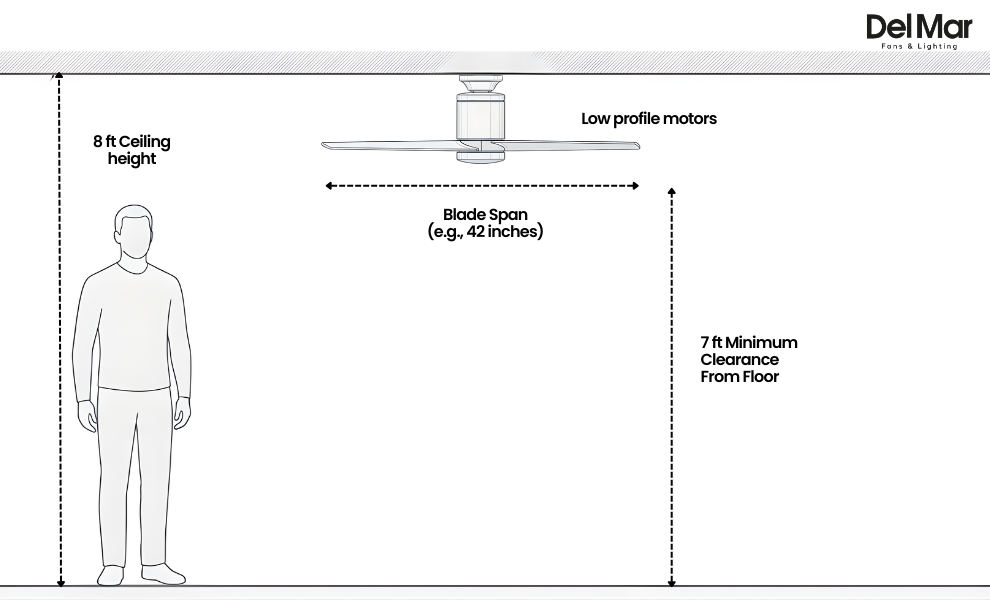
When people talk about size, they usually mean blade span. But that is only one part of the equation.
Blade Span
Blade span is the full diameter of the circle created by the spinning blades. It determines coverage area and airflow distribution.
For small rooms, the sweet spot is typically between 36 and 44 inches.
Motor Housing Width
Large motor housings in small rooms create visual bulk. Slim-profile motors look balanced and intentional.
Drop Length and Mount Type
Ceiling height changes everything.
- 8-foot ceiling: Use a flush-mount ceiling fan
- 8 to 9 feet: Low-profile with short downrod
- Below 8 feet: Strictly low-profile or hugger style
A low-profile ceiling fan sits close to the ceiling, preventing head clearance issues while maintaining airflow efficiency.
Low-Profile vs Flush Mount vs Hugger Fans
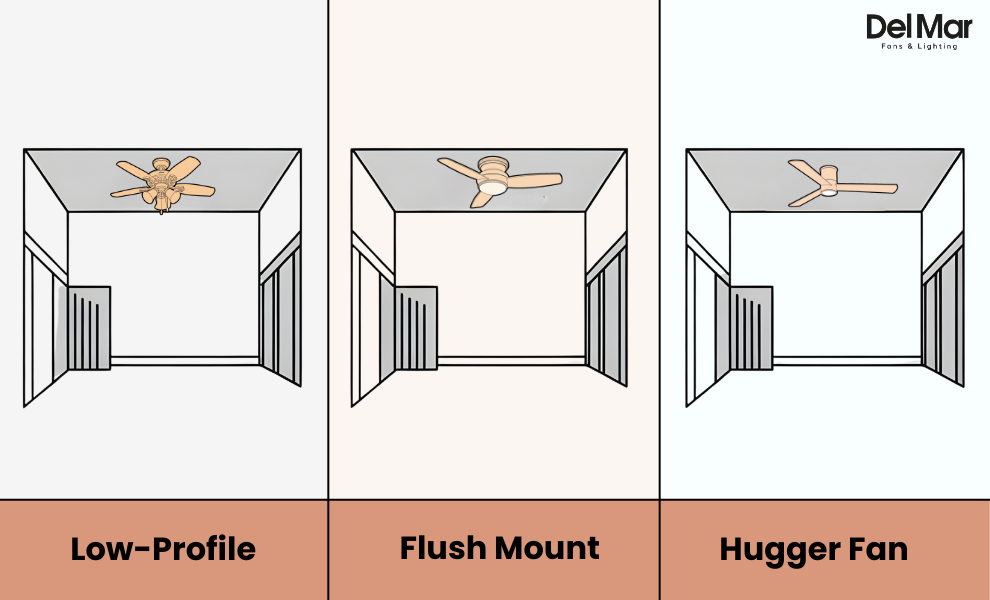
Many homeowners use these terms interchangeably, but there are subtle differences.
Low-Profile Ceiling Fan
Designed for ceilings 8 feet or lower. May include a very short mounting base.
Flush Mount Ceiling Fan
Attaches directly to the ceiling with no visible downrod.
Hugger Fan
A specific type of flush-mount fan engineered to “hug” the ceiling tightly, maximizing head clearance.
Key difference:
All hugger fans are flush mount.
Not all low-profile fans are true huggers.
Practical takeaway:
- For ceilings under 8 feet, choose a hugger fan.
- For standard 8-foot ceilings, low-profile or flush mount both work
CFM for Small Rooms Explained Clearly
CFM for small rooms refers to the cubic feet per minute of air the fan moves at high speed.
This number matters more than blade count.
Ideal CFM Range
For rooms under 144 sq ft:
2,000 to 3,500 CFM is ideal.
If CFM is too low:
The air feels stagnant
The cooling effect is minimal
If CFM is too high:
Air becomes drafty
Noise increases
Airflow efficiency is about balance, not power.
Best Ceiling Fan for Small Bedroom Spaces
Bedrooms need quiet operation, gentle circulation, and visual calm.
Here’s what defines the best ceiling fan for a small bedroom:
- Blade span between 36 and 42 inches
- 2,000 to 3,000 CFM
- DC motor for quiet operation
- Low-profile design if ceilings are 8 feet
- Integrated LED light for layered lighting
DC motors use less electricity and operate significantly quieter than AC motors. In small rooms, noise becomes noticeable quickly.
What this really means is this: silence equals comfort.
Ceiling Fans With Lights vs Without Lights: Which Should You Choose?
Choosing a ceiling fan with an integrated light is often the smartest solution when your room lacks recessed lighting, or you want a single, central fixture that handles both airflow and illumination. A model like the Hunter Swanson is perfect for small bedrooms where space efficiency matters. These fans reduce the need for multiple ceiling fixtures, create a clean and cohesive look, and provide practical overhead lighting without crowding the ceiling. Their space-saving design makes them especially ideal for compact layouts where simplicity and function need to work together.
Advantages:
- Space-saving
- Clean design
- Ideal for small bedrooms
On the other hand, ceiling fans without lights are best suited for rooms that already have recessed, layered, or strong natural lighting. If you prefer a minimal, architectural aesthetic, a design like the Mesa Mid-Size delivers a sleeker appearance while keeping the focus on airflow performance. Without a light kit, these fans often provide slightly more concentrated air circulation and eliminate glare above the bed. In well-lit bedrooms, this streamlined option enhances comfort without adding unnecessary visual clutter.
Advantages:
- Sleeker appearance
- Often slightly better airflow focus
- No glare above the bed
Expert tip:
In very small bedrooms, integrated LED fans usually make more sense because they reduce clutter.
Common Mistakes People Make with Small Room Ceiling Fans
This is where most homeowners go wrong.
1. Choosing Oversized Fans
A 52-inch fan in a 10x10 bedroom overwhelms the space and creates uneven airflow.
2. Ignoring Ceiling Height
Installing a standard downrod fan on an 8-foot ceiling reduces head clearance and safety.
3. Focusing Only on Blade Count
Three blades can outperform five. Airflow efficiency depends on motor strength and blade pitch.
4. Ignoring Room Shape
Rectangular rooms may need centered placement, not visual alignment with furniture.
5. Buying Based on Looks Alone
Design matters. But airflow matters more.
Quick takeaway:
Size first. Style second.
Step-by-Step Guide to Choosing the Right Fan
Let’s make this simple and actionable.
Step 1: Measure the Room
Length × width = square footage.
Step 2: Match Blade Span
Use the sizing table above.
Step 3: Check Ceiling Height
Select low-profile or flush mount if needed.
Step 4: Review CFM
Aim for 2,000 to 3,500 CFM.
Step 5: Consider Lighting Needs
Integrated LEDs reduce clutter in small rooms.
Step 6: Check Noise Rating
Look for DC motor technology.
Bullet Summary:
- Measure square footage
- Choose the correct blade span
- Confirm mounting style
- Verify airflow efficiency
- Prioritize quiet motors
Simple process. Smart result.
Airflow Efficiency vs Energy Use
Small rooms do not need industrial airflow. They require steady, well-balanced circulation that maintains a comfortable environment without overwhelming it. Even if you love the look of a big modern ceiling fan for large rooms, scale and proportion matter; oversized designs can visually dominate a compact bedroom or office if not chosen carefully.
Energy-efficient fans with DC motors consume up to 70 percent less electricity than traditional AC fans. What this really means is:
You can run them longer without guilt or high bills.
Look for Energy Star ratings when possible.
Placement Tips for Maximum Performance
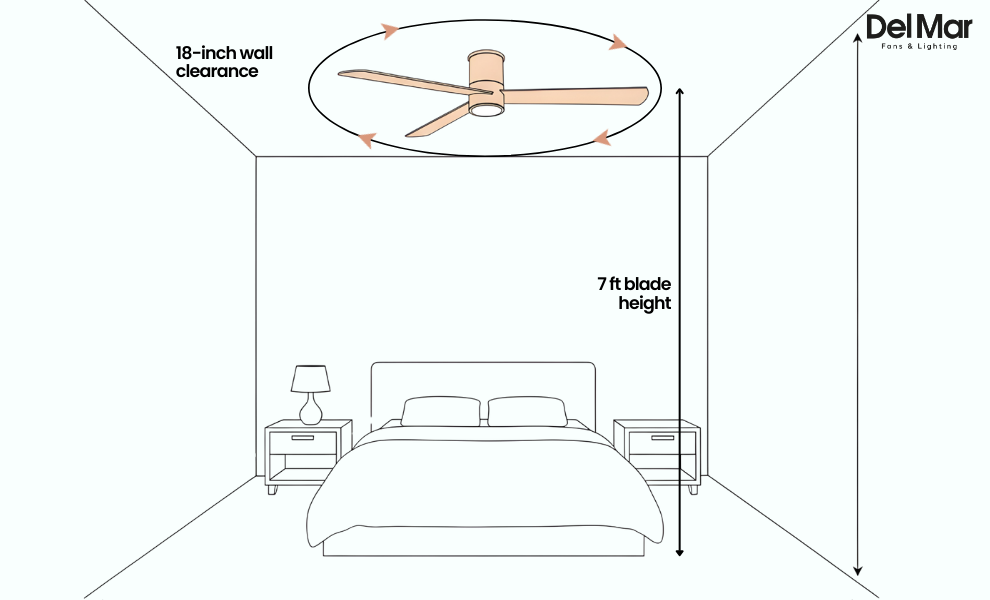
Even the perfect fan underperforms if installed incorrectly.
Placement Rules
- Install in the center of the room
- Maintain at least 18 inches from walls
- Keep blades 7 feet above the floor
If the bed dominates the room, center the fan in the room, not just the bed.
Balanced air distribution beats targeted airflow.
Comparison Table: Quick Reference Guide
| Feature | Specification |
|---|---|
| Ideal for Small Rooms | Yes |
| Blade Span | 36 to 42 inches |
| CFM | 2,000 to 3,500 |
| Mount Type | Flush or low-profile |
| Motor | DC preferred |
| Ceiling Height | 8 feet requires a hugger style |
Design Tips That Make Small Rooms Look Bigger
Ceiling fans influence visual perception.
Choose Light Colors
White or matte finishes blend into ceilings.
Avoid Heavy Ornamental Designs
Keep lines clean and minimal.
Use Integrated Lighting
Reduces the need for bulky fixtures.
Match Hardware Finishes
Consistency prevents visual clutter.
Small spaces demand intentional design choices.
Frequently Asked Questions
1. What size ceiling fan for a 10×10 room?
A. A 10×10 room equals 100 square feet.
The ideal ceiling fan size is 36″–42″ blade span, delivering approximately 2,000–3,000 CFM.
This provides balanced airflow without overwhelming the ceiling visually.
2. What size ceiling fan is best for a small room?
A. For rooms up to 150 sq ft, choose a fan between:
29″–36″ (very small rooms under 75 sq ft)
36″–42″ (most small bedrooms & studies)
44″–48″ (upper limit for 120–150 sq ft rooms)
48″ is the maximum recommended size for small rooms.
3. How many CFM is good for small rooms?
A. For rooms under 150 sq ft:
2,000–3,500 CFM is ideal
Under 2,000 CFM → weak circulation
Over 4,000 CFM → unnecessary draft & noise
Airflow efficiency matters more than blade count.
4. Is a 52-inch ceiling fan too big for a small bedroom?
A. Yes — in most cases.
A 52″ fan is designed for medium rooms (150–300 sq ft).
In a compact bedroom, it can:
- Look visually oversized
- Create concentrated downward airflow
- Disrupt room proportions
Stick to 42″ or smaller unless the room exceeds 150 sq ft.
5. Flush Mount vs Low-Profile: Which Should You Choose?
A. Follow the thumb rule:
- Ceiling under 8 ft → Flush mount / Hugger
- Ceiling 8–9 ft → Short downrod or low-profile
- Always maintain a 7 ft minimum blade clearance from the floor
- Ceiling height is just as important as blade span.
Final Takeaways
Choosing ceiling fans for small rooms is about proportion, airflow efficiency, and mounting height.
Remember:
- 36 to 42 inches is ideal for most small bedrooms
- 2,000 to 3,500 CFM delivers comfortable airflow
- Low-profile or flush mount designs suit 8-foot ceilings
- DC motors provide quiet performance
- Measure first, buy second
Get the size right, and the room feels cooler, larger, and more comfortable. Get it wrong, and you will notice it every day.
Small rooms do not need big fans. They need the right fan.
That is the difference between decoration and performance.
