


Buying a ceiling fan can feel surprisingly technical.
You start with something simple, maybe you just want a fan for your bedroom or living room and suddenly you're seeing terms like CFM, blade pitch, torque, and downrod length. It’s easy to feel unsure about what actually matters.
This guide breaks down all the important ceiling fan terms in a way that actually helps you make decisions. Think of it as your go-to reference — something you can quickly scan or dive into depending on what you need.
Blade Span
Blade span refers to the total diameter of a ceiling fan from one blade tip to the opposite blade tip. It determines how much area the fan can cover and is one of the most important factors when choosing the right fan size. A larger blade span moves air across a wider area, making it ideal for bigger rooms, while smaller spans suit compact spaces.
What this means for you:
Always match blade span to room size — too small won’t circulate enough air, too large may feel overpowering.
| Room Size | Blade Span |
|---|---|
| Small (up to 100 sq ft) | 36–42 inches |
| Medium (100–250 sq ft) | 44–52 inches |
| Large (250+ sq ft) | 60 inches+ |
Blade Sweep
Blade sweep is closely related to blade span and refers to the circular area covered by the rotating blades. It represents the actual airflow coverage zone of the fan. While blade span measures size, blade sweep helps visualize how far the airflow reaches across the room.
What this means for you:
A wider blade sweep ensures more uniform airflow, especially in open layouts or large living spaces.
Blade Pitch
Blade pitch is the angle of the blades relative to the horizontal plane, usually between 10° and 15°. This angle determines how effectively the fan pushes air downward. A higher blade pitch can move more air, but only if supported by a strong motor.
What this means for you:
Look for balanced design — high pitch + strong motor = better airflow.
Blade Curvature
Blade curvature refers to the shape or contour of the blade surface. Some blades are flat, while others are slightly curved to improve airflow efficiency and reduce turbulence. Curved blades can move air more smoothly and quietly, especially in modern aerodynamic designs.
What this means for you:
Curved blades often deliver quieter and more efficient airflow.
Blade Angle
Blade angle is sometimes used interchangeably with blade pitch, but it can also refer to how the blade is positioned relative to airflow direction. Subtle changes in angle can affect how air is pushed and distributed throughout the room.
What this means for you:
Small design differences in blade angle can impact airflow performance and comfort.
Blade Count
Blade count refers to the number of blades on a ceiling fan, typically ranging from 3 to 8. While many assume more blades mean more airflow, that’s not always true. Motor strength and blade design matter more. Fewer blades can move air faster, while more blades may operate more quietly.
What this means for you:
Choose based on performance + style, not just number of blades.
Torque
Torque is the rotational force of the motor.
It determines how effectively the fan can move air — especially with longer or heavier blades.
What this means for you:
High torque is essential for large blade fans and high ceilings.
Airflow
Airflow refers to the movement of air created by the fan. It determines how effectively the fan cools a room and circulates air. Strong airflow improves comfort by creating a gentle breeze and reducing stagnant air.
What this means for you:
Good airflow makes a room feel cooler even without lowering the temperature.
Related: Ceiling Fan Size Guide
CFM (Cubic Feet per Minute)
CFM measures how much air a fan moves per minute and is the most reliable indicator of performance. Higher CFM means more air circulation, making it essential for larger rooms or high ceilings.
| Room Type | Ideal CFM |
|---|---|
| Bedroom | 2,000–3,500 |
| Living Room | 3,500–5,000 |
| Large Spaces | 5,000+ |
Airflow Efficiency (CFM per Watt)
Airflow efficiency measures how effectively a fan converts energy into airflow. It’s calculated as CFM divided by watts used.
What this means for you:
Higher efficiency = better airflow with lower energy consumption.
Air Circulation
Air circulation refers to how air moves throughout a room over time. A good fan doesn’t just push air down — it keeps it moving continuously across the entire space.
What this means for you:
Better circulation improves comfort and prevents hot or cold spots.
Wind Chill Effect
The wind chill effect is the cooling sensation created when moving air increases evaporation from your skin. Ceiling fans don’t lower temperature — they make you feel cooler.
What this means for you:
Fans can reduce reliance on AC by improving perceived comfort.
Air Delivery
Air delivery refers to how effectively air is pushed into the usable space below the fan. It depends on blade design, motor strength, and installation height.
What this means for you:
A fan mounted too high may have good CFM but poor air delivery.
Air Distribution
Air distribution describes how evenly air spreads across a room. Some fans create concentrated airflow, while others distribute air more evenly.
What this means for you:
Even distribution ensures consistent comfort across the room.
Coverage Area
Coverage area is the space a fan can effectively cool based on its size and airflow capacity.
What this means for you:
Choosing the right fan ensures the entire room feels comfortable, not just one spot.
Static Pressure
Static pressure refers to resistance to airflow caused by obstacles like furniture, walls, or room layout.
What this means for you:
Fans with stronger motors perform better in rooms with more obstructions.
Air Velocity
Air velocity is the speed at which air moves from the fan. Faster air movement creates a stronger cooling sensation but may feel drafty if too intense.
What this means for you:
Balanced velocity provides comfort without discomfort.
Motor & Mechanical Terms
Motor
The motor is the core of a ceiling fan — it powers the blades and determines how efficiently the fan performs. A strong, well-designed motor ensures consistent airflow, smooth operation, and long-term durability.
What this means for you:
A good motor is more important than blade design alone. It directly impacts airflow, noise, and reliability.
Motor Housing
Motor housing is the outer casing that encloses and protects the motor. It also contributes to the overall design and finish of the fan. Larger or poorly designed housings can look bulky in smaller rooms.
What this means for you:
Compact housing works better in small spaces, while larger housings suit bigger fans and rooms.
AC Motor
AC motors are the traditional motor type used in many ceiling fans. They are reliable and widely available but tend to consume more energy and produce slightly more noise compared to newer technologies.
What this means for you:
A solid choice for budget-friendly fans, but less efficient than modern alternatives.
DC Motor
DC motors are more advanced and energy-efficient than AC motors. They use less electricity, operate quietly, and offer more speed settings.
What this means for you:
Ideal for bedrooms, offices, and modern homes where quiet operation matters.
Brushless DC Motor
Brushless DC motors eliminate internal friction components found in traditional motors, making them more efficient, quieter, and longer-lasting.
What this means for you:
Premium performance with minimal noise and better durability.
Motor Efficiency
Motor efficiency refers to how effectively a motor converts electrical energy into mechanical motion. Higher efficiency means less wasted energy and better performance.
What this means for you:
Efficient motors reduce electricity bills while maintaining strong airflow.
Torque
Torque is the rotational force that drives the blades. It determines how effectively a fan can move air, especially with longer or heavier blades.
What this means for you:
High torque is essential for large fans and high ceilings to maintain strong airflow.
RPM (Rotations Per Minute)
RPM measures how fast the fan blades spin. While higher RPM can indicate faster movement, it doesn’t always mean better airflow.
What this means for you:
Performance depends on a combination of RPM, blade design, and torque.
Speed Settings
Speed settings refer to the number of airflow levels a fan can operate at. Most fans offer 3–6 speeds.
What this means for you:
More speed options allow better control over comfort and energy use.
Multi-Speed Motor
A multi-speed motor allows the fan to operate at different speeds rather than a single fixed speed.
What this means for you:
Provides flexibility to adjust airflow based on weather and comfort needs.
Bearing Type
Bearings support the rotation of the motor shaft and reduce friction. The quality of bearings affects noise, smoothness, and durability.
What this means for you:
Better bearings = quieter operation and longer lifespan.
Ball Bearings
Ball bearings are a common type used in ceiling fans to ensure smooth rotation. They reduce friction and improve durability.
What this means for you:
Fans with high-quality ball bearings tend to run quieter and last longer.
Motor Winding
Motor winding refers to the copper coils inside the motor that generate motion when electricity flows through them.
What this means for you:
Higher quality winding improves performance, efficiency, and longevity.
Starting Capacitor
The starting capacitor helps the motor start spinning by providing an initial boost of energy.
What this means for you:
Without it, the fan may struggle to start or operate properly.
Run Capacitor
The run capacitor helps maintain consistent motor operation after startup. It stabilizes performance and ensures smooth running.
What this means for you:
It keeps the fan operating efficiently and prevents performance drops.
Heat Dissipation
Motors generate heat during operation, and heat dissipation refers to how effectively that heat is managed.
What this means for you:
Better heat management improves motor lifespan and performance.
Power Consumption
Power consumption refers to how much electricity the fan uses during operation.
What this means for you:
Lower consumption means lower energy bills without sacrificing comfort.
Wattage
Wattage indicates how much power the fan uses. However, lower wattage doesn’t always mean better performance — efficiency matters too.
What this means for you:
Look for a balance between wattage and airflow performance.
Power Factor
Power factor measures how effectively electrical power is used by the motor. A higher power factor means better energy utilization.
What this means for you:
Higher power factor = more efficient operation and less wasted energy.
Installation & Mounting Terms
Choosing the right ceiling fan isn’t just about size or style — how it’s installed plays a huge role in how well it performs. Proper mounting ensures better airflow, safety, and overall comfort.
Downrod
A downrod is the metal rod that connects the ceiling fan to the ceiling mount. It positions the fan at the correct height so airflow reaches the living area effectively.
What this means for you:
If a fan is too close to the ceiling, airflow stays trapped above. If it’s too low, it can become unsafe.
Rule of thumb:
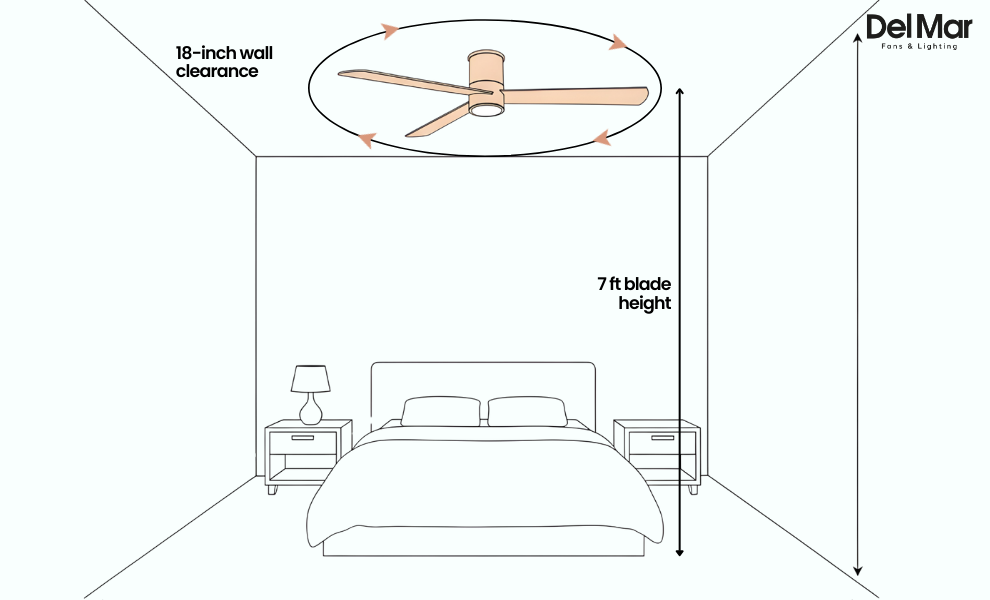
Fan blades should sit 8–9 feet above the floor.
Downrod Length
Downrod length determines how far the fan hangs from the ceiling. Taller ceilings require longer downrods to maintain proper airflow and safety clearance.
What this means for you:
Correct downrod length ensures airflow reaches where you actually live — not just the ceiling.
Recommended Downrod Length by Ceiling Height
| Ceiling Height | Recommended Downrod Length |
|---|---|
| 8 ft | Flush mount (no downrod) |
| 9 ft | 6-inch downrod |
| 10–12 ft | 12–24 inch downrod |
| 13–15 ft | 24–48 inch downrod |
| 16+ ft | 48 inches or longer |

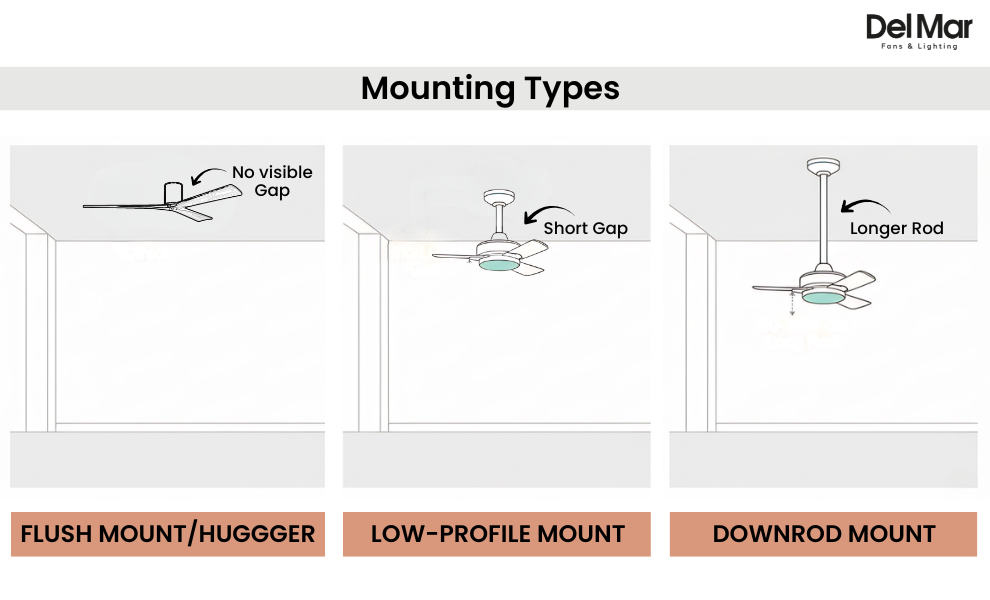
Flush Mount (Hugger Fan)
Flush mount fans attach directly to the ceiling without a downrod. They are designed for low ceilings where maintaining head clearance is important.
What this means for you:
Best for ceilings under 8 feet, but airflow is slightly reduced compared to downrod-mounted fans.
Low-Profile Fan
Low-profile fans are similar to flush mount fans but may include a very short mounting base. They provide slightly better airflow while still maintaining low clearance.
What this means for you:
A good compromise for standard 8-foot ceilings.
Standard Mount
A standard mount uses a downrod and is the most common installation type. It allows the fan to hang lower for better airflow.
What this means for you:
Best option for ceilings 9 feet and above.
Dual Mount / Tri-Mount
Some fans offer multiple installation options, such as flush mount, downrod mount, or angled mount.
What this means for you:
More flexibility if your ceiling height or room layout changes.
Convertible Ceiling Fans
Convertible fans can be installed in different configurations — flush mount, downrod, or angled ceiling.
What this means for you:
Ideal if you want a fan that adapts to different rooms or future home changes.
Related: Downrod Size Guide

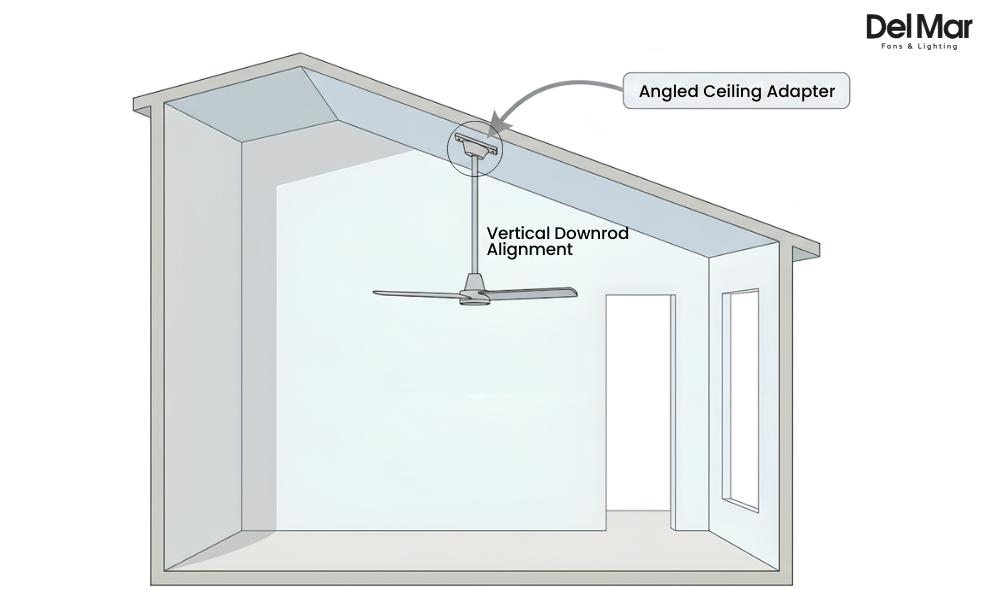
Angled Mount
Angled mounting allows ceiling fans to be installed on sloped or vaulted ceilings.
What this means for you:
Ensures the fan hangs vertically even when the ceiling is angled.
Sloped Ceiling Adapter
This is a special mounting accessory used when the ceiling angle exceeds standard compatibility limits.
What this means for you:
Necessary for steep vaulted ceilings to maintain safe and proper installation.
Ceiling Slope Angle
This refers to how steep a ceiling is, typically measured in degrees.
What this means for you:
Most fans support up to ~30° slopes — beyond that, adapters are needed.
Canopy
The canopy is the cover that hides the electrical wiring and mounting hardware at the ceiling.
What this means for you:
Primarily aesthetic, but also protects wiring and ensures a clean installation look.
Mounting Bracket
The mounting bracket secures the fan to the ceiling electrical box. It must be strong enough to support the fan’s weight and motion.
What this means for you:
Always use a fan-rated bracket — standard light fixtures won’t work safely.
Hanging System
The hanging system includes all components that suspend the fan, including the downrod and mounting assembly.
What this means for you:
A stable hanging system ensures smooth, wobble-free operation.
Ceiling Junction Box
This is the electrical box in the ceiling where the fan is mounted.
What this means for you:
It must be rated to support ceiling fans, not just light fixtures.
Fan-Rated Electrical Box
A reinforced electrical box designed specifically to handle the weight and movement of a ceiling fan.
What this means for you:
Essential for safety — prevents loosening or falling over time.
Quick Installation Rules
- Keep blades 8–9 ft above the floor
- Maintain 18 inches from walls
- Use downrod for ceilings above 9 ft
- Choose flush mount for ceilings under 8 ft
- Always install on a fan-rated electrical box
Lighting & Control Terms
Lighting and controls are what turn a ceiling fan from a simple appliance into a complete comfort solution. Whether you're creating a cozy bedroom or a well-lit kitchen, understanding these terms helps you choose a fan that fits both your functional needs and your design style.
Light Kit
A light kit is an add-on or built-in lighting component attached to a ceiling fan. Some fans come with integrated lighting, while others allow you to add a light kit separately.
What this means for you:
If your room lacks overhead lighting, a fan with a light kit can serve as both a cooling and lighting solution.
Integrated LED
Integrated LED lighting is built directly into the fan and cannot be replaced like a traditional bulb. These systems are designed to last for years and offer a clean, modern look.
What this means for you:
Great for minimal, modern interiors where you want a sleek, clutter-free design.
Replaceable Bulb
Some ceiling fans use standard bulbs that can be replaced when needed. These allow flexibility in brightness and color temperature.
What this means for you:
Ideal if you want control over lighting style or prefer easy replacements.
Lighting Comparison Table
Lumens
Lumens measure how bright a light is. Unlike watts, which measure energy use, lumens tell you how much light output you’ll get.
What this means for you:
Higher lumens = brighter room. Choose based on room size and purpose.
Color Temperature (Kelvin)
Color temperature determines whether light appears warm (yellow) or cool (white/blue). It plays a huge role in how a room feels.
- 2700K → warm and cozy
- 3000K → soft white
- 4000K → bright and functional
What this means for you:
Use warm light for relaxing spaces and cooler light for task-oriented rooms.
CRI (Color Rendering Index)
CRI measures how accurately light shows colors compared to natural light.
What this means for you:
Higher CRI (80+) makes colors look more natural and vibrant.
Dimmable Lighting
Dimmable lighting allows you to adjust brightness levels based on mood or time of day.
What this means for you:
Perfect for bedrooms and living rooms where lighting needs change throughout the day.
Uplight vs Downlight
Downlight: directs light downward (most common)
Uplight: reflects light upward for ambient glow
What this means for you:
Combining both creates layered, balanced lighting.
Control Options: Traditional vs Smart
Pull Chain Control
A pull chain is the most basic way to operate a fan. It controls speed and sometimes lighting.
What this means for you:
Simple and reliable, but less convenient for larger rooms.
Wall Control
Wall-mounted switches allow easy access to fan and light settings.
What this means for you:
More convenient than pull chains, especially for daily use.
Remote Control
A remote allows you to control fan speed and lighting from anywhere in the room.
What this means for you:
Ideal for bedrooms and living rooms where convenience matters.
Smart Ceiling Fans
Smart fans can be controlled using:
- mobile apps
- voice assistants
- automation systems
What this means for you:
Maximum convenience and customization.
Smart vs Traditional Controls Table
| Feature | Traditional Controls | Smart Controls |
|---|---|---|
| Operation | Manual (pull chain / wall) | App, voice, remote |
| Convenience | Basic | High |
| Customization | Limited | Advanced settings |
| Automation | None | Timers, schedules |
Receiver & Transmitter
Receiver: installed inside the fan
Transmitter: the remote or app
They communicate to control fan functions wirelessly.
What this means for you:
Ensures smooth and responsive control operation.
Speed Memory
This feature remembers your last used speed setting when the fan is turned back on.
What this means for you:
Adds convenience — no need to reset speed every time.
Timer Function
Allows the fan to turn off automatically after a set duration.
What this means for you:
Useful for bedrooms and energy savings.
Breeze Mode / Natural Wind Mode
This feature varies fan speed automatically to mimic natural wind patterns.
What this means for you:
Creates a more natural and comfortable airflow experience.
Quick Lighting & Control Tips
- Use warm light (2700K) for bedrooms
- Choose dimmable lighting for flexibility
- Pick integrated LED for modern design
- Use remote or smart control for convenience
- Match brightness (lumens) to room size
Environmental Ratings & Outdoor Ceiling Fan Terms
Not all ceiling fans are built the same — especially when it comes to moisture, humidity, and outdoor exposure.
Choosing the wrong rating can lead to rust, electrical issues, or reduced lifespan, so understanding these terms is essential before installing a fan in bathrooms, patios, or outdoor areas.
Dry-Rated Ceiling Fans
Dry-rated fans are designed for indoor spaces only, where there is no exposure to moisture or humidity.
Common areas include:
- bedrooms
- living rooms
- offices
What this means for you:
Never install a dry-rated fan in bathrooms or outdoor areas — it won’t withstand moisture.
Damp-Rated Ceiling Fans
Damp-rated fans are built to handle humidity and light moisture but not direct exposure to water.
Suitable for:
- covered patios
- bathrooms
- laundry rooms
- enclosed porches
What this means for you:
Safe for humid environments, but must be protected from rain.
Wet-Rated Ceiling Fans
Wet-rated fans are designed to handle direct exposure to water, including rain and outdoor elements.
Suitable for:
- open patios
- pergolas
- outdoor decks
- poolside areas
What this means for you:
The only safe option for fully exposed outdoor installations.
Rating Comparison Table
| Rating | Best For | Water Exposure |
|---|---|---|
| Dry Rated | Indoor spaces | None |
| Damp Rated | Covered outdoor / humid areas | Moisture only |
| Wet Rated | Open outdoor areas | Direct rain exposure |
Indoor vs Outdoor Ceiling Fans
Indoor fans are designed for controlled environments, while outdoor fans include additional materials and coatings to resist environmental factors.
Outdoor fans are typically:
- moisture-resistant
- corrosion-resistant
- built with durable blade materials
What this means for you:
Even if two fans look similar, outdoor-rated fans are built to last in tougher conditions.
Weather-Resistant Construction
Weather-resistant fans are designed to handle exposure to:
- humidity
- temperature changes
- light water contact
What this means for you:
Important for longevity in semi-outdoor spaces.
Corrosion-Resistant Materials
Outdoor fans often use special coatings or materials that resist rust and corrosion.
What this means for you:
Essential for coastal areas or humid climates.
UV-Resistant Blades
Blades exposed to sunlight can fade or warp over time. UV-resistant blades are designed to maintain their shape and color.
What this means for you:
Prevents discoloration and long-term damage in outdoor spaces.
Moisture-Resistant Components
Electrical components in outdoor fans are sealed or protected to prevent moisture damage.
What this means for you:
Ensures safety and reliable operation in humid environments.
Where Should You Install Each Type?
This is the section users care about most — simple placement clarity.
Quick Placement Guide
- Living room / bedroom → Dry rated
- Bathroom → Damp rated
- Covered patio → Damp rated
- Open deck / pergola → Wet rated
- Poolside → Wet rated
Common Mistakes to Avoid
- Installing dry-rated fans outdoors
- Using damp-rated fans in direct rain
- Ignoring humidity in bathrooms
- Choosing indoor finishes for outdoor spaces
Final Takeaway for Outdoor Ceiling Fans
Choosing the right environmental rating is just as important as choosing the right size or style.
A fan that isn’t built for its environment won’t last — no matter how good it looks.
By selecting the correct rating, you ensure:
- longer lifespan
- safer operation
- consistent performance
And most importantly, you avoid costly replacements down the line.


Advanced Ceiling Fan Types & Specialty Terms
Not all ceiling fans are designed the same. While most homes use standard single-motor fans, there are specialized designs built for larger spaces, directional airflow, or unique layouts.
Understanding these advanced fan types helps you choose the right solution for spaces where traditional fans may fall short.
Large Blade Ceiling Fans
Large blade ceiling fans typically range from 60 inches to over 100 inches in blade span. These fans are designed to move large volumes of air efficiently across bigger spaces like great rooms, open layouts, and vaulted ceilings.
What this means for you:
If you have a large or open space, a bigger fan often performs better than multiple smaller fans.
HVLS Fans (High Volume Low Speed)
HVLS fans are oversized ceiling fans designed to move massive amounts of air at low speeds. They are commonly used in commercial or industrial spaces like warehouses, gyms, and large halls.
What this means for you:
Ideal for very large areas where consistent, gentle airflow is needed rather than high-speed air movement.
Dual Motor Ceiling Fans
Dual motor fans feature two adjustable fan heads mounted on a single fixture. Each head can often be controlled independently, allowing airflow to be directed in different directions.
What this means for you:
Perfect for large rooms, long spaces, or areas where airflow needs to be targeted rather than centralized.
Twin Ceiling Fans / Double Head Fans
These are similar to dual motor fans but are often designed with a more decorative or symmetrical layout. They provide both performance and visual impact.
What this means for you:
Great for covered patios, large living areas, or design-focused spaces.
360° Rotational Ceiling Fans
360-degree rotational fans can rotate or pivot to distribute airflow across a wider area instead of pushing air in a single downward direction.
What this means for you:
Ideal for spaces where airflow needs to move across multiple zones rather than one fixed spot.
Oscillating Ceiling Fans
Oscillating fans move side-to-side or in a controlled motion, similar to a pedestal fan, but mounted on the ceiling.
What this means for you:
Provides dynamic airflow that reaches different parts of the room over time.
Directional Ceiling Fans
Directional fans allow you to manually adjust the fan head to point airflow in a specific direction.
What this means for you:
Useful for workshops, garages, or spaces where airflow needs to be focused.
Gyro Ceiling Fans
Gyro fans have a unique design where multiple fan heads rotate around a central axis, often creating a futuristic or industrial look.
What this means for you:
Combines visual interest with multi-directional airflow.
Multi-Directional Ceiling Fans
These fans distribute air in multiple directions simultaneously, improving overall air circulation in larger or irregular spaces.
What this means for you:
Better coverage for rooms where a single airflow direction isn’t enough.
Commercial Ceiling Fans
Designed for high durability and long operation hours, commercial fans are commonly used in offices, retail stores, and public spaces.
What this means for you:
Built for performance and longevity rather than just aesthetics.
Industrial Ceiling Fans
Industrial fans are heavy-duty fans built for large spaces and demanding environments.
Common features include:
- metal blades
- high airflow output
- rugged construction
What this means for you:
Best suited for garages, warehouses, or large workshops.
Smart Ceiling Fans
Smart ceiling fans integrate with home automation systems and allow control through apps, voice assistants, or smart hubs.
What this means for you:
Convenience, automation, and better energy management.
Quick Selection Guide
- Large living room → Large blade fan (60”+)
- Warehouse / commercial → HVLS fan
- Long room / patio → Dual motor fan
- Uneven airflow space → Oscillating / 360° fan
- Workshop / garage → Directional fan
- Smart home → Smart ceiling fan
Common Mistakes
- Using small fans in large open spaces
- Choosing decorative fans for high-performance needs
- Ignoring directional airflow requirements
- Overlooking smart features for convenience
Quick Takeaways
- Bigger spaces need larger or specialized fans
- Not all airflow is downward — direction matters
- Dual and rotational fans improve coverage
- HVLS fans are for very large spaces only
- Smart fans add control and efficiency
Final Thoughts on Advanced Ceiling Fan Types
Advanced ceiling fans aren’t just about design — they solve real airflow challenges.
If your space feels unevenly cooled, too large, or difficult to ventilate, upgrading to the right fan type can make a significant difference.
Choosing the right configuration ensures:
- better airflow distribution
- improved comfort
- enhanced usability of your space
Frequently Asked Questions About Ceiling Fan Terminology
1. What is the most important specification in a ceiling fan?
CFM (cubic feet per minute) is the most important specification because it measures how much air the fan actually moves. Higher CFM means better airflow and improved comfort. While blade size and speed matter, CFM gives the clearest picture of real performance.
2. What does blade span mean in a ceiling fan?
Blade span is the total diameter of the fan from one blade tip to the opposite tip. It determines how much area the fan can cover. Larger blade spans are suitable for bigger rooms, while smaller spans work best in compact spaces.
3. What is a good CFM for a ceiling fan?
A good CFM depends on room size:
- Small rooms: 2,000–3,500 CFM
- Medium rooms: 3,500–5,000 CFM
- Large rooms: 5,000+ CFM
- Higher CFM is better for larger spaces or high ceilings.
4. Does blade pitch affect airflow?
Yes, blade pitch directly affects airflow. A higher blade pitch allows the fan to move more air, but only if the motor is strong enough. A balanced combination of blade pitch and motor power delivers the best performance.
5. What is torque in a ceiling fan?
Torque is the rotational force of the motor that drives the blades. It determines how effectively the fan can move air, especially with larger or heavier blades. High torque is essential for large rooms and high ceilings.
6. What is the difference between AC and DC ceiling fan motors?
AC motors are traditional and more affordable but consume more energy and produce more noise. DC motors are more energy-efficient, quieter, and offer more speed options, making them ideal for modern homes.
7. What is a downrod and why is it important?
A downrod is the rod that connects the fan to the ceiling. It ensures the fan is positioned at the correct height for proper airflow. For best performance, fan blades should be placed about 8–9 feet above the floor.
8. What is a flush mount ceiling fan?
A flush mount (or hugger) ceiling fan attaches directly to the ceiling without a downrod. It is designed for low ceilings where maintaining safe head clearance is important.
9. What is a convertible ceiling fan?
A convertible ceiling fan can be installed in multiple ways, such as flush mount or downrod mount. This flexibility allows it to adapt to different ceiling heights and room types.
10. What is the difference between damp-rated and wet-rated ceiling fans?
- Damp-rated fans handle humidity but must be protected from direct rain
- Wet-rated fans are designed for direct exposure to water and outdoor elements
- Wet-rated fans are required for fully exposed outdoor areas.
11. How many blades should a ceiling fan have?
Most ceiling fans have between 3 and 5 blades, but blade count does not directly determine airflow. Motor strength and blade design play a bigger role in performance. Choose based on both efficiency and design preference.
12. What does airflow efficiency mean?
Airflow efficiency measures how much air a fan moves relative to the energy it consumes (CFM per watt). Higher efficiency means better performance with lower energy use.
13. Are smart ceiling fans worth it?
Yes, smart ceiling fans offer greater convenience through app and voice control, scheduling, and automation. They also help improve energy efficiency by allowing better control over usage.
14. What size ceiling fan do I need for my room?
Fan size depends on room size:
- Up to 100 sq ft → 36–42 inches
- 100–250 sq ft → 44–52 inches
- 250+ sq ft → 60 inches or larger
Choosing the right size ensures proper airflow and comfort.
15. Do ceiling fans actually cool a room?
Ceiling fans do not lower the temperature but create a wind chill effect that makes you feel cooler. This allows you to reduce reliance on air conditioning and save energy.
Related Resources:
