


Vaulted and high ceilings create a striking architectural feature. They instantly elevate a space, make rooms feel larger, brighter, and more open. But once you actually live with one, you start to notice something subtle, and sometimes frustrating. The air just doesn’t feel right.
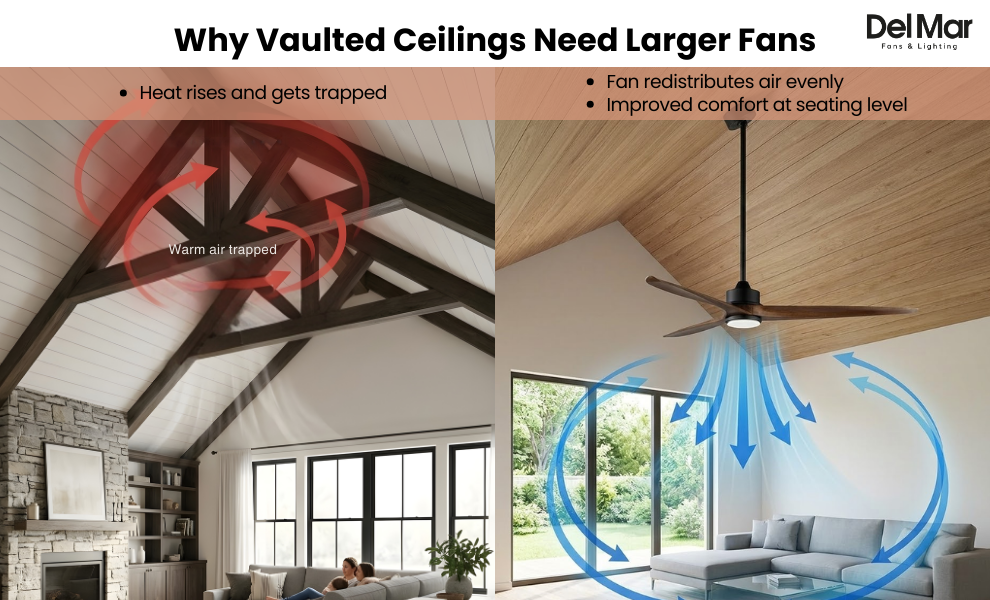
You might turn on the air conditioning and still feel warm. Or notice that certain areas of the room feel comfortable while others feel stagnant. In winter, the opposite happens: heat seems to rise, leaving the living space cooler than expected. This isn’t a flaw in your HVAC system. It’s simply how air behaves. Warm air rises. That’s a basic principle. In a standard ceiling height, the vertical distance is small, so the temperature difference isn’t dramatic. But in a vaulted ceiling, that vertical space increases significantly. Warm air collects near the highest point, while cooler air stays below. Over time, this creates layers - warm above, cool below - instead of a balanced environment. This layering is called heat stratification, and it’s the core reason vaulted ceilings need better airflow solutions.
A standard ceiling fan, especially a smaller one, struggles in this scenario. It may circulate air locally, but it doesn’t have the reach or power to move air across the full height of the room. A large blade ceiling fan for vaulted ceiling spaces approaches the problem differently. Instead of relying on speed, it relies on coverage and efficiency. With a wider blade span, each rotation moves a greater volume of air. That means the fan can pull air down from the ceiling and redistribute it evenly across the space, reducing those temperature layers. The result is cooler air and more consistent comfort. You don’t feel hot in one spot and cool in another. The room feels balanced.
And that’s really the goal of a ceiling fan in a vaulted space: not just movement, but meaningful circulation.
What Blade Size Works Best for Vaulted Ceilings

When people start shopping for ceiling fans, one of the first questions they ask is: “What size should I get?” It sounds simple, but in a vaulted ceiling, the answer depends on volume.
A room with a vaulted ceiling is wider and taller. And that added height dramatically increases the amount of air that needs to be moved. This is where blade span becomes critical.
Blade span refers to the full diameter of the fan from one blade tip to the opposite. The larger the span, the more air the fan can move in a single rotation.
In standard rooms, a smaller fan might be enough. But in vaulted ceilings, undersizing the fan is one of the most common mistakes, and one of the biggest reasons people feel like their fan “isn’t doing much.”
A larger fan moves more air more efficiently. Instead of spinning quickly and creating localized airflow, it moves a larger volume of air more gently and consistently.
| Ceiling Height | Recommended Blade Span | Application |
|---|---|---|
| 10–12 ft | 60-inch fan | Standard vaulted living rooms |
| 12–15 ft | 72-inch fan | Large open spaces or great rooms |
| 15+ ft | Focus on CFM + motor power | Extra tall ceilings |
The important thing to remember is that blade span should scale with the space - in width, and height. Because in a vaulted room, circulating an entire volume of air is crucial.
How Much CFM Is Ideal for High & Vaulted Ceilings

If blade span tells you how wide the airflow reaches, CFM tells you how powerful that airflow actually is.
CFM (Cubic Feet per Minute) measures how much air a fan can move. And in a vaulted ceiling, this number becomes incredibly important. Because the challenge is moving air through a large vertical space across the room.
Imagine trying to stir a tall glass of water with a small spoon. You can move the water, but not very effectively. Now imagine using a larger tool; suddenly, the movement becomes more noticeable and impactful.
That’s essentially what higher CFM does.
A fan with low CFM might still spin quickly, but it won’t create the kind of airflow needed to break up temperature layers. On the other hand, a fan with higher CFM moves more air with each rotation, creating a stronger and more consistent circulation pattern.
Minimum CFM Requirements
- Small vaulted spaces (200–300 sq ft)
Recommended: 4,000 – 6,000 CFM - Large open-concept rooms (300–500+ sq ft)
Recommended: 6,000 – 9,000+ CFM
Fans designed for large rooms maintain airflow efficiency while operating at moderate RPM levels, which helps reduce noise.
When evaluating a large ceiling fan for vaulted ceilings, focus on:
- CFM rating
- airflow efficiency
- blade pitch
- motor power
Choosing the Right Downrod Length for Vaulted Ceilings

One of the most overlooked aspects of ceiling fan performance has nothing to do with the fan itself - it’s where the fan is positioned.
In vaulted ceilings, it’s very common to see fans installed too close to the ceiling. It might look fine visually, but functionally, it limits how well the fan can circulate air. Airflow needs space to move. If a fan sits too high, the air it moves stays near the ceiling instead of reaching the living area. The result is a fan that looks like it’s working, but doesn’t actually improve comfort where it matters. This is why choosing the right size downrods is so important.
A downrod lowers the fan to an optimal height, typically around 8 to 9 feet above the floor. At this level, airflow can spread outward and downward, creating a more effective circulation pattern. As ceiling height increases, the downrod length needs to increase as well. It’s not just about aesthetics; it’s about positioning the fan where it can do its job properly.
Sloped & Angled Ceiling Compatibility Explained

Vaulted ceilings add height and angles. And those angles change how a fan needs to be mounted. A ceiling fan is designed to hang straight. But when the ceiling itself is sloped, the mounting system has to compensate for that angle so the fan can still operate correctly.
Not all fans are built for this.
What to Look for in Sloped Ceiling Fans?
Key features include:
- Slope compatibility rating (often up to 30° or 45°)
- Sloped ceiling adapter availability
- Longer downrod support
A properly rated vaulted ceiling fan ensures the motor remains level even when the ceiling angle is steep.
Ignoring slope ratings can lead to:
- installation difficulty
- reduced airflow efficiency
- safety risks
So when choosing a vaulted ceiling fan, slope compatibility is essential.
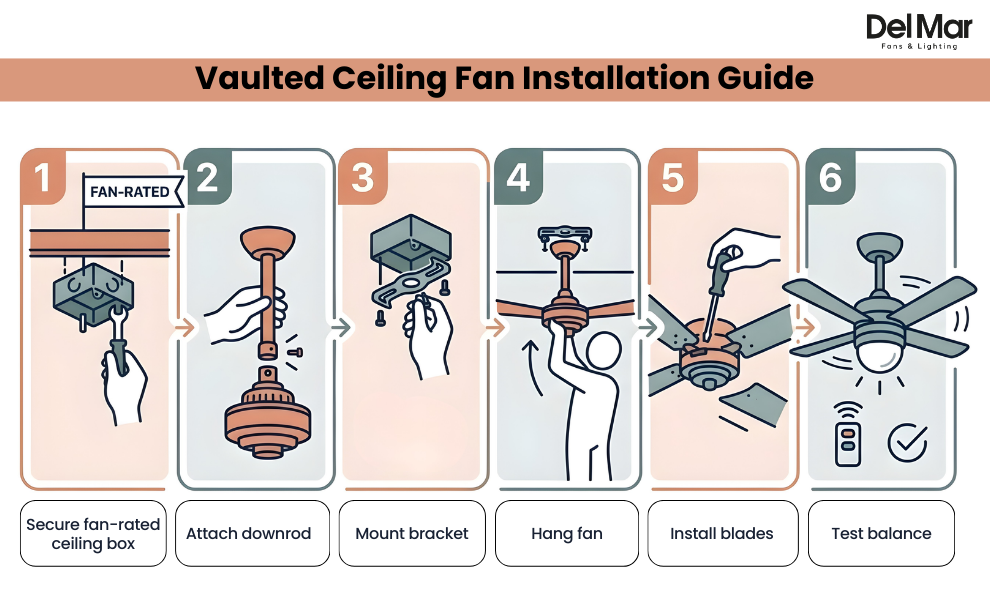
How to Install a Large Blade Ceiling Fan on a Vaulted Ceiling
Installing a ceiling fan in a vaulted ceiling follows the same general principles as a standard installation, but the added height and angle require a bit more attention to detail.
Step 1: Check Ceiling Slope
Make sure the fan supports angled ceilings.
If not, you’ll need a sloped ceiling adapter.
Step 2: Install a Fan-Rated Electrical Box
The process begins with ensuring that the ceiling can safely support the fan. Because large blade fans are heavier and generate more movement, they must be mounted to a fan-rated electrical box that is securely attached to a structural support, such as a ceiling joist or brace. This provides the stability needed to keep the fan steady over time.
Step 3: Attach Downrod to Motor
Next comes the downrod assembly. The downrod is attached to the motor housing, with wiring fed through its length. This step not only connects the fan physically but also determines its final position in the room. The mounting ball at the top of the downrod allows the fan to adjust and hang straight, even when installed on an angled ceiling.
Step 4: Mount the Fan
Once the mounting bracket is secured to the ceiling box, the fan is lifted and seated into place. Electrical connections are made, and the canopy is attached to cover the wiring and complete the installation.
Step 5: Install Blades & Testing
The final step is attaching the blades and testing the fan. At this point, it’s important to check that the fan rotates smoothly and remains stable. A properly installed fan should operate quietly and without wobble. Use a balancing kit if needed.
Because of the height involved, installing a fan in a vaulted ceiling can be more physically demanding than a standard installation. In spaces with very high ceilings, professional installation is often the safest and most practical option.
Motor Type & Efficiency for Large Blade Fans
When dealing with large blade fans, the motor becomes increasingly important.
A larger blade span requires more torque to move efficiently, and the motor must be able to handle that without generating excess noise or consuming unnecessary energy.
Motor performance becomes increasingly important as blade span increases.
| Feature | DC Motor | AC Motor |
|---|---|---|
| Energy consumption | Lower | Higher |
| Noise level | Very quiet | Moderate |
| Speed control | More speeds | Limited |
| Efficiency | Higher | Standard |
DC motors are commonly preferred for large blade ceiling fans for vaulted ceilings because they provide stronger airflow with lower energy usage. They are also known for smooth operation and quieter performance.
Noise Levels & Airflow Balance in Large Fans
Many buyers assume that more blades automatically mean quieter performance. In reality, fan balance and aerodynamic blade design play a larger role in noise reduction.
Why Fan Balance Matters More Than Blade Count
Well-designed large fans feature:
- precision-balanced blades
- optimized blade pitch
- stable motor housings
Poorly balanced fans may cause:
- wobbling
- vibration
- uneven airflow
High-quality high ceiling ceiling fans are engineered to move air efficiently while maintaining noise-free operation.
When noise does occur, it’s usually due to imbalance rather than size. Even a small misalignment in the blades can create wobbling or vibration.
That’s why build quality and proper installation matter so much. A well-balanced fan should feel smooth and almost effortless in its movement.
Modern vs Traditional Large Blade Fans for Vaulted Ceilings
Because vaulted ceilings create visual height, fan style should complement the architectural scale of the room.
Modern Ceiling Fan Design
Modern fans typically feature:
- minimal blade count
- aerodynamic blade shapes
- matte or metallic finishes
These designs suit contemporary interiors and large open spaces.
Traditional Ceiling Fan Styles
Traditional fans often include:
- decorative motor housings
- carved or wood blades
- classic finishes like bronze or brushed nickel
These styles complement rustic, farmhouse, and classic interiors.
Best Large Blade Ceiling Fans for Vaulted Ceilings
When selecting a fan, it helps to think in terms of both performance and style.
In modern spaces, larger fans with high airflow and efficient motors tend to provide the best balance of function and design. In more traditional settings, fans with wood finishes and classic detailing offer a better visual match while still delivering strong airflow.
The goal is to choose a fan that not only performs well, but also feels like a natural part of the space.
Matthews Ariella 64″ ceiling fan

The Matthews Ariella 64″ ceiling fan is a powerful, design-forward option for vaulted ceilings and large spaces. Featuring an eight-blade configuration, it delivers strong airflow up to around 6,800 CFM while maintaining quiet performance. Its DC motor ensures energy efficiency, and the wet-rated construction makes it suitable for indoor or outdoor use. With a sloped ceiling canopy and multiple finish options, it blends performance with versatile design.
Hinkley Indy 72"

The Hinkley Indy 72″ ceiling fan stands out with its bold, industrial-inspired design and sleek three-blade profile, making it a striking addition to vaulted ceilings and open spaces. Equipped with a WiFi-enabled DC motor and 6-speed control, it offers precise airflow adjustment and smart home compatibility. Designed for sloped ceilings up to 20 degrees and rated for indoor/outdoor use, it combines modern functionality with architectural presence.
Maxim Fans Condor 65"

The Maxim Condor 65″ ceiling fan combines an expansive eight-blade design with strong, steady airflow, making it ideal for vaulted ceilings and larger rooms. Its high-efficiency DC motor delivers up to 8,200+ CFM while maintaining quiet operation and low energy use. With an 18° blade pitch and wet-rated construction, it’s built for both indoor and outdoor spaces, offering reliable performance and a clean, contemporary look.
Common Mistakes to Avoid When Installing Ceiling Fans on Vaulted Ceilings
Installing a fan on a vaulted ceiling requires careful planning. Some mistakes can significantly reduce airflow performance.
Avoid these issues:
- Choosing a blade span that is too small
- Using an incorrect downrod length
- Ignoring slope compatibility
- Prioritizing blade count instead of airflow (CFM)
Proper sizing and installation are critical for maximizing the performance of a large blade ceiling fan for vaulted ceiling spaces.
What to Choose for Vaulted Ceilings
A well-chosen ceiling fan can completely transform how a vaulted room feels.
By selecting the right blade size, ensuring strong airflow, and installing the fan at the correct height, you create a space that feels balanced, comfortable, and easy to live in.
In the end, it’s not just about moving air — it’s about making the space feel right.
FAQs
What size ceiling fan is best for vaulted ceilings?
Most vaulted ceilings perform best with 60–72 inch blade span fans, depending on room size and ceiling height.
How many blades are best for a vaulted ceiling fan?
Blade count matters less than airflow performance. Well-designed 3–5-blade fans can deliver excellent airflow when paired with strong motors.
Do vaulted ceilings need higher CFM fans?
Yes. Because vaulted ceilings contain more air volume, higher CFM fans (6,000+ CFM) help circulate air more effectively.
Can any ceiling fan be installed on a sloped ceiling?
No. Only fans rated for sloped or angled ceiling installation should be used unless a compatible adapter is available.
What downrod length works for high ceilings?
Downrod length depends on ceiling height. The goal is to position the fan 8–9 feet above the floor.
Are large blade fans noisy?
High-quality large fans are typically quiet because they move more air at lower speeds, reducing noise and vibration.
