


Open-concept homes create bright, connected living spaces where the kitchen, dining room, and living area flow together seamlessly. While this layout makes a home feel larger and more inviting, it also requires a different approach when choosing and placing ceiling fans.
Unlike traditional rooms, open-concept spaces often include multiple activity zones, varying ceiling heights, and larger areas to serve. The right ceiling fan strategy isn't simply about choosing the biggest fan—it's about selecting the right size, deciding whether you need one or multiple fans, and placing them where they'll provide the most comfort.
In this guide, you'll learn how to plan ceiling fans for an open-concept home, from choosing the right fan size and placement to understanding the features that matter most, so you can create a space that's both comfortable and beautifully designed.
Step 1: Understand Your Space Before Choosing a Ceiling Fan
Before you start comparing finishes, blade spans, or smart features, take a few minutes to understand how your space functions. This simple planning step will help you choose ceiling fans that not only look right but also support the way your home is used every day.
Unlike traditional homes with separate rooms, an open-concept layout combines several living areas into one continuous space. While everything feels connected, each area still serves a different purpose. The living room is designed for relaxing, the dining area for gathering around meals, and the kitchen for cooking and entertaining. Because these spaces are used differently, they don't all have the same comfort requirements.
Instead of thinking about your home as one large room, think of it as a collection of activity zones. This mindset makes it much easier to decide how many ceiling fans you need, where they should be installed, and what size will work best for each part of the home.
Identify Your Activity Zones
Walk through your home and look at how the space is naturally divided—not by walls, but by furniture and everyday use.
Typical activity zones include:
- Living Area – Sofas, sectionals, media walls, and conversation spaces.
- Dining Area – Dining table or breakfast space used for everyday meals and entertaining.
- Kitchen – Islands, prep areas, and spaces where family and guests naturally gather.
- Flexible Spaces – Reading nooks, home office corners, or game areas that share the same open layout.
These zones don't always need their own ceiling fan, but identifying them is the first step toward creating a balanced ceiling fan plan.
Designer Tip: Imagine removing every ceiling fixture from the room. If you can still clearly identify separate living, dining, and kitchen areas based on the furniture layout, you've already identified your activity zones.
Think Beyond Square Footage
One of the most common mistakes homeowners make is choosing a ceiling fan based only on the total square footage of their open floor plan.
Imagine two homes that are both 800 square feet. One is a wide, square great room with a central seating area, while the other is a long layout that connects the kitchen, dining room, and living room in a straight line. Although they have the same square footage, they'll likely need very different ceiling fan strategies.
The shape of the room, the location of furniture, and how people move through the space all influence where ceiling fans should be placed. In many cases, it's more effective to plan around individual activity zones than to treat the entire floor plan as one oversized room.
That's why professional lighting and ceiling fan plans begin with the layout, not the fixture itself.
Questions to Ask Before You Buy
A few simple questions can help you narrow your options before you begin shopping.
✔ Where does your family spend the most time?
✔ Is there one main seating area or several gathering spaces?
✔ Does the kitchen island double as a dining or entertaining area?
✔ Are the ceilings standard height, vaulted, or two-story?
✔ Is the layout square, rectangular, or L-shaped?
✔ Will one fan comfortably serve the space, or would multiple fans create a better balance?
Taking a few minutes to answer these questions will make the rest of your planning much easier.
Why Planning First Saves Time and Money
Choosing a ceiling fan before understanding your space often leads to disappointing results. Homeowners may install a fan that's too small for the area, place it where it doesn't serve the main seating area, or realize later that a second fan would have created a more balanced layout.
Starting with a simple plan helps you avoid costly changes later and makes it easier to compare ceiling fan sizes, styles, and features with confidence.
Once you understand how your home is organized, the next decision becomes much simpler:
Do you need one ceiling fan or several?
Step 2: Decide Whether You Need One Ceiling Fan or Multiple
There's no universal rule for how many ceiling fans an open-concept home should have. The right answer depends on how your space is laid out, where people spend the most time, and how large each activity zone is.
Many homeowners assume one oversized fan can handle the entire space, while others install multiple fans without considering whether they're actually necessary. Both approaches can lead to disappointing results.
Instead of asking "How many ceiling fans do I need?", ask yourself:
"How many distinct living spaces am I trying to make comfortable?"
Once you have identified your activity zones, choosing the right number of ceiling fans becomes much clearer.
When One Ceiling Fan Is the Right Choice
A single ceiling fan works well when the open-concept layout functions as one primary living area rather than several separate destinations.
For example, many apartments, condominiums, and smaller open floor plans combine the living room, dining area, and kitchen into one compact space. Because these areas are closely connected, one properly sized ceiling fan can often provide comfortable coverage.
A single ceiling fan is usually a good choice when:
- The layout is relatively compact.
- Most daily activities happen in one shared space.
- The seating area is centrally located.
- Ceiling heights are standard.
- Furniture doesn't naturally divide the room into separate zones.
The key is choosing a fan that's appropriately sized for the area it serves, not simply the largest model available.

Homes with a single shared living space benefit from a ceiling fan that balances performance with scale. The Hinkley Indy 72" smart fan is an excellent example, offering a 72-inch blade span that's ideal for many open-concept layouts. It provides consistent air movement across connected living areas to help minimize hot spots while maintaining a streamlined, contemporary look that suits modern interiors without overwhelming the space.
When Multiple Ceiling Fans Are a Better Solution
As homes become larger, the way people use the space also changes.
Instead of one shared gathering area, you may have a dedicated living room, formal dining table, oversized kitchen island, reading corner, or game area—all within the same open floor plan.
Rather than expecting one ceiling fan to serve every corner, it's often more effective to assign each major activity zone its own fan.
This approach creates more balanced comfort throughout the home while allowing each fan to operate at a comfortable speed.
Multiple ceiling fans are commonly recommended for:
- Large great rooms
- Homes with clearly defined living and dining areas
- Long or rectangular floor plans
- L-shaped layouts
- Open-concept homes with vaulted or two-story ceilings
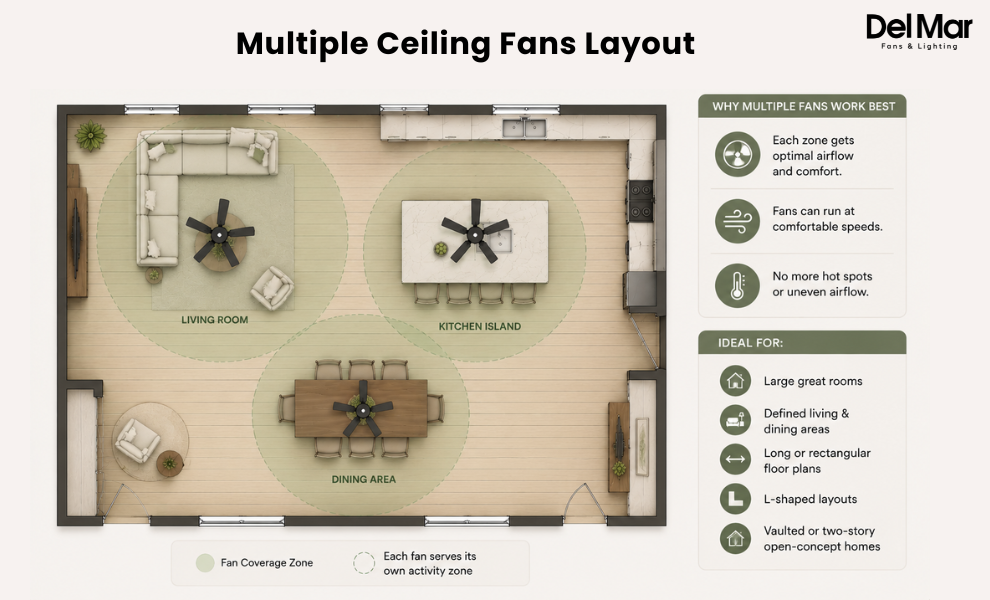
Rather than relying on one oversized ceiling fan, consider using multiple fans that complement both your layout and your interior style. The Hinkley Speck 52" ceiling fan is an excellent example, with a versatile 52-inch blade span that's ideal for individual activity zones within a larger open-concept home. Installing matching fans throughout the living, dining, and kitchen areas creates balanced comfort while maintaining a cohesive, modern look across connected spaces.
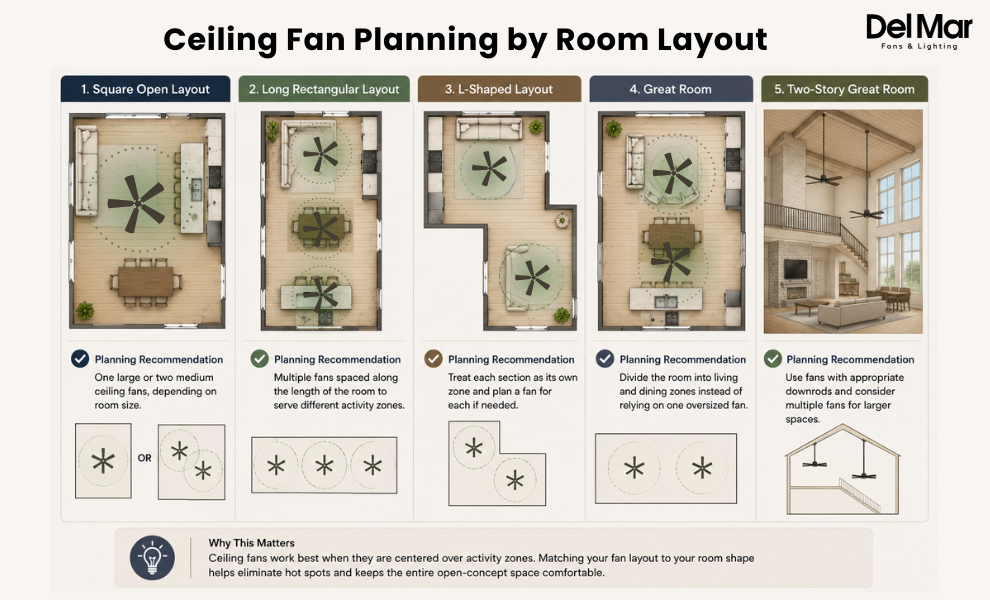
Which Layout Looks Most Like Your Home?
The shape of your room often has a greater impact on ceiling fan planning than the total square footage.
Use the guide below to identify the layout that most closely matches your home.
| Room Layout | Ceiling Fan Recommendation |
|---|---|
| Square Open Layout | One large or two medium ceiling fans, depending on room size. |
| Long Rectangular Layout | Multiple fans spaced along the length of the room to serve different activity zones. |
| L-Shaped Layout | Treat each section as its own zone and plan a fan for each if needed. |
| Great Room | Divide the room into living and dining zones instead of relying on one oversized fan. |
| Two-Story Great Room | Use fans with appropriate downrods and consider multiple fans for larger spaces. |
Bigger Isn't Always Better
One of the biggest misconceptions about ceiling fans is that installing the largest model available will automatically create a more comfortable space.
In reality, an oversized fan isn't always the best solution.
A fan that's too large may dominate the room visually, while still leaving distant activity zones underserved. In many larger homes, two appropriately sized ceiling fans create a more balanced design and better everyday comfort than one oversized fixture.
Think about your home's lighting for a moment. You wouldn't expect a single chandelier to illuminate an entire open-concept floor plan. Instead, you layer lighting with pendants, recessed lights, and wall sconces to support different areas of the room.
Ceiling fans work much the same way. Planning them around activity zones creates a more intentional design and a more comfortable living experience.
Designer Tip: When multiple ceiling fans are visible from the same space, choose models from the same collection or with similar blade finishes and proportions. They don't have to be identical, but they should feel coordinated to maintain a cohesive look throughout the home.
Watch for Hot Spots in Larger Open-Concept Homes
One of the biggest signs that your ceiling fan strategy needs rethinking is the presence of hot spots—areas that consistently feel warmer or less comfortable than the rest of the room.
In large open-concept homes, hot spots often develop because one ceiling fan can't evenly serve every activity zone. The living room may feel comfortable while the dining area or kitchen island remains noticeably warmer, particularly during gatherings or meal preparation.
Rather than simply increasing the fan speed, it's often more effective to rethink your ceiling fan layout. Adding a second ceiling fan or repositioning the existing one can create more balanced coverage and improve comfort where people actually spend time.
Common locations for hot spots include:
- Seating areas beside large windows
- Kitchen islands during cooking
- Dining spaces beyond the fan's reach
- Corners of long or L-shaped floor plans
- Great rooms with high or vaulted ceilings
Designer Tip: If one part of your open-concept home always feels less comfortable than the rest, don't assume you need a larger ceiling fan. It may simply be a sign that the space would benefit from an additional fan serving that activity zone.

Step 3: Plan the Best Ceiling Fan Placement
Choosing the right number of ceiling fans is only part of the equation. Where you install them has just as much impact on comfort, performance, and the overall look of your space.
Unlike traditional homes where each room has a clear center point, open-concept layouts require a more thoughtful approach. Furniture arrangements, lighting, architectural features, and everyday activities all influence the ideal placement.
Rather than centering every fan in the middle of the ceiling, position each one where people spend the most time.
Living Room: Center the Fan Around the Seating Area
Instead of automatically centering the fan in the room, center it over the main seating arrangement. Whether the room is arranged around a television, fireplace, or conversation area, the fan should support that layout rather than the room's geometry.
Best Practice:
- Install the fan above the primary seating area.
- Choose a size that's proportionate to the furniture arrangement.
- Coordinate the fan with nearby lighting fixtures for a balanced ceiling design.
Avoid:
- Centering the fan over empty floor space simply because it's the middle of the room.
- Placing the fan too close to walls or tall cabinets.
Designer Tip: If your sectional sofa is positioned closer to one side of the room, let the furniture, not the ceiling, determine the fan's location.
Dining Room: Create Gentle, Comfortable Air Movement
Dining rooms don't require the same level of air movement as living areas. Instead, the goal is to create a comfortable environment where family and guests can enjoy meals without feeling a strong breeze.
If your dining area has its own ceiling fan, position it directly above the center of the dining table. This creates even coverage while keeping the fixture visually aligned with the furniture below.
Best Practice:
- Center the fan above the dining table.
- Operate at lower speeds during meals.
- Keep the fan visually aligned with the table rather than the overall room.
Avoid:
- Positioning the fan too close to a chandelier or pendant light.
- Installing an oversized fan that visually overwhelms the dining space.
Designer Tip: If your dining room already features a statement chandelier, choose a ceiling fan with a clean, understated design so the two fixtures complement rather than compete with each other.
Kitchen: Focus on Gathering Spaces, Not the Cooktop
The kitchen has become one of the busiest areas in today's open-concept homes. It's where meals are prepared, conversations happen, and guests naturally gather around the island.
When installing a ceiling fan, think about where people spend time—not where appliances are located.
A fan is typically most effective above a kitchen island or an open walkway where it can improve comfort without interfering with the range hood or cooking area.
Best Practice:
- Position the fan above the kitchen island or seating area.
- Coordinate placement with pendant lights and recessed lighting.
- Leave adequate clearance from upper cabinets and surrounding fixtures.
Avoid:
- Installing a fan directly above the cooktop or range.
- Crowding the ceiling with oversized fans and decorative lighting.
Designer Tip: In kitchens with oversized islands, let the island lighting be the focal point and choose a ceiling fan that complements the overall design without dominating it.
Great Rooms: Think in Zones Instead of One Large Space
Great rooms often combine the living room, dining area, and kitchen beneath one expansive ceiling. While they feel like one impressive space, they are rarely used as one continuous room.
Instead of relying on a single oversized ceiling fan, divide the room into functional zones.
For example:
- One fan serving the main seating area.
- One fan centered over the dining space.
- A third fan supporting the kitchen or casual gathering area, if the layout is large enough.
This approach creates a more balanced design while allowing each fan to operate comfortably at lower speeds.
Best Practice:
- Divide the room into separate activity zones.
- Maintain visual symmetry when multiple fans are visible.
- Select fans from the same collection or with similar finishes for a cohesive look.
If your great room has large sliding patio doors or windows on opposite sides, take advantage of natural cross ventilation during mild weather. Fresh outdoor air, combined with thoughtfully placed ceiling fans, helps maintain a more comfortable environment across each activity zone.
Avoid:
- Assuming one oversized fan can comfortably serve every part of a large great room.
- Mixing drastically different fan styles within the same open space.
Vaulted & High Ceilings: Plan for Scale
Vaulted ceilings add drama and openness to a home, but they also require a different approach to ceiling fan installation.
The most common mistake is choosing the correct fan but mounting it too close to the ceiling. This often leaves the fan visually disconnected from the living space below and reduces its effectiveness where people actually gather.
Using the appropriate downrod helps position the fan at a comfortable height while keeping it proportional to the room.
Ceiling Height Guide
| Ceiling Height | Recommended Installation |
|---|---|
| 8 ft | Flush mount or low-profile fan. |
| 9–10 ft | Short downrod. |
| 10–12 ft | Standard downrod. |
| Over 12 ft | Longer downrod sized for the ceiling height. |
Designer Tip: In two-story great rooms, the ceiling fan should feel connected to the living space—not lost near the ceiling. The right downrod creates better proportions and a more intentional design.
Step 4: Choose the Right Ceiling Fan
With your layout planned and fan locations mapped out, it's time to choose the right ceiling fans for each space.
A beautiful ceiling fan can become a focal point in an open-concept home, but appearance should never be the only deciding factor. The best fan balances size, performance, functionality, and style to suit the room it serves.
Instead of getting overwhelmed by technical specifications, focus on answering five simple questions.
Pro Tip: Don't Overlook the Rest of the Room
Your ceiling fans will perform even better when paired with a few simple habits:
- Keep HVAC supply and return vents clear.
- Replace HVAC filters regularly.
- Use kitchen exhaust fans while cooking.
- Open windows on opposite sides of the home during mild weather to encourage natural cross ventilation.
- Adjust ceiling fan direction seasonally for year-round comfort.
1. What Size Ceiling Fan Do I Need in Open-Concept Home?
Choosing the right size is one of the most important decisions you'll make. A fan that's too small may look out of proportion and struggle to provide comfortable air movement, while an oversized fan can overwhelm smaller spaces visually.
For the best results, measure the dimensions of the activity zone each ceiling fan will serve, not the total square footage of the entire open-concept home. If you are installing multiple fans, size each one independently based on its designated living, dining, or kitchen area.
General Ceiling Fan Size Guide
| Activity Zone | Recommended Blade Span |
|---|---|
| Breakfast nook or reading area | 44–52 inches |
| Dining room | 52–56 inches |
| Living room | 52–60 inches |
| Great room | 60–72 inches |
| Large open-concept homes | Multiple fans instead of one oversized model. |
These recommendations are a starting point. Always review the manufacturer's room-size guidelines for the specific model you are considering.
Designer Tip: If you're deciding between one large fan and two medium-sized fans, consider how the room is used. Multiple fans often create a more balanced design while giving you greater flexibility over each activity zone.
2. Is CFM More Important Than Blade Span?
If you've been shopping for ceiling fans, you've probably noticed CFM listed alongside blade span.
While blade span tells you how large the fan is, CFM (Cubic Feet per Minute) tells you how much air the fan moves.
A simple way to think about it is:
- Blade span determines the fan's physical size.
- CFM measures its performance.
Two ceiling fans with the same blade span can produce very different airflow depending on their blade design, pitch, and motor efficiency.
When comparing similar-sized fans, CFM is often the better indicator of overall performance.
Blade Span vs. CFM
| Blade Span | CFM (Cubic Feet per Minute) |
|---|---|
| Indicates the physical diameter of the fan. | Indicates how much air the fan moves. |
| Helps determine the fan's visual scale. | Helps compare airflow performance. |
| Should match the size of the activity zone. | Should match your airflow and comfort needs. |
You don't need to chase the highest CFM available. Instead, look for a fan that delivers the right balance of performance for the area it will serve.
Pro Tip: Compare CFM only between fans of a similar size. A larger blade span naturally moves air differently than a smaller fan, so comparing vastly different models isn't always meaningful.
3. Do I Need a Downrod?
Ceiling height doesn't just influence how a fan looks—it also affects how it should be mounted.
The goal is to position the fan so it feels visually connected to the room while maintaining the recommended clearance from the floor.
Ceiling Height Recommendations
| Ceiling Height | Mounting Recommendation |
|---|---|
| 8 feet | Flush mount or low-profile fan. |
| 9–10 feet | Short downrod. |
| 10–12 feet | Standard downrod. |
| Over 12 feet | Longer downrod sized to the ceiling height. |
Many ceiling fans designed for vaulted ceilings also require a sloped-ceiling adapter, so it's worth confirming compatibility before making your purchase.
Pro Tip: A properly sized downrod doesn't just improve the fan's proportions—it also helps create a more intentional look in rooms with high ceilings.
4. Should I Choose an AC or DC Motor?
Most modern ceiling fans are powered by either an AC (Alternating Current) motor or a DC (Direct Current) motor.
Both provide dependable performance, but each offers different advantages.
| AC Motor | DC Motor |
|---|---|
| Reliable everyday performance. | Quieter operation. |
| Wide variety of styles. | More energy efficient. |
| Often lower upfront cost. | More speed settings. |
| Proven technology. | Smooth, precise speed control. |
If you're furnishing a primary living space where the fan may run for extended periods, a DC motor is often worth considering for its quiet operation and energy efficiency.
For many homeowners, however, an AC motor fan remains an excellent choice and offers a wider selection of styles and finishes.
5. Do I Need an Integrated Light?
Open-concept homes often rely on layered lighting rather than a single ceiling fixture.
Before choosing a ceiling fan with an integrated LED light, think about how the rest of the room is illuminated.
An integrated light kit works well when the fan will provide:
- General room lighting
- Everyday task lighting
- A clean, simplified ceiling design
However, if your space already includes recessed lighting, pendants over the kitchen island, and a chandelier above the dining table, a fan without a light kit may create a cleaner, less crowded ceiling.
There's no right or wrong choice, it depends on your lighting plan.
Designer Tip: Look up before you shop. If your ceiling already includes several decorative fixtures, a fan without a light kit often creates a more balanced composition.
6. Are Smart Ceiling Fans Worth It?
Smart ceiling fans have become increasingly popular, particularly in newer homes where lighting, climate, and security systems are already connected.
Depending on the model, smart features may include:
- Smartphone app control
- Voice assistant compatibility
- Scheduling
- Timer functions
- Remote operation
- Smart home integration
While these features aren't essential, they do make it easier to adjust fan settings without leaving your seat or to automate comfort throughout the day.
If you're already building a connected home, a smart ceiling fan is a natural addition.
Choose a Fan That Fits Your Style
Performance matters, but so does appearance, especially in an open-concept home where ceiling fans are visible from multiple rooms.
Choose a style that complements your home's architecture and nearby lighting fixtures.
a. Modern Homes
- Clean lines
- Matte black or white finishes
- Integrated LED lighting
- Minimal hardware
b. Transitional Homes
- Soft curves
- Mixed finishes
- Versatile blade designs
- Timeless silhouettes
c. Farmhouse & Rustic Homes
- Natural wood blades
- Warm metallic finishes
- Larger blade spans
- Textured details
d. Coastal Homes
- Light wood tones
- White finishes
- Relaxed, airy profiles
When multiple ceiling fans are visible from the same space, consistency creates a more polished look. They don't have to be identical, but they should share a similar design language, finish, or blade style.
Things to Care Before You Buy Ceiling Fan for Open-Concept Homes
Before adding a ceiling fan to your cart, run through this quick checklist:
- Is it the right size for the activity zone?
- Does its CFM match your performance expectations?
- Is it compatible with your ceiling height?
- Do you prefer an AC or DC motor?
- Will an integrated light improve your lighting plan?
- Do smart features fit your lifestyle?
- Does the finish coordinate with nearby fixtures?
Taking a few extra minutes to answer these questions will help you choose a ceiling fan that not only looks beautiful but also performs well for years to come.
Step 5: Avoid These 7 Ceiling Fan Planning Mistakes
Even with the right ceiling fan, a few planning mistakes can affect both the appearance of your space and your everyday comfort. Fortunately, they're also some of the easiest mistakes to avoid.
1. Choosing a Ceiling Fan Before Planning the Room
It's tempting to fall in love with a particular style or finish and make that the starting point. However, successful ceiling fan planning always begins with the room itself.
Before comparing finishes or features, identify your activity zones, furniture layout, ceiling height, and whether the space calls for one fan or multiple.
Better approach: Plan the room first, then choose the ceiling fan that fits it.
2. Buying Based Only on Blade Span
Blade span tells you how large a fan is, but it doesn't tell you how well it performs.
Two 60-inch ceiling fans can have noticeably different airflow performance depending on blade design, motor efficiency, and CFM.
Better approach: Compare both blade span and CFM before making a decision.
3. Assuming One Fan Can Serve Every Space
Large open-concept homes often include multiple gathering areas. Trying to cover the entire space with one oversized fan may leave some areas less comfortable while creating unnecessary visual weight in others.
Better approach: If your home naturally divides into separate living, dining, and kitchen zones, consider planning each area individually.
4. Forgetting to Plan Around Lighting
Ceiling fans are only one part of your ceiling design.
Pendant lights above the kitchen island, chandeliers over the dining table, recessed lighting, and ceiling fans should work together instead of competing for attention.
Better approach: Look at the ceiling as a complete design before deciding where each fixture belongs.
5. Choosing the Wrong Mounting Option
A flush-mount fan works beautifully in a room with an 8-foot ceiling but may look out of place in a vaulted great room.
Likewise, using an unnecessarily long downrod in a standard-height room can make the ceiling feel crowded.
Better approach: Match the mounting option to your ceiling height rather than using the same installation style throughout the home.
6. Mixing Too Many Fan Styles
Because open-concept homes have uninterrupted sightlines, several ceiling fans are often visible at the same time.
A sleek modern fan in the living room paired with a rustic farmhouse design over the dining area can make the overall space feel disconnected.
Better approach: Choose fans that share a similar design language, finish, or blade style for a cohesive appearance.
7. Forgetting About Everyday Living
The most beautiful ceiling fan won't feel successful if it doesn't suit your lifestyle.
Think about how you use your home every day.
- Do you entertain often?
- Do family members gather around the kitchen island?
- Do you prefer integrated lighting?
- Would smart controls make daily operation easier?
The best ceiling fan isn't simply the most powerful or the most expensive—it's the one that supports the way you live.

In conclusion...
Planning ceiling fans for an open-concept home isn't about finding the biggest fan or following a one-size-fits-all formula. It's about understanding how your home functions and choosing ceiling fans that support the way you live.
Start by identifying your activity zones, then decide whether one fan or multiple fans best suit your layout. From there, focus on thoughtful placement, appropriate sizing, ceiling height, and features that complement your lifestyle and interior design.
By taking a planning-first approach, you will create spaces that not only look cohesive but also feel comfortable every day. Whether you are furnishing a newly built home or updating an existing one, with the right plan in place, your ceiling fans become more than functional fixtures. They help define spaces, complement your interior design, and create a home that's comfortable in every season.
