


The best number of ceiling fan blades is usually three or four for most homes. This setup delivers strong airflow efficiency, balanced motor performance, and lower energy consumption. Three-blade fans typically offer higher airflow efficiency because they create less aerodynamic drag, while four-blade fans provide quieter and more balanced performance. However, blade pitch, motor efficiency, and CFM ratings ultimately matter more than blade count alone.
Here’s the thing. More blades do not automatically mean better airflow. The real performance of a fan depends on blade pitch angle, motor efficiency, rotational speed, and overall design.
Let’s break it down clearly so you can choose the right ceiling fan blade count for your space.
Does Blade Count Really Matter?
Yes, but not in the way most people think.
When people ask how many blades a ceiling fan should have, they often assume more blades equal more air. In reality, airflow is measured in cubic feet per minute (CFM). That number tells you how much air the fan moves.
A fan with three well-designed blades can outperform a five-blade fan if the motor is stronger and the blade pitch angle is optimized. In fact, many of the most energy-efficient ceiling fans focus more on motor performance, aerodynamic blade design, and balanced engineering rather than simply increasing blade count.
Quick Definition Block
- Ceiling fan blade count refers to the total number of blades attached to the motor housing.
- CFM (cubic feet per minute) measures how much air the fan circulates.
- Blade pitch angle is the angle of the blade relative to the horizontal, which affects how much air it pushes.
What this really means is that blade design and motor strength matter more than sheer quantity.
Ceiling Fan Blade Comparison: 2, 3, 4, or 5 Blades

Let’s practically compare common options.
Two-Blade Fans
- Modern ceiling fan design
- Lower aerodynamic drag
- Higher rotational speed (RPM)
- Slightly more visible wobble if the balance is off
These are often chosen for contemporary interiors. They can deliver excellent ceiling fan blades airflow when engineered properly.
Kichler Link 2-Blade Ceiling Fan

Sleek, sculptural, and undeniably modern, the Kichler Link 2-blade ceiling fan redefines what a ceiling fan can look like. Designed with just two striking blades, this 54-inch fan creates a bold visual statement while delivering airflow comparable to a traditional five-blade design.
Its signature open-air circular center forms a dramatic focal point, seamlessly connecting the motor housing and blades for a clean, architectural silhouette. The result? A fan that feels light, balanced, and effortlessly contemporary, perfect for modern and transitional interiors.
- Crafted with durable ABS blades and available in multiple refined finishes, each option is thoughtfully paired for a cohesive look:
- Natural Brass with Cherry blades
- Brushed Nickel with Silver blades
- Oil Brushed Bronze with Dark Oak blades
- Polished Nickel with Walnut blades
Three-Blade Fans
- Excellent airflow efficiency
- Lower motor strain
- Strong energy performance
- Popular in minimalist spaces
This is often considered the sweet spot for performance and design.
Matthews Irene 3-Blade Ceiling Fan

The Matthews Irene 42" ceiling fan with remote and wall control makes a statement with its striking three-blade design. Crafted with solid wood barnwood-tone blades, this 42" fan blends rustic warmth with modern minimalism. Its spherical motor housing and streamlined profile create a clean, sculptural look.
Powered by an energy-efficient DC motor, it features six speeds, a reversing function, and both wall and remote controls. Damp-rated and sloped-ceiling compatible, it’s built for stylish, versatile performance.
Four-Blade Fans
- Balanced airflow and aesthetics
- Slightly quieter operation
- Good indoor air circulation for bedrooms
Four blades offer strong ceiling fan blade performance without significantly increasing energy consumption.
Hunter Dempsey

The Hunter Dempsey 4-Blade ceiling fan with remote brings modern style and powerful performance together in one sleek design. This 4-blade fan features reversible Black Oak/Chocolate Oak composite blades that add bold contrast and versatility to your space. With a 52-inch blade span, it’s perfect for cooling large rooms while the low-profile housing keeps the look clean and streamlined. Finished in Desert Platinum, it includes a three-speed motor, universal remote control, and manual reversing switch for year-round comfort and effortless control.
Five-Blade Fans
- Traditional ceiling fan styles
- Slightly reduced RPM due to added weight
- Often quieter at lower speeds
- More visual symmetry
They look full and classic, but airflow does not automatically improve with that extra blade.
Tempo 5-Blade Tempo Hugger Ceiling Fan

The Craftmade Tempo 5-blade hugger ceiling fan is the perfect fit for smaller rooms and low ceilings. This sleek 5-blade fan features white plywood blades and a clean, contemporary profile that blends effortlessly into modern interiors. Designed for indoor use, it includes integrated LED downlighting for efficient, long-lasting illumination. Crafted with durable silicon steel and finished in crisp white, it comes with a three-speed remote, wall control, full-range light dimming, and a reverse function for year-round comfort.
Comparison Summary Table

What Affects Ceiling Fan Blade Performance More Than Blade Count?
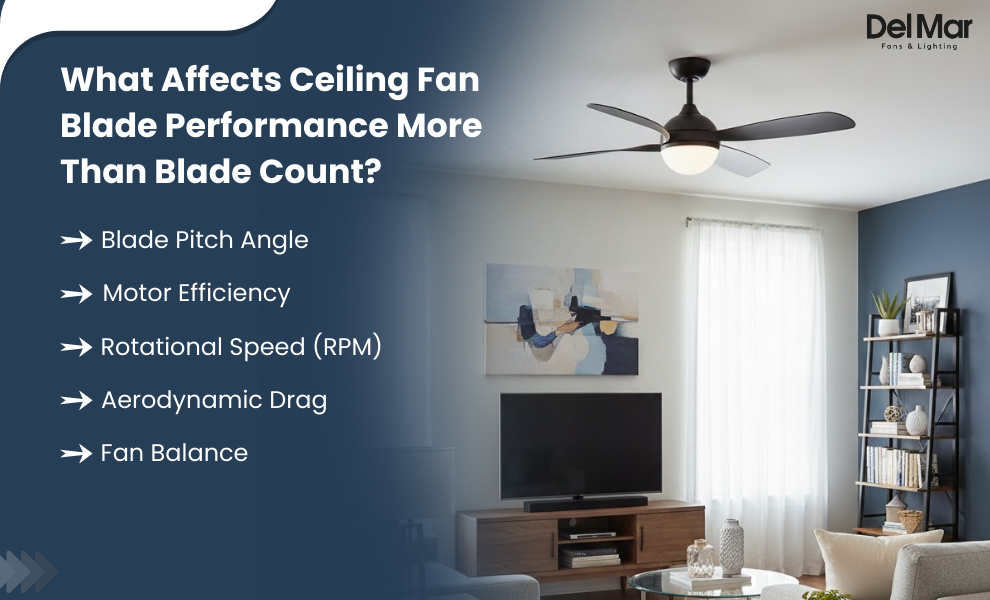
1. Blade Pitch Angle
Most high-performing fans have a pitch between 12 and 15 degrees.
- Too flat and the fan moves little air.
- Too steep and the motor strains, increasing energy consumption.
2. Motor Efficiency
A high-quality motor maintains stable RPM without overheating. Better motor efficiency means stronger airflow at lower power usage.
3. Rotational Speed (RPM)
Higher RPM increases airflow, but only if the blades are aerodynamically shaped.
4. Aerodynamic Drag
Adding more blades increases drag. More drag can reduce speed and strain the motor.
5. Fan Balance
Improper balance increases noise levels and reduces overall performance. A well-balanced three-blade fan often feels smoother than a poorly aligned five-blade model.
Here’s the bottom line. Blade engineering and motor quality define real performance.
Choosing Based on Room Size Compatibility

The best number of ceiling fan blades also depends on room size and ceiling height.
Small Rooms (Up to 100 sq ft)
- 2 or 3 blades
- Lower CFM required
- Compact motor housing
Medium Rooms (100 to 300 sq ft)
- 3 or 4 blades
- Balanced airflow
- Moderate RPM
Large Rooms (300+ sq ft)
- Focus on high CFM rating
- Blade span matters more than blade count
- Strong motor efficiency required
Ceiling height also matters when selecting the right ceiling fan size. For standard 8-foot ceilings, proper mounting height improves indoor air circulation more effectively than simply adding extra blades.
Airflow, Noise, and Energy Consumption
Many assume that more blades reduce noise levels. That can be true at lower speeds because the fan can move sufficient air without spinning as fast.
However, increased blade count also means more weight. More weight means the motor works harder. That can increase energy consumption if the motor is not efficient.
If you want quiet operation:
- Look for high CFM at low RPM
- Check motor quality
- Ensure proper fan balance
If you want energy savings:
- Choose a fan with a strong motor efficiency
- Do not rely on blade count alone
Modern vs Traditional Design Considerations
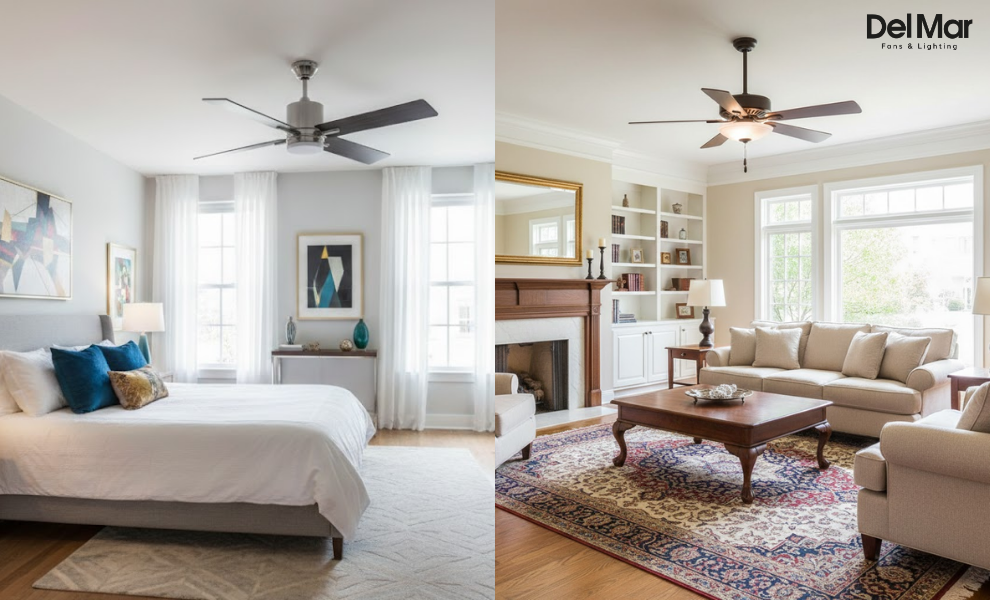
Modern ceiling fan design often favors 2 or 3 blades. The look is minimal, clean, and architectural.
Traditional ceiling fan styles usually feature 4 or 5 blades for visual fullness. The design feels balanced and classic.
This is not just about airflow. It is about how the fan fits your interior.
Ask yourself:
- Do you want visual simplicity or decorative presence?
- Performance can be excellent in both categories when engineered correctly.
So, What Is the Best Number of Ceiling Fan Blades?
Here is the clear answer.
- For most homes, the best number of ceiling fan blades is three or four.
- Three blades typically deliver the highest airflow efficiency with lower aerodynamic drag and better motor performance.
- Four blades offer slightly quieter operation with balanced airflow, making them ideal for bedrooms.
- Five blades are chosen more for aesthetics than superior airflow.
If you’re installing a big modern ceiling fan in a large living room or open-concept space, blade span and motor power become even more important than blade count. Larger fans are designed to move more air efficiently, so performance specs matter more than simply adding extra blades.
What matters most is this:
- High CFM rating
- Proper blade pitch angle
- Efficient motor
- Correct size for the room
Blade count is one piece of the puzzle, not the whole story.
Final Takeaway
If you are choosing a new fan, do not obsess over how many blades a ceiling fan should have. Instead, focus on:
- Cubic feet per minute (CFM)
- Motor efficiency
- Blade pitch angle
- Room size compatibility
- Noise levels
- Energy consumption
When those elements are right, the ceiling fan blade performance will follow.
Three or four blades usually hit the sweet spot. Clean design. Strong airflow. Efficient operation.
That is what actually keeps a room comfortable.
